


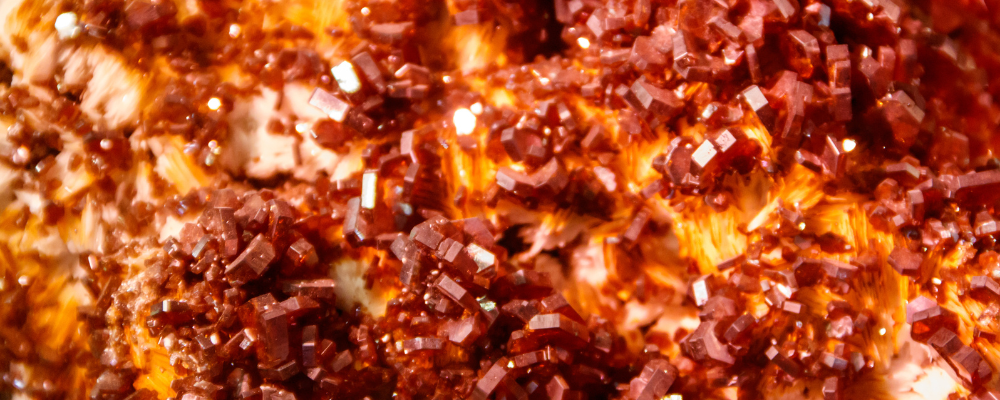
Vanadinite’s red prisms resemble small hexagonal embers resting on the rock. Yet their luster carries a more complex history: that of a lead ore that revealed a lost element, which was rediscovered and then named after Vanadis, one of Freyja’s names.
This meeting of red, heavy metal, and a goddess of desire gives the stone a symbolism of contained power. Vanadinite should not be worn or used in contact with the body. It works from inside a closed display case, a photograph, or a geometric seal.
To place this stone among related minerals, compare it with Lead, Galena, and Cerussite.
The Lead Vanadate with Red Prisms
Vanadinite is a lead chlorovanadate with the formula Pb5(VO4)3Cl. Its crystals belong to the hexagonal system and take on red, orange, brown, or yellow hues. Its high density comes from the lead contained in its structure.
The Handbook of Mineralogy compiles its mineralogical characteristics. The National Museum of Wales places it in the oxidized zones of lead deposits, where it forms after older ores transform.
The Metal Discovered, Forgotten, Then Recognized
In 1801, Andrés Manuel del Río studied an ore in Mexico then called “brown lead.” He recognized a new element, initially naming it Panchromium and then Erythronium because of the red colors produced by its compounds. His identification was challenged and remained in obscurity.
In 1830, Nils Gabriel Sefström rediscovered the same element in Sweden. Friedrich Wöhler later established that it was indeed Del Río’s discovery. This history makes Vanadinite a stone of belated recognition, resumed work, and value restored to its original author.
Vanadis, Freyja, and the Name Vanadium
Sefström named the new element Vanadium after Vanadis, one of the names of the Norse goddess Freyja. He chose this reference because of the rich colors of its compounds. The stone was later given the name Vanadinite, preserving this lineage.
Vanadinite unites the embers of Mars, the beauty of Venus, and the weight of Saturn. Its history does not promise easy power: it speaks of a desire that accepts form, merit finally recognized, and strength kept under guard.
Freyja, Venus, Mars, and Saturn
Freyja and Venus govern desire, beauty, worth, and attraction. Mars corresponds to red and the courage needed to resume work that was rejected. Saturn belongs to Lead, boundaries, and the time that ultimately delivers justice.
Friday is suitable for requests for favor and attraction; Tuesday supports resuming an action; Saturday establishes protection. Dark red, orange, black, and gold make up a palette faithful to the stone.
Recognition, desire, and contained power
Vanadinite accompanies work involving professional recognition, creations dismissed too quickly, and requests that require charm, courage, and patience to be brought together. It is also suitable for situations where real strength must remain controlled.
It reminds us that attraction has value only when it respects the boundary that has been set. In love or commercial work, it supports presence and displayed worth at the right moment, without exerting control over others.
The Seal of Vanadis
Draw a hexagon on red paper and write your name, or the name of the work to be recognized, in the center. Place a photograph of Vanadinite above it, then light a golden candle at a distance.
Say: “What was seen and then rejected returns under its true name. My worth is revealed; my strength remains measured.” Fold the paper six times toward the center and keep it in a black envelope until the expected response.
Correspondences and references
| Reference | Correspondence |
|---|---|
| Nature | Lead vanadate with hexagonal crystals |
| Etymology | Vanadium named after Vanadis, a name of Freyja |
| Deity | Freyja |
| Celestial bodies | Venus, Mars, and Saturn |
| Elements | Fire and Earth |
| Days | Friday, Tuesday, and Saturday |
| Areas | Recognition, worth, desire, renewal, and mastery |
| Ritual support | Photograph or hexagonal seal, without contact with the mineral |