






















































































































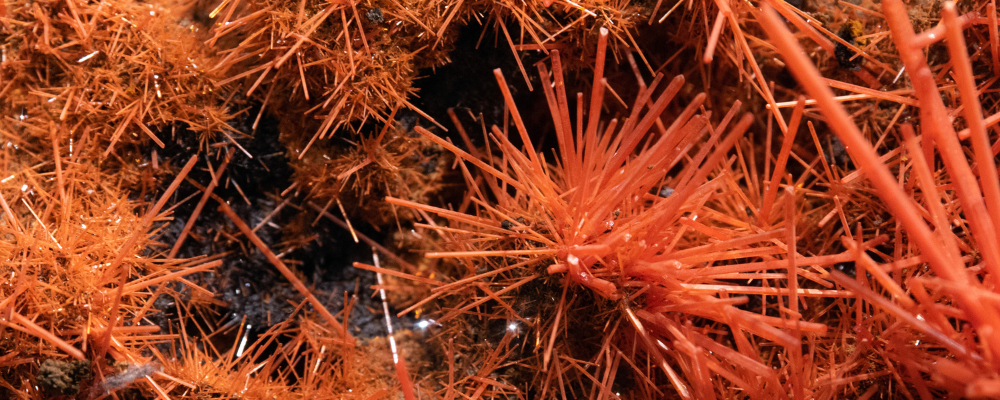
Crocoite forms red-orange prisms whose luster evokes saffron, embers, and a signal. This spectacular beauty rests on a very soft lead chromate. The stone therefore brings together the call of Fire and the need for a framework: what attracts the eye must also be approached with moderation.
Known since the 18th century, it played a role in the discovery of chromium but has no distinct ancient magical tradition. Its contemporary interpretation associates the Sun with signaling, Mars with impulse, and Saturn with containment. Fire awakens; Earth contains.
To place this stone among related minerals, compare it with Lead, Galena, and Cerussite.
The color of saffron
The name crocoite comes from the Greek krokos, saffron, referring to its red-orange color. The Handbook of Mineralogy describes prismatic or acicular crystals, transparent to translucent, with an adamantine luster.
The connection with saffron belongs to the vocabulary of color. It does not establish a ritual continuity between the spice and the mineral.
Lead chromate
Crocoite is a lead chromate, PbCrO4. Its hardness ranges from 2.5 to 3; its elongated crystals are therefore brittle and sensitive to handling. Their high density contrasts with their delicacy.
The Australian Museum fact sheet explains that its formation requires the rare meeting of solutions from chromium-rich rocks and lead-bearing ores.
A stone at the origin of chromium
Discovered in the Urals in the 18th century, crocoite was analyzed by Nicolas-Louis Vauquelin in 1797. He recognized a new element in it, naming it chromium after the colors of its compounds.
The history of chrome pigments places this discovery within the development of mineral yellows and oranges. Today, the most famous specimens come from Dundas, Tasmania.
A signal calls for a response, not agitation. The color draws attention; Saturn then decides the framework in which the impulse can act without overflowing.
Sun, Mars, Saturn, and Fire
The Sun governs visibility and the clear signal. Mars provides impetus and quick decision-making. Saturn imposes distance, containment, and rules. Fire awakens action; Earth gives it a material limit.
Sunday is suitable for announcements, Tuesday for departure, and Saturday for securing. An orange thread placed in a black square replaces all ritual contact with the specimen.
Signal, alert, and structured impulse
Crocoite accompanies a launch, a warning, or a message that must be seen immediately. It invites you to choose a clear signal, then prepare the expected response.
It is also suitable for powerful impulses that require a limit: enthusiasm, desire, anger, or urgency. The frame does not suppress the Fire; it gives it a function.
The rite of the contained flame
Draw a black square and place an orange thread shaped like a flame in the center. Write outside what must not be crossed; inside, write the immediate action you authorize. Keep the Crocoite in its box nearby.
Say: “I recognize the signal. My impulse receives direction, and my Fire remains within its limit.” Perform the action written down without moving the frame.
Correspondences and references
| Reference | Correspondence |
|---|---|
| Nature | Mineral species, lead chromate |
| Celestial bodies | Sun, Mars, and Saturn |
| Elements | Fire and Earth |
| Days | Sunday, Tuesday, and Saturday |
| Ritual colors | Orange, red, black |
| Domains | Signal, alert, launch, limit |
| Associated objects | Orange thread, black square, closed box |
| Gesture | Giving an immediate impulse a framework |