















































































































































































































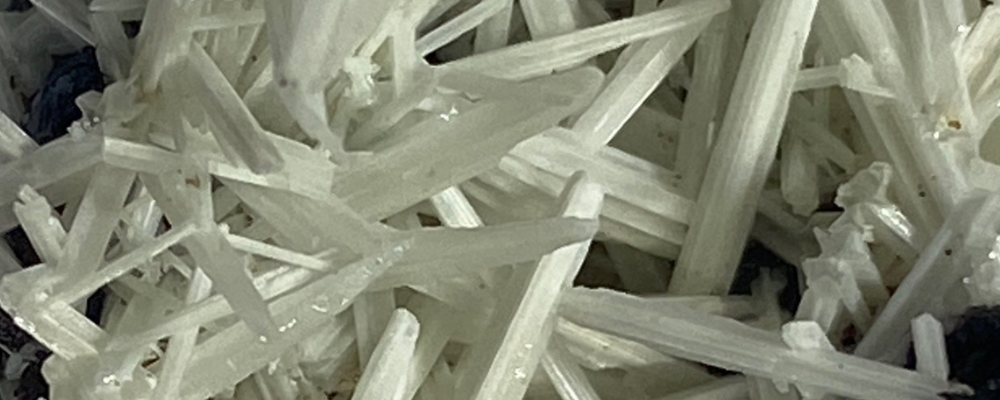
Cerussite transforms lead into brilliance. Heavy in the hand and fragile in form, it may remain colorless, turn white, gray, or honey-colored, and form twinned crystals that resemble stars.
This meeting of weight and light gives it a remarkably apt Saturnian language: acknowledging consequences, clarifying a burden, and giving visible structure to what remained buried. Its composition nevertheless calls for simple care, without ritual water or unnecessary handling.
To place this stone among related minerals, compare it with Lead, Galena, and Pyromorphite.
A luminous lead carbonate
Cerussite is a lead carbonate with the formula PbCO3. It has a very high density, an adamantine luster, and a hardness of 3 to 3.5. Its crystals may be prismatic, tabular, or joined in complex twins.
The Handbook of Mineralogy describes its strong light dispersion and numerous forms. Despite this brilliance, it remains brittle and requires more protection than Quartz.
From dark ore to clear crystal
Cerussite forms in the oxidized zones of lead deposits. It appears notably when Galena, a dark metallic lead sulfide, transforms through contact with water, air, and carbon dioxide.
This origin provides a solid ritual framework: heavy matter does not disappear but changes state and becomes legible. The clear crystal represents revealed consequence, not the erasure of the past.
White lead and the stone’s name
Wilhelm Karl von Haidinger established the name “Cerussite” in 1845 from the Latin cerussa, “white lead.” The Mindat entry recalls this origin.
White lead was once used as a white pigment, but its toxicity caused serious exposure. A collector’s crystal must not be ground into powder or used to recreate historical recipes.
Cerussite does not need an invented legend. It already embodies the transformation of lead, Saturn’s metal, into a luminous crystal. Its modern magic can speak of burden, consequence, and clarification while acknowledging its origins.
Saturn, Moon, Earth and Air
Saturn governs lead, debt, responsibility, and time. The Moon corresponds to white, reflection, and change of form. Earth represents weight; Air, oxidation and clarification. Saturday is suited to settling a burden, and Monday to examining it.
A document, a drawn balance scale, a white candle at a distance, or a closed box is sufficient. The stone remains on its support, without anointing, water, or direct smoke.
Responsibility, Debt, and Clarification
Cerussite accompanies financial assessments, obligations, complex inheritances, and situations where a consequence must be faced directly. It helps separate what can be repaired, paid, refused, or transferred to the appropriate authority.
It is also suitable for transformations that cannot be reversed. Its luster does not promise to make every burden lighter: it helps reveal the exact form it has taken and choose the appropriate response.
The Rite of the Named Weight
Keep the Cerussite in a closed box. On a sheet of paper, write down the burden to be clarified, its origin, its amount, or its consequence. Divide the page into three columns: recognize, repair, close.
On a Saturday, place the box above the sheet and say: “The weight is named, the consequence is clear, my response is taking shape.” Circle one measure and give it a date. Wash your hands after moving the container.
Correspondences and References
| Reference | Correspondence |
|---|---|
| Nature | Dense, shiny, brittle lead carbonate |
| Formation | Secondary mineral of oxidized zones in lead deposits |
| Name | From the Latin “white lead” |
| Planets | Saturn and Moon |
| Elements | Earth and Air |
| Days | Saturday and Monday |
| Areas | Debt, consequence, responsibility, assessment, and closure |
| Ritual act | Recognize, Repair, and Close |










