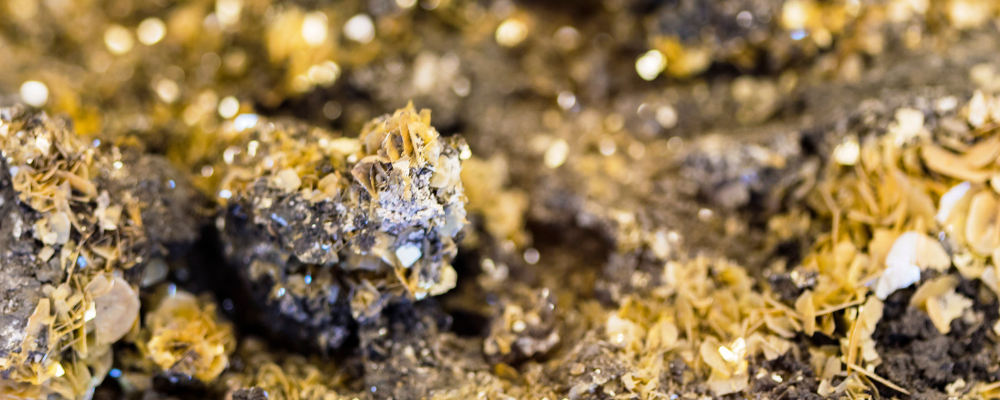
Wulfenite brings together two opposing images: the heaviness of Lead and the light of an almost transparent orange plate. Its square crystals appear thin as glass, but they form in the altered parts of metal-bearing veins.
This encounter gives it a clear place in symbolic work. Wulfenite speaks of an ambition that receives a framework, light contained within a heavy material, and a value that discipline makes visible. The presence of Lead requires use at a distance.
To place this stone among related minerals, compare it with Lead, Galena, and Cerussite.
The orange Lead molybdate
Wulfenite is a Lead molybdate, with the formula PbMoO4. It crystallizes in the tetragonal system and forms square or rectangular plates that are yellow, orange, red, or brown. Despite its high density, it remains soft and very fragile.
The Handbook of Mineralogy describes its characteristics. The National Museum of Wales notes that it appears in the oxidized zone of Lead deposits, after water and air act on older ores.
Wulfen, Haidinger, and the Bleiberg ores
Franz Xaver von Wulfen, an 18th-century Jesuit scholar, studied the ores of Bleiberg in Carinthia. At the time, the stone had a long Latin designation describing a yellow-red sparry Lead. In 1845, Wilhelm Karl von Haidinger gave it the name Wulfenite in honor of Wulfen.
The Australian Museum preserves this historical reference. The name therefore unites the naturalist’s patience, the mining terrain, and the decision to make a material identifiable through a more stable word.
The square of light in heavy rock
The most beautiful crystals resemble orange windows set on a dark matrix. The square imposes four sides and four boundaries; transparency lets light pass through; Lead maintains the weight of reality.
Wulfenite does not separate radiance from structure. It supports what must become visible without losing its rules, price, deadline, or responsibility.
Saturn, Sun, Earth, and Fire
Saturn corresponds to lead, heavy matter, limits, and the time required for the work. The Sun responds to the yellow and orange hues as well as visibility. Earth forms the matrix; Fire provides momentum and color.
Saturday is used to establish the framework and obligations. Sunday supports presentation, recognition, and authority. Black, orange, yellow, and brown make up a palette faithful to the mineral.
Framework, value, and visibility
Wulfenite accompanies the setting of a price, the presentation of a work, the drafting of a contract, and the preparation of a request for recognition. It helps make an ambition clear without concealing the conditions that make it possible.
It is also suitable for appealing but fragile projects. Its square invites you to check four supports: available materials, time, rules, and the person responsible.
The solar square under protection
Cut out a square of orange paper. Draw a black frame and write your objective in the center. In each corner, write one concrete condition: budget, deadline, limit, and commitment.
Place a photograph of Wulfenite above the paper, then light a yellow candle at a distance. Say: “My light appears within a framework that protects it.” Keep the square in your file until the project is complete.
Correspondences and references
| Reference | Correspondence |
|---|---|
| Nature | Lead molybdate with tetragonal crystals |
| Name | Named in 1845 in honor of Franz Xaver von Wulfen |
| Celestial bodies | Saturn and Sun |
| Elements | Earth and Fire |
| Days | Saturday and Sunday |
| Ritual colors | Black, orange, yellow, and brown |
| Areas | Framework, value, visibility, contract, and responsibility |
| Ritual support | Photograph and square of paper, without contact with the mineral |