















































































































































































































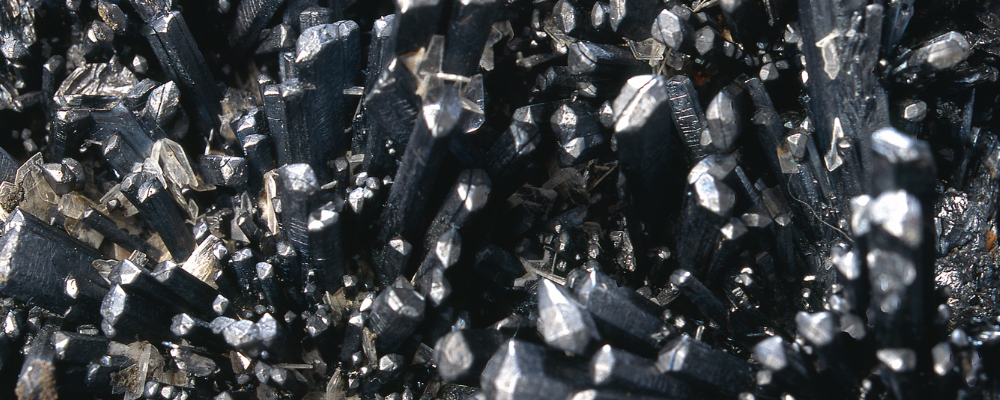
Stibnite is antimony sulfide, a black and lustrous substance that alchemists subjected to fire, separation, and testing. Its metallic needles unite attraction and danger; its magical language is therefore not that of contact, but of transformation conducted with discipline.
Antimony was given the image of the gray wolf, capable of “devouring” metals in the crucible. In the Grimoire, Stibnite governs the sorting between pure and impure, the end of confused mixtures, and the passage from a raw state to a mastered form.
To place this stone among related minerals, compare it with Antimony, Boulangérite, and Orpiment.
The Dark Luster of Antimony
Stibnite, also called Stibnite, has the formula Sb2S3. It crystallizes in the orthorhombic system and forms blades, sprays, or long steel-gray needles. With a hardness close to 2, it scratches and breaks very easily.
The Handbook of Mineralogy describes it as the principal ore of Antimony. Its beauty calls for a distanced approach: a closed display case, a stable base, and no direct ritual handling.
From stibium to black powders
The chemical symbol Sb preserves the Latin stibium. Ancient vocabularies connected this word with black substances intended for the eyes, but they did not separate each compound according to modern chemistry. Analyses of Egyptian cosmetics notably show a major role for Galena and other Lead compounds.
Stibnite does indeed belong to the history of black ores and Antimony, without thereby becoming the ingredient in every ancient kohl. This distinction reinforces its symbolic function: never allow a familiar name to replace examination of the material.
The Triumphal Chariot of Antimony
A work attributed to Basil Valentine, published in English in 1678 under the title The Triumphal Chariot of Antimony, establishes Antimony as a major alchemical subject. The text describes a black substance whose colors are revealed by fire and organizes the separation of what must be rejected or retained.
The book also compares Antimony to a closed volume: appearance alone does not reveal its contents, and reading requires a method. It places the operator at the “school of Vulcan,” that is, under the authority of the workshop fire. This image does not prescribe any household manipulation; it offers a grammar of stripping away, testing, and revelation.
The Gray Wolf, Saturn and Vulcan
Antimony was called lupus metallorum, the wolf of the metals, in reference to its role in operations for purifying Gold. A historical study devoted to the Antimony controversy recalls this medieval name and its place in alchemical work.
Saturn dominates through blackness, weight, toxicity, limitation, and the affinity that the Chariot itself establishes between Antimony and Lead. Vulcan, the figure of mastered fire, represents the operation that cuts and transforms. Stibnite therefore unites Earth and Fire: a dense material confronted with a will to separate.
Separating, testing, and transforming
Stibnite is suited to ends of cycles, breaks with a corrosive influence, difficult investigations, and decisions that require removing what is unnecessary before protecting what is sound at the core. It promises neither gentleness nor immediate reconciliation. It asks you to look at what attracts, what poisons, and what deserves to be kept.
In defensive work, its role is that of a locked-up guardian: the stone remains under glass while the intention acts through the paper, words, and conduct. It supports non-negotiable boundaries, closing off access, and recovering strength held in a relationship that has become harmful.
The rite of the dross and the core
Leave the specimen in its box. In front of it, place two sheets of paper: on the first, write what must leave your life; on the second, what must survive the separation. Read the first aloud quietly, tear it up, then discard it without fire.
Fold the second sheet into thirds toward you and place it in front of the display case, never beneath the crystal. Say: “I separate without losing myself. I keep the core and close access to the rest.” Within twenty-four hours, take a concrete measure: revoke an authorization, move an object, cancel a commitment, or set a boundary.
Correspondences and references
| Reference | Correspondence |
|---|---|
| Nature | Antimony sulfide; very fragile metallic-gray crystals |
| Historical corpus | Alchemy of Antimony in the 16th and 17th centuries |
| Operative image | Gray wolf of the metals |
| Planet | Saturn |
| Elements | Earth and Fire |
| Day | Saturday |
| Domains | Separation, boundaries, end of a cycle, stripping away, and transformation |
| Associated figure | Vulcan, master of the workshop fire |
| Ritual method | Remote work, stone kept under glass |










