






















































































































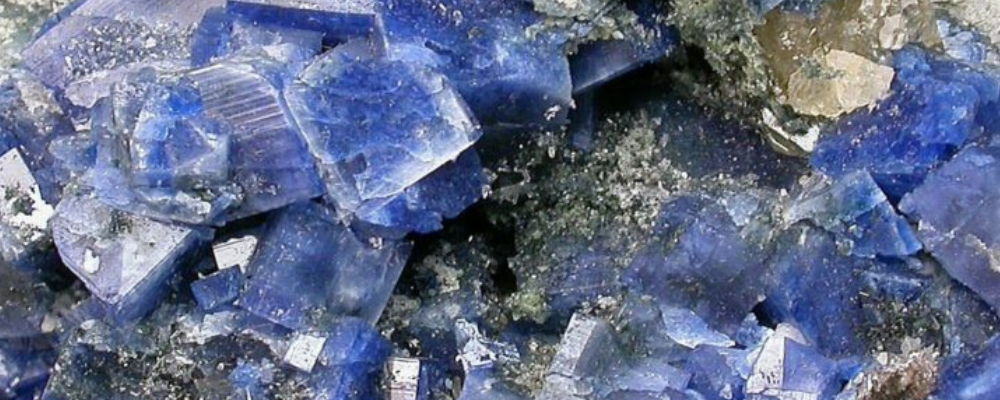
Carletonite is a rare pale-blue mineral associated with a remarkable Canadian locality: Mont Saint-Hilaire in Quebec. Its translucent crystals seem to retain the color of a cold sky. Its history invites less escape than attention to origin, traces, and the exact names of things.
Described in the 20th century, it has no documented ancient magical use. Its contemporary interpretation is based on its restricted provenance and its journey from quarry to university and then museum. Mercury governs study and archives; Saturn, place and continuity; the Moon, the blue sheen; Earth, origin.
To place this stone among related minerals, compare it with Jeremeyevite, Bergénite, and Canasite.
The name of a university
Carletonite was named after Carleton University in Ottawa, where it was recognized and studied. The Mindat entry connects its description to the work of George Y. Chao, published in 1971.
This name recalls that a mineral’s identity does not end with its place of discovery. It also passes through those who observe, compare, describe, and transmit a specimen.
A translucent blue silicate
Carletonite is a complex silicate containing sodium, calcium, carbonate, fluorine, and water. Its crystals belong to the tetragonal system and display colorless, white, pink, or light-blue hues.
The Handbook of Mineralogy indicates a hardness of 4 to 4.5 and perfect cleavage. This relative fragility reinforces its role as a collector’s piece, to be observed without subjecting it to repeated handling.
Mont Saint-Hilaire
Mont Saint-Hilaire is renowned for the richness of its alkaline rocks. The Canadian Museum of Nature presents Carletonite among the new species discovered at this site and preserves a major collection from the massif.
Locality is part of a stone’s identity. A carefully maintained label—location, quarry, date, previous owner—is not an administrative detail: it preserves part of the specimen’s scientific and human value.
What has an origin deserves a record. Naming a place, a custodian, and a date keeps the object from becoming anonymous. Material memory begins with this modest chain.
Mercury, Saturn, Moon, and Earth
Mercury corresponds to study, cataloging, and writing the label. Saturn safeguards continuity and the custodian's responsibility. The Moon receives memory and translucent blue; Earth represents the actual locality.
Wednesday is suitable for inventory and Saturday for preservation. A blank card, blue thread, and gray box accompany the stone. The practice remains tied to what can be verified.
Provenance, Archive, and Belonging
Carletonite accompanies the cataloging of a collection, the transfer of an inheritance, or research into an object's origin. It invites you to preserve the information that will allow someone else to understand what has been entrusted to them.
It is also suitable for periods when a sense of belonging seems unclear. Returning to places, people, and dates does not solve everything, but it provides a foundation from which to choose what comes next.
The Provenance Rite
On a card, write four reference points: object, place, custodian, date. Fill in what is known and leave a line open for what still needs to be researched. Place the Carletonite near the card, then tie a blue thread around it without touching the stone.
Say: “I preserve the record of what is entrusted to me. I connect the name, place, and memory.” Store the card with the relevant specimen or file.
Correspondences and Reference Points
| Reference Point | Correspondence |
|---|---|
| Nature | Rare Mineral Species, Complex Silicate |
| Celestial Bodies | Mercury, Saturn, and Moon |
| Elements | Earth and Water |
| Days | Wednesday and Saturday |
| Ritual Colors | Pale Blue, White, Gray |
| Areas | Provenance, Archive, Memory, Belonging |
| Associated Objects | Blank Card, Blue Thread, Gray Box |
| Gesture | Record the Chain of Custody |