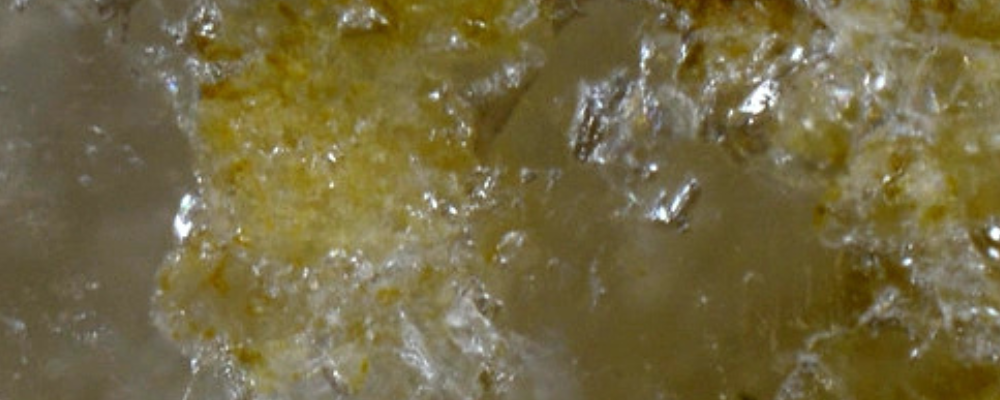
Ekanite is a rare calcium and thorium silicate discovered in Sri Lanka in the 20th century. Its olive-green and greenish-brown hues may be appealing, but its radioactivity is part of its composition. It should remain a controlled collection specimen. In this profile, symbolic work is based solely on a photograph.
There is no ancient esoteric tradition associated with Ekanite. Its contemporary interpretation is based on facts: Saturn for long time spans and limits, the veiled Sun for invisible radiation, Earth for the mineral, and Fire for the slow transformation of its lattice. The primary correspondence, however, remains measurement: time, distance, and shielding.
To place this stone among related minerals, compare it with Becquerelite, Bergénite, and Betafite.
A Sri Lankan discovery
The species was recognized in the early 1960s from a gem-quality pebble from Sri Lanka. It was named after F. L. D. Ekanayake, who had drawn attention to the stone. The study published by the Gemological Institute of America examines the distinctive shape of gem-quality Ekanites from Sri Lankan gravels.
Their presence on the market does not eliminate the physical property that requires appropriate handling.
Thorium in the composition
The ideal formula Ca2ThSi8O20 contains thorium, a naturally radioactive element. The ORAU Museum of Radiation and Radioactivity shows a measured example and explains that the activity comes from thorium and its decay chain.
This property cannot be removed by washing or ritual purification. The intensity depends on the specimen; only suitable equipment can assess it.
The metamict crystal
When it forms, Ekanite has a tetragonal structure. Over time, emissions associated with thorium displace atoms and disorder the lattice: the mineral becomes metamict while retaining its external appearance. The Mindat page provides the species' formula, properties, and localities.
A stable appearance can therefore contain an ongoing transformation. Here, the symbol concerns responsibility toward what acts unseen, not beneficial energy.
Distance is an act, not a fear. Recognizing a dangerous property makes it possible to choose an appropriate framework. One can study, pass on, and admire a material without wearing it or bringing it close to the body.
Saturn, Veiled Sun, Earth, and Fire
Saturn corresponds to time, preservation, and the rule. The Veiled Sun represents radiation that is not visible to the eye. Earth corresponds to the silicate; Fire denotes the slow transformation of the structure, without suggesting any actual heating.
Saturday is suitable for monitoring and inventory. Black, olive green, and pale yellow form the palette. A photograph, a graduated ruler, and a labeled box replace all ritual contact with the specimen.
Measurement, inheritance, and responsibility
Ékanite accompanies reflection on an inheritance, a deferred debt, an object to be passed on, or a decision whose effects continue over time. It invites you to observe what continues to act after the initial gesture.
It is suitable for prevention and inventory work: identifying, measuring, recording the rule, and passing the information on to the next person.
The Rite of Proper Distance
Work with a printed photograph, never with the stone. Place a ruler between the image and a closed box. On one side, write what you wish to understand; on the other, the boundary that makes this study safe.
Say: “I observe without exposing myself. I measure what is active and pass on the rule.” Then store the image with the note, separately from the specimen.
Correspondences and references
| Reference | Correspondence |
|---|---|
| Nature | Radioactive calcium and thorium silicate |
| Celestial bodies | Saturn and Veiled Sun |
| Elements | Symbolic Earth and Fire |
| Day | Saturday |
| Ritual colors | Black, olive green, pale yellow |
| Domains | Measurement, inheritance, prevention, responsibility |
| Associated objects | Photograph, graduated ruler, labeled box |
| Gesture | Observe from a distance and pass on the instruction |