















































































































































































































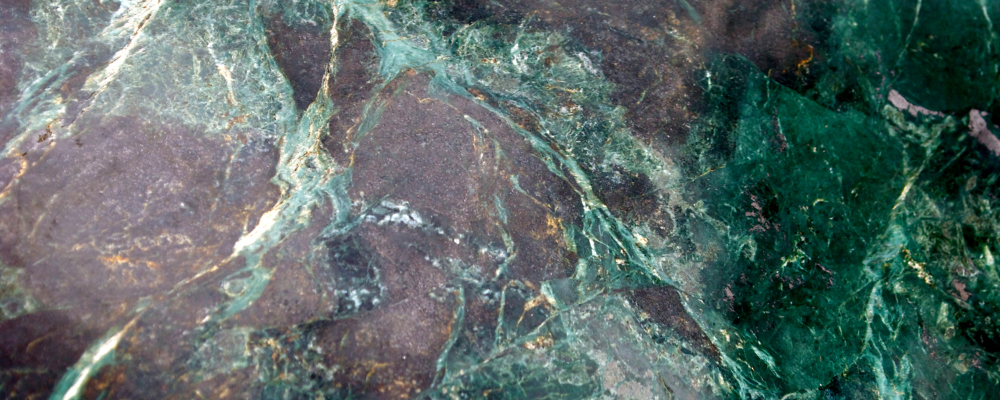
Nephrite is one of the two materials encompassed by the word jade today. Its exceptional toughness has made it a stone of tools, rank, ritual, and transmission. In China, it represents integrity, purity, and passage into the afterlife; among the Māori, pounamu becomes heritage, authority, and kinship. Its magic demands respect for these distinct histories.
Occult authors of the 20th century associate it with Libra, Venus, Water, protection, love, wisdom, and prosperity. These correspondences echo its longstanding image as an incorruptible material and a symbol of moral value.
To place this stone among related minerals, compare it with Jade, Serpentine, and Anyolite.
The highly resilient fibrous jade
Nephrite is a very tightly packed aggregate of amphibole minerals, primarily from the tremolite–actinolite series. It differs from jadeite, the other material recognized as jade. Its hardness is around 6 to 6.5, but its interwoven fibers give it remarkable resistance to impact.
This toughness made it possible to carve blades, axes, ornaments, and ritual objects. The Metropolitan Museum of Art feature shows how nephrite’s physical properties fostered spiritual and social relationships in several regions of the world.
Disks, virtues, and the passage of the dead
In China, nephrite was worked as early as the Neolithic period. The bi disks and cong tubes were associated with rank insignia, offerings, and funerary practices. A ritual disk held by the Met recalls that jade could play a role in purifying the soul for its journey after death.
Its resistance to alteration symbolized integrity; its translucency, honesty. In Aotearoa New Zealand, pounamu has its own history. Nephrite hei tiki are passed down through families and represent the lineage of their bearers, as explained by the Met. These traditions must not be merged into a universal rite.
From Libra to Venus and Kuan Yin
Isidore Kozminsky devotes a long passage to Nephrite in The Magic and Science of Jewels and Stones, published in 1922. He mentions the Chinese virtues of Jade, its resonant stones, and hei tiki, and places the Nephrite family under Libra.
In 1988, Scott Cunningham associated Jade with Venus, Water, and Kuan Yin. He brought together love, protection, wisdom, prosperity, and longevity. This modern system aligns with several historical qualities without reproducing a Chinese or Māori ceremony.
Jade’s value is measured by conduct. Its hardness was not admired merely as a feat of matter. It became the image of a person who remains upright, preserves memory, and passes on without corrupting what was entrusted to them.
Venus, Libra, Water, and Earth
Venus governs accord, value, and prosperity. Libra brings balance and justice. Water comes from Cunningham and joins Kuan Yin’s compassion; Earth carries endurance, matter, and lineage.
Friday is suited to bonds, harmony, and prosperity. Saturday supports ancestors, heritage, and lasting commitments. Green, white, copper, the circle, and clear sound make up its ritual vocabulary.
Protection, wisdom, and transmission
For protection, place the Nephrite near a written commitment. Ask what must be preserved intact: reputation, word, home, or inheritance. The stone safeguards a named value, not an undefined defense.
For wisdom, formulate the decision, then write down the moral quality it requires. An advantageous solution that destroys integrity contradicts the very language of Jade.
For transmission, place the stone between a received object and an object intended to be given. Tell their story aloud. The Western rite proposed here honors the idea of lineage without imitating a cultural ceremony that does not belong to us.
The Disc of Right Conduct
Draw a green circle on a sheet of paper. At the center, write the value you refuse to abandon. Around it, write three acts through which this value becomes visible.
Place the Nephrite on the circle and say: “May my conduct preserve what my words affirm.” Gently ring a bell once, then perform one of the three acts before evening.
Correspondences and References
| Reference | Correspondence |
|---|---|
| Nature | Fibrous aggregate of Tremolite-Actinolite, one of the two Jades |
| Traditions | Chinese ritual Jades and Māori pounamu, according to distinct histories |
| Sign | Libra according to Isidore Kozminsky |
| Planet | Venus according to Scott Cunningham |
| Elements | Water and Earth |
| Figure | Kuan Yin according to Scott Cunningham |
| Areas | Protection, wisdom, integrity, prosperity, and transmission |
| Ritual Act | Inscribing a Value at the Center of a Circle of Deeds |










