















































































































































































































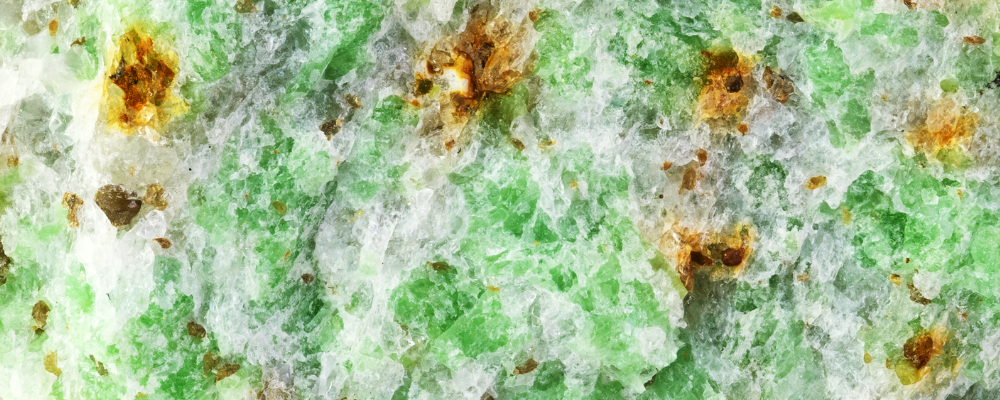
Edenite is an amphibole containing sodium, calcium, and magnesium, found in metamorphic or igneous rocks. Its name comes from Edenville, in New York State: it does not refer to the biblical garden. This difference is fruitful. It makes it possible to distinguish the real origin of a name from the images that a reader later chooses to attach to it.
Edenite has no known ancient magical tradition. The ritual reading proposed here is modern: Mercury for the name and distinction, Saturn for the boundary, Air for the double silicate chains, and Earth for the rock that receives them. A compact prismatic specimen can be handled with ordinary precautions; a fibrous or friable piece, however, requires enclosed storage.
To place this stone among related minerals, compare it with Actinolite, Pargasite, and Nephrite.
Edenville, not the Garden of Eden
The name was already in use at the beginning of the 19th century and refers to Edenville, in Orange County, New York State. The Mindat entry specifies this geographical origin.
The biblical echo is therefore secondary. It can become a contemporary metaphor for the garden, the threshold, or proper boundaries, provided it is not presented as the species’ etymology.
The amphibole’s double chains
Its ideal formula, NaCa2Mg5(Si7Al)O22(OH)2, places Edenite in the amphibole group. The Webmineral page describes the monoclinic system, the light to dark green hues, and the two characteristic cleavage directions.
The silicate tetrahedra form two adjoining chains. Between them, several sites accommodate sodium, calcium, magnesium, and aluminum. Its identity arises from an architecture and a composition, not from a visual resemblance.
From the real place to the chosen image
Edenite occurs in metamorphic marbles, skarns, and other rocks formed at high temperatures. The place name is a discovery reference; the image of the garden is an interpretive creation.
This distinction helps us use symbols without falsifying history. A ritual garden is not evidence about the stone’s past: it is a present-day device for thinking about what we cultivate, what we prune, and what we keep outside the enclosure.
A stated metaphor remains honest. A symbol does not need to be ancient to be fruitful. It is enough to indicate its origin, so that mineral history and imagination do not replace one another.
Mercury, Saturn, Air, and Earth
Mercury governs language, etymology, and comparison. Saturn corresponds to boundaries and thresholds. Air corresponds to the chains that structure the silicate; Earth recalls marble, skarn, and inscription in a real place.
Wednesday is suitable for work on words, Saturday for setting a boundary. Dark green, gray, white, and black form the palette. A label, a small key, and a drawn square accompany the stone.
Name, Threshold, and Interpretation
Edenite accompanies the study of a family name, a place, a symbol, or a transmitted story. It invites you to separate the verifiable origin, received interpretations, and the meaning you choose today.
It is also suitable when you need to delimit a workspace, a rest period, or a relationship. The boundary is not an absolute wall: it makes the passage and the conditions of entry visible.
The Rite of Returning the Name to Its Place
Write a word laden with imagery, then note its verified origin beneath it and, beside it, the meaning you give it. Place the compact Edenite on the origin and a small key on the interpretation. If the piece is fibrous, use its photograph.
Say: “I return the name to its place. I choose my symbol without stealing the history.” Then draw a square around the concrete commitment associated with this word.
Correspondences and Markers
| Marker | Correspondence |
|---|---|
| Nature | Magnesian calcic-sodic amphibole |
| Celestial Bodies | Mercury and Saturn |
| Elements | Air and Earth |
| Days | Wednesday and Saturday |
| Ritual Colors | Dark green, gray, white, black |
| Domains | Etymology, Threshold, Boundary, Interpretation |
| Associated Objects | Label, Key, Drawn Square |
| Gesture | Separate the Origin from the Chosen Symbol |










