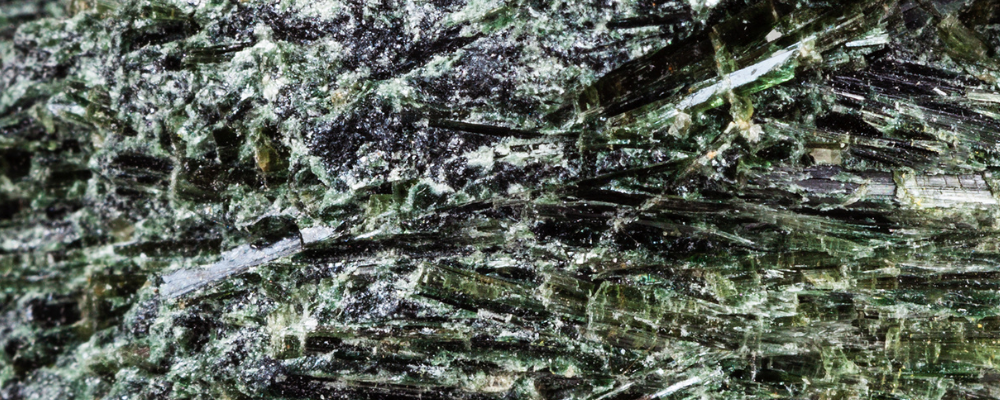
Actinolite forms green blades, needles, and sprays whose name evokes the ray. When it runs through Quartz, European collectors of old gave it charming names: arrows of love, hair of Venus, shafts of Cupid. Its magic speaks of presence, grace, movement, and a beauty that radiates rather than remaining still.
This association does not concern an imaginary antiquity. It appears in lapidary collections from the early 20th century and is based on the visible appearance of the inclusions. Venus governs allure; the Sun provides the ray; Air carries gesture and dance.
To place this stone among related minerals, compare it with Pargasite, Edenite, and Nephrite.
The Green Amphibole in Rays
Actinolite belongs to the calcium amphiboles. It forms a series with Tremolite and Ferro-actinolite. Its color ranges from light green to almost black green, depending on its iron content. Its crystals take the form of blades, columns, or radiating bundles.
The Handbook of Mineralogy indicates a hardness of 5 to 6. Mindat distinguishes massive aggregates, visible crystals, and fibrous forms. Some Actinolites contribute to the formation of Nephrite.
A Stone Named After Light
Its name comes from the Greek aktis, ray, and lithos, stone. It describes crystals arranged like luminous rays around a center. The material thus receives a very direct image: a force that starts from a point and expands into space.
In Quartz, the green needles seem suspended. The transparent crystal gives them a stage and preserves their direction. This included form inspired a language of charm distinct from that of massive Actinolites.
Arrows of Love and Hair of Venus
In The Magic and Science of Jewels and Stones, published in 1922, Isidore Kozminsky classifies Actinolite needles included in Quartz among the “arrows of love,” “hair of Venus,” and “shafts of Cupid.”
It reports their use as charms for beauty, grace, hair, and skill in dance. Gesture, bearing, and allure matter more here than passive seduction. Current practices can follow this thread to work on presence, bodily ease, and personal expression.
Charm begins with direction. An arrow does not fill all the space: it chooses a point, leaves the bow, and moves forward. Actinolite invites you to give visible form to what you wish to express.
Venus, Sun, Air, and Earth
Venus embodies grace, attraction, harmony of movement, and the pleasure of being seen without a mask. The Sun corresponds to the ray and confident presence. Air guides dance and movement; Earth comes from the green color and the body's grounding.
Friday is suited to charm and accord. Sunday supports confidence and radiance. Green, gold, a ribbon, a mirror, and a drawn arrow extend its correspondences.
Charm, ease, and presence
Before a meeting, place the Actinolite near a mirror and name three qualities you want to make visible. Then adjust one concrete gesture: your posture, gaze, or the clarity of your first sentence.
For dancing or public speaking, draw a line from the center of the sheet to its edge. Place the stone at the origin, then repeat the movement or phrase until your body owns it.
For attraction work, write down the type of relationship sought and the conduct that should accompany it. Venus draws people closer, but the solar ray keeps the intention upright.
The ray of grace
On a Friday, place the stone at the center of a circle drawn on paper. Draw three rays: “appear,” “speak,” and “act.” At the end of each, write a short action.
Turn the stone toward the first ray and say: “What I carry receives a visible form.” Repeat for the other two, then perform one of the actions before the end of the day.
Correspondences and references
| Reference | Correspondence |
|---|---|
| Nature | Green calcium amphibole, in blades, bundles, or aggregates |
| Lapidary image | Arrows of love and Venus's hair in Quartz |
| Planets | Venus and Sun |
| Elements | Air and Earth |
| Days | Friday and Sunday |
| Areas | Charm, grace, presence, movement, and expression |
| Symbols | Ray, arrow, hair, ribbon, and mirror |
| Ritual gesture | Direct three rays toward three visible actions |