


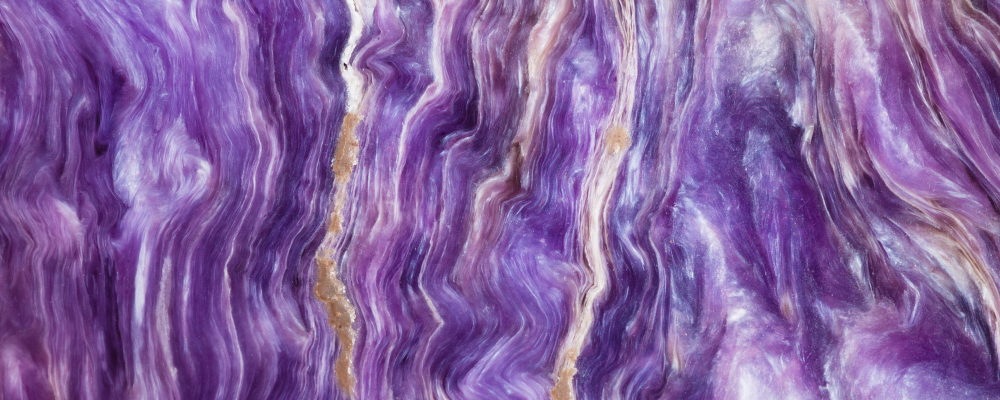
Charoite displays purple, lilac, white, and black veins that seem to swirl through the stone. Discovered by mineralogists in the 20th century, it has no hidden ancient cult. Its magical place is recent, but its language is clear: move through change, come to terms with the unknown, and give direction to inner movement.
Its purple color calls forth Jupiter and the authority of the spirit; its currents evoke Water, dreams, and passages. It suits periods when the old order is breaking down and fear must no longer decide everything on its own.
To place this stone among related minerals, compare it with Actinolite, Pargasite, and Edenite.
The purple currents of Siberia
Charoite is a complex calcium- and potassium-rich silicate. Its interwoven fibers produce the swirls and chatoyant effects that are its signature. The ornamental rock sold under this name, called charoitite by geologists, combines charoite with other minerals.
A study in Mineralogical Magazine describes its highly complex fibrous structure. Its hardness is around 5 to 6 on the Mohs scale.
The Murun massif and modern science
Charoite comes from the Murun alkaline massif in eastern Siberia, in the Chara River region. The mineralogical community recognized it as a species in 1978. Its formation results from geological transformations linked to contact between rocks rich in alkaline elements and limestone.
The Mindat page compiles its location data and mineralogical characteristics. This late discovery calls for an honest chronology: accounts of Charoite as a sacred stone since antiquity are not based on any identifiable transmission.
A magic born at the end of the 20th century
Charoite entered books and correspondence practices after its mineralogical recognition. Contemporary authors connect it with transformation, sleep, intuition, and overcoming fear. These uses belong to a recent reception, shaped by its color and flowing pattern.
A symbolic precedent nevertheless helps to understand this interpretation. In 1922, Isidore Kozminsky associates violet with Jupiter in The Magic and Science of Jewels and Stones. This color rule does not yet refer to Charoite, but it provides a dated basis for its Jovian attribution.
A recent tradition can be demanding. The absence of an ancient past does not prohibit the rite. It asks you to state where the correspondences come from: here, from Jovian purple, the movement of the fibers and the place taken by the stone at the end of the 20th century.
Jupiter, Neptune, Water and Akasha
Jupiter governs the expansion of consciousness, confidence and the meaning given to adversity. Neptune corresponds to swirls, dreams and what dissolves old forms. Water carries emotional movement; Akasha designates the threshold at which an experience changes meaning.
Thursday is suited to confidence, spiritual study and a decision directed toward the future. Purple, silver, a bowl of clear water and the image of a spiral create a coherent altar without claiming to reproduce a Siberian rite.
Passage, dreams and inner courage
During a period of transition, place the Charoite on a sheet divided in two: what is changing around you and what you can choose. Work only on the second column. The stone then accompanies the passage without glorifying chaos.
For dreams, place it near the notebook, away from the bed. Upon waking, write down an image and an emotion before seeking an interpretation. Neptunian language benefits from beginning with lived experience.
For fear, give it a precise sentence: “I am afraid of… because…”. Then choose a reasonably sized action. Jupiter does not command you to deny fear; it asks you to broaden the field in which it acts.
The Rite of the Violet Current
On a Thursday at dusk, place a bowl of water on the left and a purple candle on the right. Set the Charoite between them, on a wavy line drawn in ink.
Name what must be crossed, then say: “I let the current carry away fear, not my direction.” Pass the stone over the water without dipping it in, bring it close to the candle without heating it, then write down the act that will give shape to the passage.
Correspondences and references
| Reference | Correspondence |
|---|---|
| Nature | Complex fibrous silicate; major constituent of charoite |
| Origin | Murun Massif, eastern Siberia |
| Recognition | Mineral species recognized in 1978 |
| Planets | Jupiter and Neptune in contemporary systems |
| Elements | Water and Akasha |
| Day | Thursday |
| Areas | Passage, dream, intuition, confidence and overcoming fear |
| Ritual act | Giving direction to the current of change |