


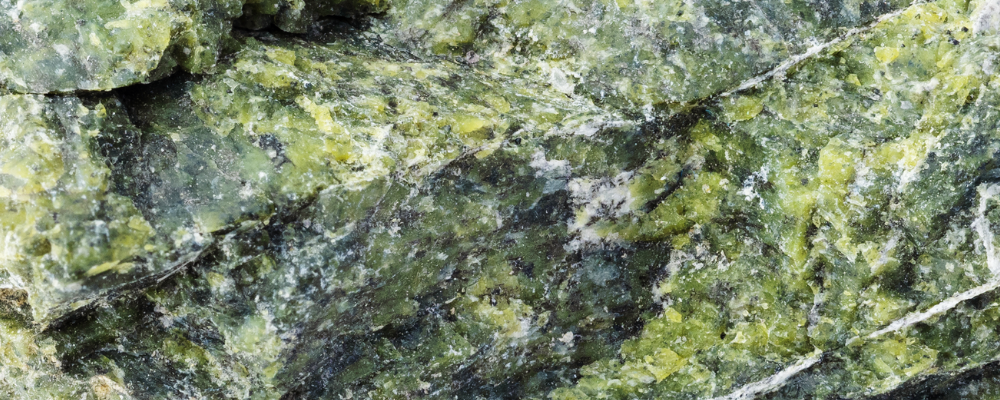
Serpentine bears the image of the serpent in its name, greens, and patterns. Ancient lapidaries attributed protection against venomous creatures to it, while Egypt and the Near East carved it into amulets and seals. It thus unites protection, vigilance, authority, and renewal.
Its association with Capricorn appears in Isidore Kozminsky’s work in 1922. Saturn gives it boundaries, endurance, and mastery of the threshold. The serpent’s shedding completes this legacy: leaving an old form behind, retaining what it taught, and establishing better-adapted protection.
To place this stone among related minerals, compare it with Jade, Nephrite, and Anyolite.
The Stone of Serpent Greens
The name Serpentine refers to a family of hydrated magnesium silicates, as well as rocks containing a large proportion of them. Antigorite and Lizardite are well-known members. Their colors range from yellow-green to almost black-green, with veins, spots, and a greasy luster reminiscent of scaly skin.
The mineralogical sheets from Lizardite and Antigorite show that hardness and appearance vary depending on the material. This variety calls for gentle care, but it also enriches its symbolism: protection can remain firm without becoming rigid.
Scarabs, Amulets, and Seals
In Egypt, amulets took the form of animals, deities, and scarabs. The Metropolitan Museum of Art notes that these objects could protect the living, accompany the deceased, and embody the qualities of the figure represented. Kozminsky lists Serpentine among the materials used for sacred scarabs.
In the Near East, it was also used to engrave cylinder seals. An example preserved at the British Museum attests to this use. Rolled over clay, the seal repeated a scene and marked an identity, authority, or right of passage.
The stone protects through its mark and its boundary. The scarab accompanies renewal; the seal establishes an identity. Together, these two images give Serpentine a language broader than mere defense against a threat.
The Hydrinus of the lapidaries
In The Magic and Science of Jewels and Stones, published in 1922, Isidore Kozminsky brings together the names Serpentine, ophite stone, and Hydrinus. He draws on accounts that presented it as an amulet against bites, stings, and venomous animals.
These texts do not replace any care. Their interest lies in the talismanic function they give the stone: detecting danger, maintaining the proper distance, and preventing a hostile influence from crossing the boundary.
Kozminsky also mentions an image of a fish-tailed goat engraved under certain degrees of Capricorn. The talisman then combined matter, the zodiacal figure, and the astrological moment.
Saturn, Capricorn, and Earth
Kozminsky places Serpentine under Capricorn. Saturn, the ruler of this sign, governs duration, boundaries, restraint, and transitions that require constancy. Earth corresponds to the rock, its muted greens, and the protection of a territory.
Saturday is suitable for rites of closure, household protection, and lasting change. A green or black cord, a circle drawn on paper, the image of a scarab, or a personal seal may accompany the stone.
The serpent brings vigilance and shedding. It does not destroy its old skin in anger: it leaves it when its growth requires it. Serpentine therefore supports changes that preserve acquired experience.
Protection, shedding, and authority
At the entrance to a place, Serpentine represents a clear rule. Place it near the threshold and name what remains outside: intrusion, imported conflict, hurtful speech, or a request made during an hour reserved for rest.
For a personal change, write down the habit that once protected you before becoming too restrictive. Then note the boundary that must replace it. This work prevents confusing liberation with a lack of protection.
The stone also accompanies authority, signatures, and the stewardship of a role. Place it near a notebook, key, or seal when you accept a responsibility that requires calm, endurance, and discernment.
The Circle of the Shed Skin
On a Saturday, form a circle with a green cord. Place the Serpentine at the center, then write the form you are leaving behind on a strip of paper. Wrap the paper around the stone without tightening it.
Say: “I shed the old skin and retain its vigilance.” Remove the band, place it outside the circle, and write the new boundary on a second sheet. Slide this sheet beneath the stone for seven days, then perform the gesture that makes the decision visible.
Correspondences and references
| Reference | Correspondence |
|---|---|
| Nature | Family of magnesium silicates with serpentine greens |
| Planet | Saturn |
| Sign | Capricorn according to Isidore Kozminsky |
| Element | Earth |
| Day | Saturday |
| Figures | Serpent, scarab, seal, and threshold guardian |
| Domains | Protection, vigilance, shedding, boundary, authority, and endurance |
| Gesture | Leaving behind an old defense and establishing an appropriate boundary |