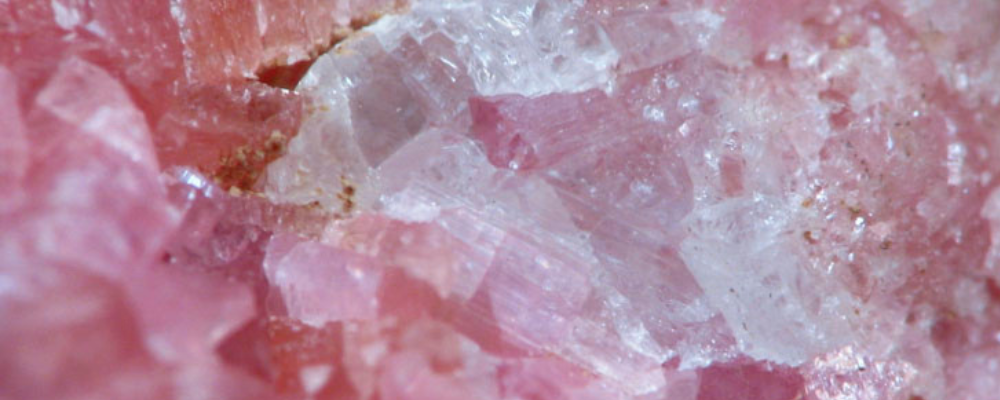
Cahnite brings together boron and arsenic in small clear crystals capable of forming cross-shaped twins. Its geometry evokes two axes meeting: a decision is no longer reduced to choosing a direction; it requires examining the point where several constraints intersect.
Described at the beginning of the 20th century, it has no ancient magical tradition under this name. Mercury receives arsenic, reading, and the crossroads; Saturn imposes confinement; Air represents the directions and Earth the fixed point. The actual specimen remains enclosed throughout any practice.
To place this stone among related minerals, compare it with Andalusite, Staurolite, and Adamite.
A calcium and boron arsenate
Cahnite is a calcium and boron arsenate, with the formula Ca2B(AsO4)(OH)4. The Handbook of Mineralogy describes it as belonging to the tetragonal system, with small colorless, white, or pale yellow crystals.
It appears in rare geological contexts, notably in pegmatites that cut through Franklin’s metamorphosed zinc deposit in New Jersey.
The Cross and the Axes
The crystals can form penetration twins whose outline resembles a cross. The Mindat entry details its properties and history.
In a ritual reading, the cross announces neither automatic salvation nor a threat. It becomes a plan with four directions, organized around a center that makes it possible to compare the paths.
Lazard Cahn and Franklin
Charles Palache named Cahnite in 1921 in honor of Lazard Cahn, a mineral collector and dealer who had identified the species. The detailed description was published in 1927 by Palache and Lawson Henry Bauer.
The locality of Franklin is known for its rich and complex mineralogy. Cahnite belongs to this modern scientific history, not to an ancient talismanic corpus.
An intersection becomes legible when its center is fixed. Before choosing a path, one must know the constraint, resource, cost, and endpoint of each direction.
Mercury, Saturn, Air, and Earth
Mercury governs arsenic, routes, and comparison. Saturn receives limitation, risk, and irreversible decision. Air represents the possible directions; Earth, the center where the decision takes effect.
Wednesday is suitable for examining the paths, and Saturday for the choice that closes off certain possibilities. A cross drawn on paper, four words, and a neutral stone placed at the center serve as supports.
Crossroads, Constraint, and Choice
Cahnite accompanies decisions in which several criteria conflict: cost, timing, desire, responsibility, or safety. It invites you to give each constraint a place before prioritizing a direction.
It also supports rejecting a false alternative. Four axes reveal that a third or fourth path may exist outside the presented choice.
The Rite of the Four Directions
Use a photograph. Draw a cross and write one option at each end. In the center, write the condition that cannot be sacrificed. For each path, note what it provides and what it closes off.
Say: “I fix my center, I see every path, and I choose by weighing its consequences.” Circle the direction compatible with your central condition.
Correspondences and reference points
| Reference point | Correspondence |
|---|---|
| Nature | Calcium and boron arsenate |
| Celestial bodies | Mercury and Saturn |
| Elements | Air and Earth |
| Days | Wednesday and Saturday |
| Ritual colors | White, pale yellow, black |
| Domains | Crossroads, choice, constraint, consequence |
| Supports | Photograph, cross, central stone |
| Gesture | Compare the paths from a fixed center |