























































































































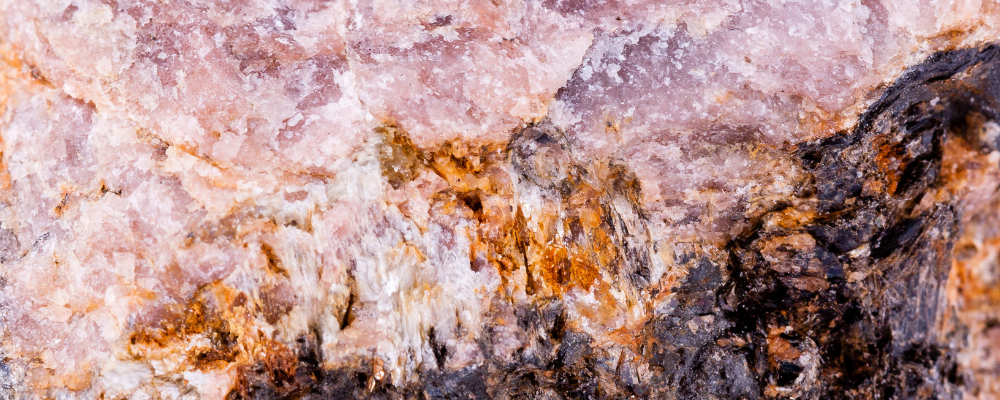
Andalusite displays several colors within a single crystal. Its Chiastolite variety bears, in section, a dark cross formed by carbonaceous inclusions. This natural sign made it a stone of prudence, faith, protection, and steadfastness in European lapidary narratives.
In 1922, Isidore Kozminsky distinguished two lineages: Aquarius for Andalusite and Capricorn for Chiastolite. Saturn links these two signs in ancient astrology. It brings limitation, sincerity, caution, and commitment that withstands adversity.
To place this stone among related minerals, compare it with Kyanite, Kyanite, and Staurolite.
A silicate with changing colors
Andalusite is an aluminum silicate with the formula Al2SiO5. It shares this formula with Kyanite and Sillimanite, but its atoms are arranged differently. Its crystals can be pink, brown, green, yellow, gray, or white.
The Handbook of Mineralogy describes a hardness of 6.5 to 7.5 and pleochroism that reveals red, green, or yellow tones depending on the orientation. Mindat also traces the history of its identification in Spain.
The natural cross of Chiastolite
Chiastolite is an Andalusite containing abundant dark inclusions. During growth, carbonaceous matter gathers according to the crystal’s geometry. A cross-section reveals a cross, a diamond, or a grid-like pattern.
Its name comes from the Greek chiastos, “marked with a cross.” The figure was not engraved: it belongs to the stone. This meeting between mineral geometry and religious symbolism explains its place in European Christian narratives.
The natural pattern existed before human interpretation. The talisman was born when the Christian gaze recognized a sign of faith and protection in this geometry. This distinction preserves both the mineral reality and the religious history of its use.
Saint James, prudence, and sincerity
In The Magic and Science of Jewels and Stones, published in 1922, Isidore Kozminsky reports the Spanish legends linking Chiastolite to Saint James. He also cites royal, military, and maritime accounts associated with a stone marked with a red cross.
Kozminsky makes it a symbol of prudence, faith, caution, and sincerity. He places Chiastolite under Capricorn, while general Andalusite is assigned Aquarius. These attributions come from his 20th-century astrological system.
The cross does not eliminate the crossroads. It shows four directions gathered around a center. Andalusite reminds us that prudence does not mean remaining still, but knowing the point to which each choice must remain faithful.
Saturn, Capricorn, and Earth
Saturn governs limits, tested faith, constancy, and discernment before action. Capricorn brings patient ascent and responsibility. Earth carries the geometry, the brown stone, and the stable center.
Saturday is suitable for protections, oaths, and decisions that require time. Brown, black, an equal-armed cross, four stones, and a dark thread accompany its work.
Protection, prudence, and commitment
To protect a decision, place the Andalusite at the center of a drawn cross. Reserve each branch for a question: what to gain, what to lose, what to preserve, what to repair?
For a commitment, write a promise you can keep on easy days as well as difficult ones. Saturn prefers a limited, real word to an overly broad declaration.
To discern a relationship, note the actions that confirm sincerity and those that contradict it. The stone does not pass judgment; it maintains the center from which you can form it.
The four paths of the cross
On a Saturday, place the stone at the crossing of two threads. Point the four ends toward north, east, south, and west. Place one word at each: duty, word, desire, limit.
Read the four words, then say: “I choose without leaving my center.” Tie the threads together beneath the stone and carry out the action that makes your choice verifiable.
Correspondences and references
| Reference | Correspondence |
|---|---|
| Nature | Aluminum silicate, polymorph of Kyanite and Sillimanite |
| Variety | Chiastolite with cross-shaped inclusions |
| Signs | Aquarius for Andalusite, Capricorn for Chiastolite according to Kozminsky |
| Planet | Saturn |
| Element | Earth |
| Day | Saturday |
| Areas | Protection, prudence, faith, sincerity, and commitment |
| Ritual gesture | Bringing four paths together around a center |