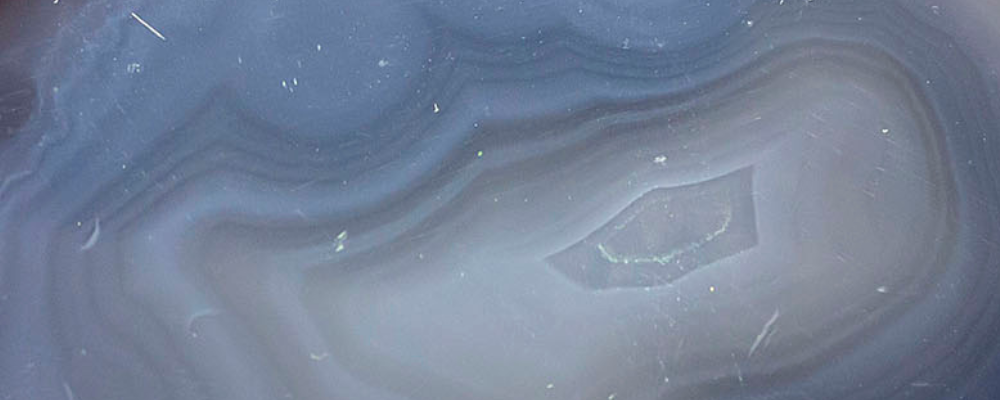
The Enhydros Agate presents a very simple-to-see enigma: water remains inside a cavity in stone. When the bubble moves, what seemed fixed suddenly reveals an inner life.
This meeting of mineral duration and liquid movement makes it an exceptional aid for study, patience, and memory. It invites us to observe before interpreting, then to let time test what we believe we know.
To place this stone among related minerals, compare it with Agate, Blue Agate, and Dendritic Agate.
A Liquid Pocket in Chalcedony
An Enhydros Agate is a Chalcedony nodule or geode whose cavity contains liquid and a bubble. This bubble makes the level visible when the piece is turned. In translucent specimens, the movement can be seen with the naked eye; a soft light source helps observe it.
The \Mindat entry\ describes Enhydros as an aqueous cavity contained in a nodule. A case study by the \Georgia Mineral Society\ recalls that these stones also have a geological history unique to each deposit.
Cavity, Porosity, and Inclusion
The term Enhydros should not indiscriminately refer to every liquid inclusion in a crystal. Here, the water occupies a macroscopic cavity within a nodule. The Chalcedony shell may allow some moisture to pass through very slowly; the contents have therefore not necessarily remained perfectly isolated since formation.
This precision takes nothing away from the object. On the contrary, it makes its symbol more vivid: memory is not a dead archive, but a substance preserved, exchanged, and reread through time.
A Name from Antiquity
Enhydros means “containing water.” In the 1st century, \Pliny the Elder\ mentions under this name a stone in which a watery substance appears to move. His text shows that this spectacle already intrigued ancient authors, even though the exact mineralogical identification remains unresolved.
\
Saturn, Mercury, Water, and Earth
Saturn corresponds to time, preservation, and the testing of facts. Mercury governs observation, classification, and the formulation of questions. Water represents the mobile content; Earth, the shell that preserves it.
Saturday is suited to lengthy research and memory work, while Wednesday is suited to investigation and writing. A drawn clepsydra, an old key, or a dated notebook can accompany the stone.
Patience, Evidence, and Memory
Enhydrite Agate supports study, family archives, the examination of a recurring dream, and decisions that require verification. It encourages distinguishing fact, hypothesis, and desire before drawing a conclusion.
It can also represent a memory one wishes to preserve without freezing it in place. On a desk, it reminds you to date your notes and return to the sources. Near a photograph, it helps you welcome what you know and what will remain unknown.
The Rite of the Kept Question
On a Saturday, write a precise question at the top of a page. Below it, draw two columns: “what I know” and “what I suppose.” Fill them in without seeking an immediate conclusion, then place the Enhydrite between the two.
Say: “I give time to truth and form to my research.” Close the notebook for seven days. When you return to it, add a source, testimony, or verifiable fact before deciding.
Correspondences and References
| Reference | Correspondence |
|---|---|
| Nature | Chalcedony Nodule with a Liquid Cavity |
| Name | From the Greek, “containing water” |
| Celestial Bodies | Saturn and Mercury |
| Elements | Water and Earth |
| Days | Saturday and Wednesday |
| Ritual Colors | Gray, Dark Blue, Black |
| Areas | Study, Time, Evidence, Archives, Memory |
| Ritual Gesture | Separating Fact from Hypothesis |