















































































































































































































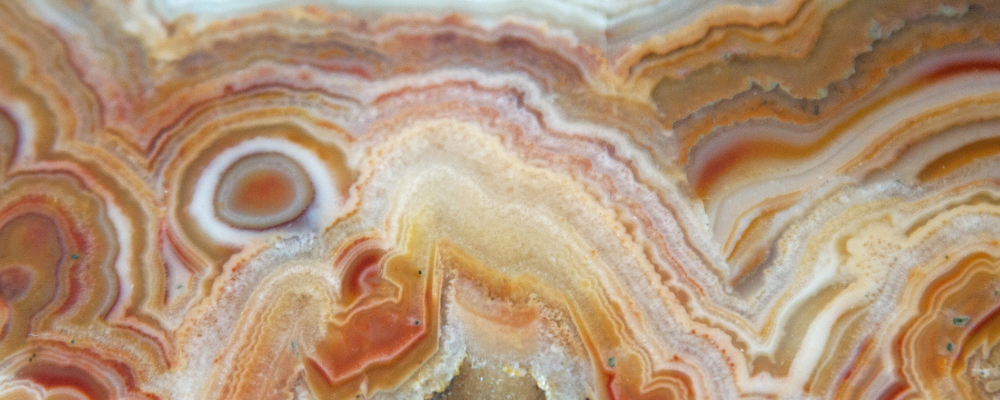
Agate is a threshold stone: its bands form an enclosure, its eye-like shapes seem to watch over us, and its successive layers speak of a strength built without rushing time. The texts associated with it give it a highly coherent domain, shaped by protection, eloquence, victory, and peaceful prosperity.
This identity does not depend on a single color. Banded, moss, dendritic, black, and red Agate have been assigned different uses. The right approach, therefore, is to look at the stone one possesses before assigning it a function: the eye preserves, the enclosure protects, the moss promotes growth, and the red supports action.
To place this stone among related minerals, compare it with Blue Agate, Dendritic Agate, and Moss Agate.
Chalcedony Written in Bands
Agate is chalcedony, meaning quartz formed from very small interlocking crystals. It fills cavities or fissures through successive silica deposits. Each arrival of material can produce a different layer: this is how the lines, fortifications, eyes, and landscapes that make each slice recognizable come into being.
Its hardness, close to 7, allows everyday use while leaving the stone sensitive to impacts. A review published in the journal Minerals describes the rhythmic growth of Agate and the questions about its formation that remain open. For practical purposes, one idea is enough: its patterns are the visible result of a long process and material deposited layer by layer.
From the Achates River to Theophrastus
The name comes from the Achates, a river in Sicily now identified as the Dirillo. Toward the end of the 4th century BCE, Theophrastus wrote that the stone was named after the watercourse near which it was found. His treatise On Stones is one of the earliest Greek accounts in which this name clearly appears.
Ancient authors classified stones by color, appearance, and location, not according to our mineralogical families. Therefore, no ancient “achates” can be identified with certainty as a current commercial variety. Nevertheless, the continuity of the name remains remarkable: it connects Agate to a real landscape, to the water that carries it, and to the rock that preserves it.
The eye, the enclosure, and protection
Agates whose circles form an eye have been worn as stones of vigilance. The concentric bands also evoke a wall seen from above, hence the name “fortification” Agate. In both cases, the shape provides the magical language: seeing danger approach and setting a boundary around what must remain intact.
In The Magic and Science of Jewels and Stones, published in 1922, Isidore Kozminsky compiles attributions of protection against storms, lightning, and war. He also links certain Agates to favor, happy dreams, eloquence, and victory. His book reflects early-20th-century occultism: it transmits and rearranges older materials without, on its own, constituting evidence of ancient use.
Shape determines function. An eye Agate suits vigilance; a stone with closed bands, boundary-setting; a moss Agate, growth. This reading by resemblance belongs to sympathetic magic: the visible pattern becomes the model for the intended action.
Correspondences by color
It would be misleading to assign one planet and one element to all Agates. In his 1988 encyclopedia, Scott Cunningham distinguishes the varieties by their color. Moss or green Agate belongs to Earth; blue Agate, to Water; red, brown, or black tones, to Fire.
This method is more fruitful than a uniform table. Green supports the garden, resources, and maturation. Blue favors calm speech and peace. Red accompanies courage. Multicolored forms can help bring complementary forces together around the same project.
Eloquence, favor and growth
Agate is suitable before a negotiation, hearing, or speech. Wear a stone with clear lines, then prepare a sentence that states your request directly. The eloquence it represents is not the art of dazzling: it is the ability to guide speech toward its goal.
Moss Agate belongs near seeds, a gardening journal, or a project that needs to grow. It does not promise immediate success. Its plant inclusions and slow formation make it a witness to continuity, patience, and steady growth.
For household protection, an eye Agate can be placed near the entrance. Name what is admitted into the home—peace, loyalty, hospitality—then what must remain outside—violence, deception, intrusion. The stone materializes this boundary.
The Rite of the Guarded Boundary
Place the Agate at the center of a cord closed into a circle. Beside it, place a paper bearing the name of the person, place, or project to be protected. Light a white candle, then trace the stone’s bands with your finger, from the outside toward the center.
Say: “What protects remains firm; what threatens meets its limit.” Then tie the cord around the stone or the pouch containing it. Keep everything near the threshold, in a work drawer, or with the project papers. If the goal is growth, use a green cord and open the circle once a month to note the step completed.
Correspondences and references
| Reference | Correspondence |
|---|---|
| Nature | Banded Chalcedony, Quartz family |
| Hardness | Approximately 7 on the Mohs scale |
| Ritual images | Eye, boundary, rampart, layers of growth |
| Green or moss Agate | Earth, growth, garden, resources |
| Blue Agate | Water, peace, measured speech |
| Red Agate | Fire, courage, defense |
| Areas | Protection, eloquence, favor, victory, and maturation |
| Ritual act | Draw a boundary and clearly name its purpose |










