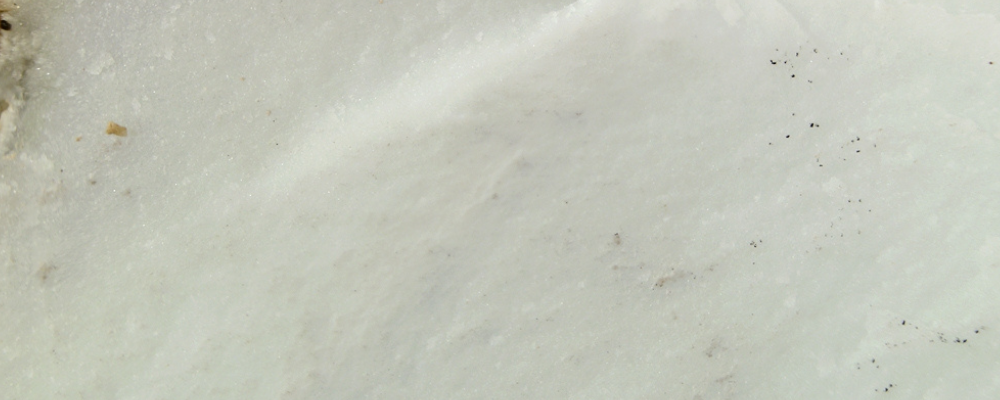
Bakerite tells a rare story: that of a stone whose name lived for more than a century before the classification changed. Older specimens have lost neither their material nor their beauty; they have been given a new place in the Datolite family.
This revision offers a more fruitful esoteric theme than an invented virtue. Bakerite accompanies the true name, the memory of former states, and the ability to correct a work without erasing its path. Mercury governs naming, Saturn the archives, Earth preserves, and Air renews interpretation.
To place this stone among related minerals, compare it with Fassaïte, Cafetite, and Staurolite.
A boron-rich Datolite
The name Bakerite was given to a white or colorless, compact, boron-rich material discovered in Californian borates. Older descriptions presented it as a distinct calcium borosilicate.
Research into its structure, summarized by the University of Modena and Reggio Emilia, showed its close relationship with Datolite. The Mindat database now classifies it as a boron-rich variety of Datolite.
The 2016 change
In 2016, the Nomenclature Commission of the International Mineralogical Association removed Bakerite from the list of independent species during its revision of the Gadolinite supergroup.
The commission’s official letter records this decision. The word remains relevant on a historical or commercial label, provided that its current status is indicated.
Richard Baker and California
The name was published in 1903 in honor of Richard C. Baker, head of the Pacific Coast Borax Company. The type material came from the Corkscrew Canyon area, near Death Valley.
A stone acquired under its former name does not become false after 2016. Its label retains historical value; a second mention allows the current interpretation to be added without destroying the first.
Bakerite teaches correction without erasure. The former name bears witness to the path; the new classification bears witness to refined knowledge. Keeping them together transforms revision into an act of faithfulness to truth and memory.
Mercury, Saturn, Earth, and Air
Mercury governs names, notes, and the transmission of corrected information. Saturn preserves archives, dates, and versions. Earth safeguards matter; Air enables a new reading.
Wednesday is suitable for correction and Saturday for archiving. Two labels, gray ink, and white thread can accompany the stone.
Revision, memory, and truth
Bakerite accompanies the correction of a file, the revision of a rule, the renaming of a project, or reconsideration of a decision. Symbolically, it allows one to acknowledge change without rewriting the past.
It is suitable for work where traceability matters: collections, genealogies, contracts, manuscripts, and personal archives.
The Rite of the Two Labels
On a first card, write the former status of an idea or decision and its date. On a second, note the revision, its source, and the date it takes effect. Place the stone between them.
Say: “I preserve the record, I correct the name, and I let the truth continue its work.” Tie the cards together with white thread, then keep them together.
Correspondences and reference points
| Reference point | Correspondence |
|---|---|
| Status | Former name, associated with boron-rich Datolite |
| Celestial bodies | Mercury and Saturn |
| Elements | Earth and Air |
| Days | Wednesday and Saturday |
| Ritual colors | White, gray, beige |
| Domains | Revision, memory, truth, archives |
| Associated objects | Labels, gray ink, white thread |
| Gesture | Preserve the former status with its dated revision |