


Bonamite bears a name that comes from commerce and old labels, while its material belongs to Smithsonite. This dual identity does not diminish the stone: it shows how a common name can preserve a color, origin, or market history without replacing the mineralogical definition.
Its blue-green tone calls to Venus, its change of name relates to Mercury, its carbonate base belongs to Earth, and its formation through alteration waters receives Water. It supports work on identity, recognized value, and speaking truthfully about oneself or an object.
To place this stone among related minerals, compare it with Smithsonite, Calamine, and Hemimorphite.
A common name for Smithsonite
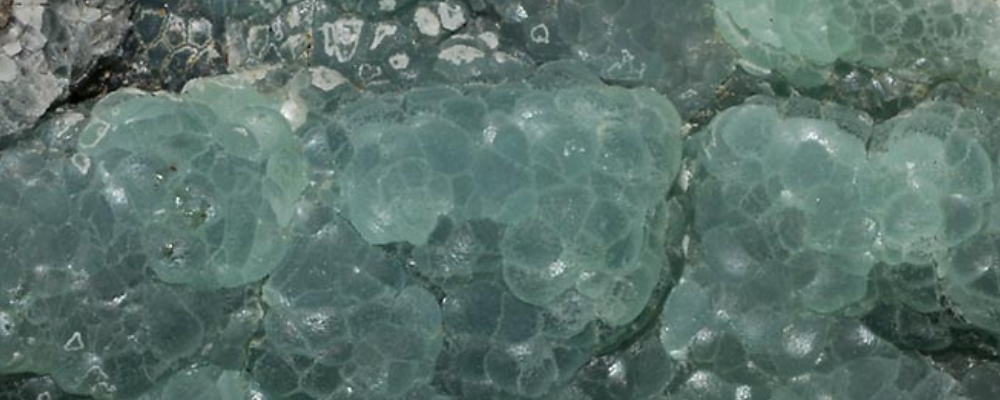
Bonamite is not the name of a distinct mineral species. The Mindat entry classifies it as a synonym of Smithsonite. The term is still encountered on labels and in commerce for blue to blue-green materials.
A commercial designation may be retained if the nature of the stone is clearly indicated: “Bonamite, a variety of Smithsonite” connects the use of the name with its current identification.
Zinc carbonate
Smithsonite is a zinc carbonate with the formula ZnCO3. The Handbook of Mineralogy describes a trigonal, soft mineral with a vitreous or pearly luster, capable of forming botryoidal masses and crystals.
Its palette depends on traces of elements and inclusions: green, blue, yellow, pink, brown, or colorless. Color provides information, but it replaces neither the structure nor the composition.
Smithson and the modern name
At the beginning of the 19th century, James Smithson showed that materials then grouped under the name Calamine did not all have the same composition. In 1832, François Sulpice Beudant gave the name Smithsonite to zinc carbonate.
The Smithsonite entry preserves this history. Bonamite belongs to a more recent layer of commercial vocabulary, not to an ancient magical corpus.
A name can convey a history without holding the whole truth. The right name does not destroy the charm of customary use; it gives it a clear, transferable foundation.
Venus, Mercury, Water, and Earth
Venus receives blue-green, allure, and the value bestowed. Mercury governs names, exchanges, and precision of language. Water corresponds to the circulations that form secondary minerals; Earth, to the carbonate that fixes the zinc.
Friday is suitable for recognizing value, and Wednesday for correcting a name. A blue-green ribbon, a white label, and a seal of Mercury accompany the stone.
Identity, value, and the right name
Bonamite supports moments when an old name is no longer sufficient, yet remains charged with affection or memory. It helps reframe a role, activity, relationship, or commercial presentation without denying what came before.
It also supports recognizing value independent of the prestige of a label. Describing something accurately strengthens trust rather than diminishing its appeal.
The Rite of Two Names
Write on the left the name you received or that has become too narrow. On the right, write the designation that better corresponds to the present situation. Between the two, draw a blue-green line and note what remains true in both names.
Place the Bonamite above the line and say: “I preserve the history, name the material, and let truth guide value.” Use the new term in a concrete action.
Correspondences and reference points
| Reference point | Correspondence |
|---|---|
| Nature | Common name for Smithsonite, zinc carbonate |
| Celestial bodies | Venus and Mercury |
| Elements | Water and Earth |
| Days | Friday and Wednesday |
| Ritual colors | Blue-green, white, gray |
| Areas | Identity, value, language, transmission |
| Associated objects | Ribbon, label, seal of Mercury |
| Gesture | Connecting the old name to the correct definition |