


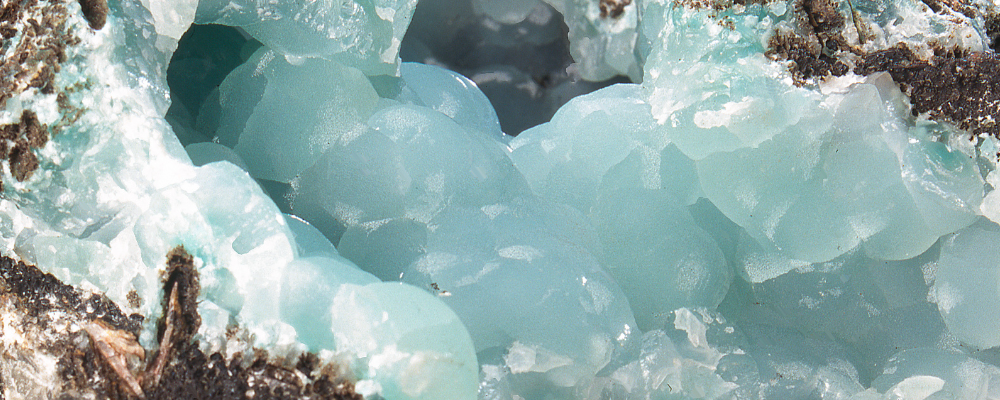
Smithsonite forms rounded crusts in milky colors: blue, green, pink, yellow, or white. Long confused with other ores under the name calamine, it now carries a language of discernment, accurate naming, and clarification.
Its mineralogical identity was established in the 19th century following James Smithson’s work on zinc ores. This late history rules out an ancient body of lore specific to the stone, but provides a solid foundation for its contemporary correspondences: Mercury for analysis and the right name, Earth for matter deposited layer by layer.
To place this stone among related minerals, compare it with Zincite, Sphalerite, and Sphalerite.
The carbonate with rounded forms
Smithsonite is a zinc carbonate, with the formula ZnCO3. It appears in crystals, but mainly forms crusts, botryoidal masses, and rounded aggregates. Its colors come from its composition and the elements present in the deposit.
The Handbook of Mineralogy describes a stone that is fairly dense but soft and brittle. The contrast between its visual gentleness and the fragility of its material reminds us that calm speech may require great precision.
Moving beyond the confusion of the calamines
The name “calamine” long brought together several zinc ores. Smithsonite, a carbonate, and Hemimorphite, a hydrated silicate, were thus placed under the same name even though their compositions differ.
This ancient confusion nourishes the central symbolism of Smithsonite. A general label can conceal several realities. Finding the right name makes it possible to distinguish the causes, responsibilities, and appropriate actions.
Naming separates without dividing. Discernment does not seek to complicate a situation. It removes the overly broad label so that each element receives its place, measure, and appropriate response.
James Smithson and the right name
At the beginning of the 19th century, James Smithson studied calamines and contributed to distinguishing their compositions. In 1832, François Sulpice Beudant gave Smithsonite its name. The Smithsonian Institution traces this connection between the mineral, the scientist, and the bequest that founded the institution.
History associates the stone with analysis, the transmission of knowledge, and the correction of a category that has become imprecise. It is suited to periods when a situation calls for better vocabulary rather than fewer immediate answers.
Botryoidal forms add another image: clarity does not always come from a straight line. It can be built through successive deposits until the structure becomes visible.
Mercury, Earth, and colors
Mercury governs language, distinctions, examination, and the passage of information from one form to another. In book I of his Occult Philosophy, Agrippa places stones with multiple colors and patterns under Mercury. Smithsonite’s palette follows this logic by analogy.
Earth corresponds to carbonate, crusts, and growth in layers. Wednesday is suitable for sorting, study, preparing for a conversation, and searching for the exact term. A pale yellow or white candle, three sheets of paper, and a pencil accompany the stone.
Blue supports measured speech, green a decision oriented toward growth, pink relational clarification, and yellow the examination of an intellectual question. The color guides the rite without changing its core: seeing distinctly and naming things accurately.
Discernment, sorting, and clear speech
Smithsonite accompanies situations cluttered by an overly broad word: failure, conflict, fear, delay, or blockage. Write down the term, then separate the facts, interpretations, and needs. Keep the stone near the facts to maintain a stable point.
Before a conversation, prepare three sentences: what you observed, what it produces, and what you are asking for. This structure prevents a general accusation from replacing useful speech.
For a work or study session, place the Smithsonite near the notes to be sorted. Give each group a short name, remove duplicates, and finish with a decision. Material sorting supports inner sorting.
The Three Names Ritual
On a Wednesday, place three sheets of paper in front of the Smithsonite. On the first, write the name you have given the situation up to now; on the second, what the facts show; then on the third, the more precise name that should guide your action from now on.
Say: “I separate what was confused, I name what is present, and I align my action with the right name.” Tear up the first sheet, keep the second in your notebook, and place the third beneath the stone until the decision.
Correspondences and references
| Reference | Correspondence |
|---|---|
| Nature | Zinc carbonate with crusts and mamillated forms |
| Proposed planet | Mercury |
| Proposed element | Earth |
| Day | Wednesday |
| Colors | Blue, green, pink, yellow, and white |
| Areas | Discernment, naming, study, sorting, transmission, and clear speech |
| Associated objects | Pencil, three sheets of paper, notebook, and white or pale yellow candle |
| Practice | Replace a general label with a precise name and an appropriate action |