


Hemimorphite carries its lesson in its form: the two ends of a single crystal do not resemble each other. This asymmetry gives it a rare language, that of opposites that nevertheless belong to a single structure.
Blue, white, or colorless, it was long confused with other zinc minerals under the name “calamine.” Its mineralogical identity became clearer in the 19th century. Its more recent esoteric uses benefit from starting with this fact rather than an imaginary antiquity.
To place this stone among related minerals, compare it with Zincite, Sphalerite, and Sphalerite.
A Zinc Mineral with Distinct Forms
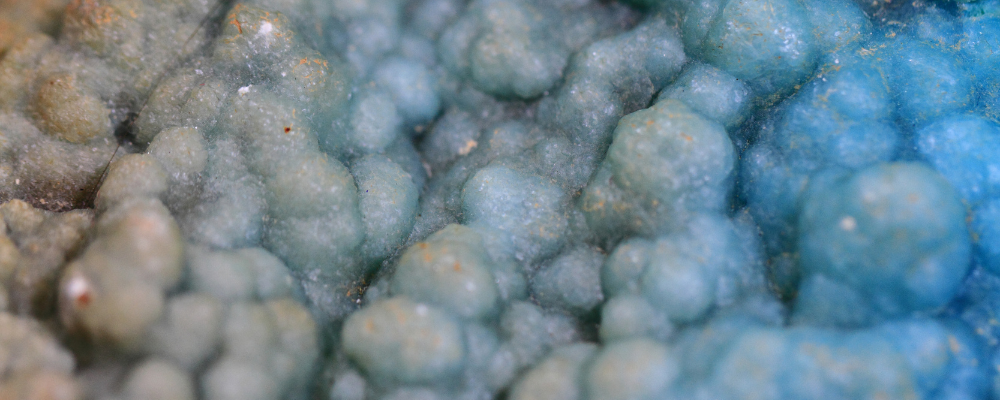
Hemimorphite is a hydrated zinc silicate. It forms in the oxidized zones of zinc deposits and may appear as flattened crystals, botryoidal crusts, or blue and white masses. Its luster ranges from vitreous to pearly.
The Handbook of Mineralogy details its composition and structure; the Mindat entry notes that its hardness is around 4.5 to 5. It therefore deserves careful handling, especially when it forms small plates or crystallized surfaces.
Two Ends, a Single Crystal
The mineralogist Adolph Kenngott gave it its name in 1853. “Hemimorphic” designates a crystal whose two terminations have different forms. One end does not repeat the other, although both belong to the same body.
This characteristic opens up symbolic work on polarity: giving and receiving, speaking and listening, beginning and concluding. The aim is not to make the two poles identical, but to have them participate in a single accord.
From Calamine to Hemimorphite
For centuries, “calamine” served as a collective name for several secondary zinc minerals, notably Hemimorphite and Smithsonite. The historical notice on Calamine shows how mineralogical study separated materials that had previously been confused with one another.
Its story is therefore about discernment. What seemed to form a single whole reveals several identities when examined more closely. In magical work, Hemimorphite helps distinguish without dividing and name without reducing.
Mercury, Venus, Air, and Water
Contemporary correspondences associate Mercury with definition, speech, and circulation; Venus with agreement and reciprocity. Air allows the difference to be expressed, while Water keeps one connected to what it makes one feel. Wednesday is suited to clarification; Friday to conciliation.
Blue calls for calm candor, while white represents the space left for the other person. Two candles of the same height but different colors can frame the stone to represent positions that do not need to become identical.
Agreement, Candor, and Fair Exchange
Hemimorphite supports negotiations, relationship reviews, contracts, and decisions made by two people. It helps examine what flows in each direction: time, money, attention, speech, and responsibility.
It is also suited to personal work when two needs seem incompatible. Instead of eliminating one, seek the structure that can give both a place. The stone guarantees neither forgiveness nor harmony; it supports the clarity needed to determine whether an agreement is possible.
The Ritual of the Two Ends
On a sheet of paper, draw a horizontal line. On the left, write what you give; on the right, what you receive. Place the Hemimorphite at the center and observe the imbalances without justifying them.
Add an adjustment sentence below the line beginning with “For the exchange to remain fair…”. Read it on a Wednesday or Friday, then turn it into a request, a boundary, or a concrete proposal. The ritual is complete when the other party can respond freely.
Correspondences and References
| Reference | Correspondence |
|---|---|
| Nature | Hydrated zinc silicate, white or blue |
| Form | Hemimorphous crystal with two different terminations |
| History | Formerly grouped with other ores under “calamine” |
| Planets | Mercury and Venus in Contemporary Systems |
| Elements | Air and Water |
| Days | Wednesday and Friday |
| Areas | Discernment, Reciprocity, Negotiation, and Boundaries |
| Ritual Act | Comparing What Is Given and What Is Received |