


Sphalerite can appear metallic, resinous, dark, or traversed by a colored fire. Its former name, Blende, and its Greek name both evoke deception, because miners confused it with more familiar ores. It thus becomes a stone of discernment, trial, and hidden value.
Its brilliance can exceed that of much more resistant materials, while its cleavage makes it fragile. This opposition forms the basis of its ritual language: what attracts the eye reveals neither the composition, nor the solidity, nor the actual use. One must observe, compare, and put it to the test before choosing.
To place this stone among related minerals, compare it with Zincite, Sphalerite, and Marmatite.
The zinc ore with a thousand fires
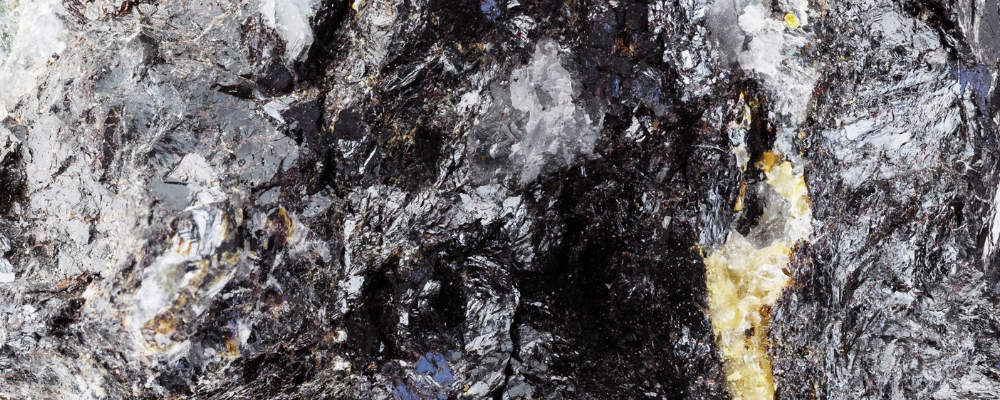
Sphalerite is a zinc sulfide, with the formula ZnS, and the principal ore of this metal. Almost colorless when it contains little iron, it becomes yellow, orange, red, brown, or black as its composition changes.
The Handbook of Mineralogy describes a soft, brittle stone with very pronounced cleavage. The material can therefore offer spectacular brilliance while requiring careful handling.
Blende and deceptive stone
Georgius Agricola used the name Blende in the 16th century. In 1847, Ernst Friedrich Glocker formed the name Sphalerite from the Greek sphaleros, “deceptive.” The Aalto University page notes that its dark forms resembled Galena without providing the expected lead.
The name recounts a mistake in identification. The stone does not deceive intentionally: the observer assigns a familiar identity to a brilliance too quickly. Sphalerite therefore asks us to suspend judgment and seek the criterion that distinguishes two similar appearances.
Appearance opens the investigation; it does not end it. Sphalerite accompanies choices in which immediate allure must be weighed against composition, durability, and the intended use.
Brilliance and resistance
Transparent crystals have very high dispersion: white light separates into vivid colors. The Gemological Institute of America describes this remarkable brilliance, but also points out the stone’s softness, fragility, and cleavage.
A spectacular quality can therefore coexist with a clear limitation. In ritual, this coexistence teaches us to assess a person, project, or proposal according to several criteria instead of asking a single appeal to prove everything.
Shades ranging from honey to black add a second lesson. The composition changes the mineral’s appearance without erasing its identity. A situation can change in appearance while retaining the same structure.
Mercury, Earth, and Fire
The correspondences of Sphalerite are contemporary. Mercury governs examination, naming, comparison, and the ability to recognize what lies beneath a resemblance. In Book I of his Occult Philosophy, Agrippa also associates Mercury with stones of mixed colors and shapes.
Earth corresponds to the ore, the value contained in the rock, and the material test. Fire corresponds to the yellow, orange, and red flashes, as well as the light that decomposes within transparent crystals.
Wednesday is suitable for decisions, verifications, and matters that require reading a contract or comparing several offers. Three sheets of paper, a pen, a pale yellow candle, and a small box accompany the stone.
Discernment, value, and decision
When faced with an enticing proposition, write down what immediately attracts you, what will withstand use, and what remains to be verified. Place the Sphalerite near the third sentence until you obtain the missing information.
To recognize hidden value, note a real capability that lacks visibility. Then define the framework that will allow it to emerge without exposing it to a strain it cannot withstand.
In a financial matter, the stone accompanies the examination of figures, deadlines, and obligations. It supports discernment, but the decision must be based on the documents and the actual conditions.
The Rite of the Three Tests
On a Wednesday, place three sheets of paper in front of the Sphalerite. Write “appearance” on the first, “composition” on the second, and “resistance” on the third. Describe the situation from each of these angles.
Place the stone in the center and say: “May the luster be seen, may the material be recognized, and may use reveal the proper value.” Put away the first sheet, keep the other two, and postpone the decision until each criterion has an answer.
Correspondences and references
| Reference | Correspondence |
|---|---|
| Nature | Zinc sulfide in shades ranging from honey to black |
| Proposed planet | Mercury |
| Proposed elements | Earth and Fire |
| Day | Wednesday |
| Figures | Deceptive luster, hidden ore, and decomposed light |
| Areas | Discernment, examination, value, decision, truth, and verification |
| Associated objects | Three sheets of paper, a pen, a box, and a pale yellow candle |
| Gesture | Compare appearance, composition, and resistance before choosing |