























































































































Clear, brilliant, and easy to mistake for Quartz, Phenakite carries in its name the memory of a corrected error. The mineralogists’ “deceiver” becomes a stone of discernment, verification, and precise speech: observing a resemblance without confusing it with identity.
Described in the 19th century, it has no long-standing magical tradition of its own. Its contemporary ritual role is built rigorously around its real history. Mercury examines, compares, and names; the Sun brings facts to light; Air supports thought and clear expression.
To place this stone among related minerals, compare it with Sphalerite, Cafetite, and Orpiment.
The crystal mistaken for Quartz
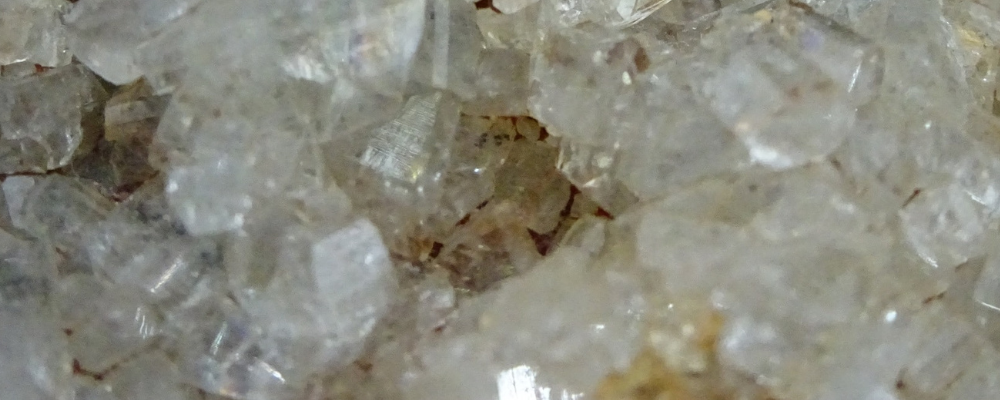
Phenakite is a beryllium silicate, Be2SiO4, transparent to translucent. The Handbook of Mineralogy describes a hard, lustrous trigonal mineral whose appearance can resemble Quartz.
This visual similarity gives it a precise ritual role. It accompanies situations where two propositions seem equivalent even though their nature, value, or consequences differ.
The Greek name for the deceiver
Nils Gustaf Nordenskiöld gave it its name in 1833 from the Greek phenax, “deceiver,” because it had been confused with Quartz. The Mindat entry preserves this etymology and the date it was named.
The name does not condemn the stone to deceit. It celebrates the moment when closer observation corrects a first impression. Phenakite thus becomes a witness to truth obtained through examination, not revelation without proof.
Mercury, comparison, and the right name
Mercury governs signs, classifications, exchange, and the intelligence that distinguishes. Under this planet, Phenakite accompanies contracts, non-medical diagnoses, research, and decisions where the wording used changes the outcome.
The Webmineral database makes it possible to compare its formula, hardness, and optical properties. This method inspires its magic: an impression initiates the search, then several independent characteristics lead to the name.
Clarity is valuable only if it withstands scrutiny. The spectacular powers attributed to Phenakite today do not come from an ancient lapidary. Its authentic history already offers a strong domain: exposing a deceptive resemblance.
Sun, Air, and visible truth
The Sun illuminates, reveals, and grants the authority needed to name what has been established. Air carries the analysis and formulation. Wednesday is suitable for gathering the elements; Sunday for the conclusion, declaration, and bringing things to light.
A clear mirror, two documents placed side by side for comparison, and a white candle kept at a distance make up its altar. The crystal remains between the two versions until the criterion separating them is written down.
Discernment, truth, and informed choice
For a choice, place the Phenakite between the two options and write down their similarities. On another sheet, note what creates a real difference: cost, timeframe, commitment, origin, or consequence. Make the decision based on this second sheet.
When faced with a rumor, consecrate it to verification. Seek two independent sources before passing on the information. For difficult words, it helps remove exaggeration and retain the wording that can be defended.
It is also suited to mistakes that must be corrected publicly. Acknowledging confusion does not destroy authority; it shows that judgment knows how to evolve in contact with the facts.
The two proofs
On a Wednesday, write an affirmation in the center of a sheet. On each side, draw a space intended for an independent proof. Place the Phenakite above it and look for two elements that do not come from the same source.
If the two proofs converge, formulate the conclusion under a clear light. If they diverge, write “unresolved” and keep the crystal on the sheet until a new verification. The rite consecrates both the right to conclude and the discipline of waiting.
Correspondences and reference points
| Reference point | Correspondence |
|---|---|
| Nature | Transparent to translucent beryllium silicate |
| Name | From the Greek phenax, “deceiver” |
| Proposed planets | Mercury and Sun |
| Proposed element | Air |
| Days | Wednesday and Sunday |
| Areas | Discernment, verification, truth, choice, and correction |
| Ritual image | Two similar crystals separated by an exact criterion |
| Ritual gesture | Gather two independent proofs before drawing a conclusion |