






















































































































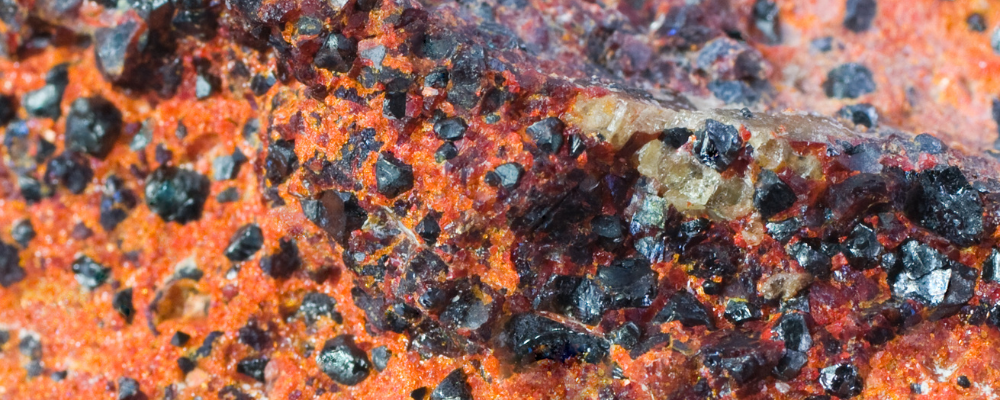
Natural Zincite concentrates an incandescent red in matter born without a visible flame. On the market, it also exists alongside crystals formed in industrial Zinc furnaces. Both are Zinc oxide, but their histories are not the same.
This distinction informs its symbolism: origin, transformation, and the truth of matter. Zincite supports projects that require fire, provided one knows the provenance of what feeds the flame.
To place this stone among related minerals, compare it with Sphalerite, Sphalerite, and Marmatite.
The red oxide of Zinc
Zincite is the mineral form of Zinc oxide, ZnO. Pure, this material would be almost colorless; Manganese and Iron give natural specimens their red, orange, or yellow hues. The mineral crystallizes in the hexagonal system.
The Handbook of Mineralogy describes its composition, hardness, and associations. Well-formed natural crystals remain rare. Zincite more commonly occurs as granular masses mixed with Franklinite and Willemite.
Franklin and Sterling Hill, the land of Zinc
The Franklin and Sterling Hill deposits in New Jersey yielded extraordinary Zinc ores. Red Zincite forms a major part of certain layers there, alongside black Franklinite and pale Calcite.
The Franklin-Ogdensburg Mineralogical Society describes these mineral-rich areas. This mineral landscape gives natural Zincite a strong geographic identity, linked to mining, working-class heritage, and the color enclosed in the rock.
Crystals born in furnaces
ZnO crystals also appear in Zinc production ducts and furnaces, when vapors condense. Others are obtained through controlled growth. These materials can display remarkable colors and forms.
Natural, furnace-produced, or made in a laboratory, Zincite requires a clear provenance. Its origin does not alter the crystal’s chemical reality; it changes its history, rarity, and the meaning one may give it.
Mars, Sun, Fire, and Earth
Mars corresponds to red, effort, metal, and the triggering of action. The Sun governs light, authority, and visible success. Fire represents the transformation of ore or steam; Earth belongs to the natural deposit.
Tuesday supports drive and work. Sunday accompanies presentation and fulfillment. Red, orange, yellow, and black form a palette attuned to Zincite.
Origin, energy, and implementation
Zincite accompanies the launch of a task, the resumption of a stalled project, and the search for a reliable source. It encourages you not to confuse intensity with disorder: a useful flame knows its fuel, its hearth, and its duration.
It is also suitable for purchases, collections, and inheritances whose origin must be traced. Asking where a material comes from does not devalue it; it restores its history and allows an informed choice.
The Rite of the Three Origins
On a red sheet, draw three lines: origin, transformation, destination. Write beneath each what you know about the project, object, or relationship being studied.
Place the Zincite above the sheet and light an orange candle at a distance. Say: “I know the source, I master the fire, and I choose the use.” Immediately complete the missing information or note the person to ask.
Correspondences and references
| Reference | Correspondence |
|---|---|
| Nature | Zinc oxide, red to orange in its famous natural forms |
| Major location | Franklin–Sterling Hill District, New Jersey |
| Celestial bodies | Mars and Sun |
| Elements | Fire and Earth |
| Days | Tuesday and Sunday |
| Ritual colors | Red, orange, yellow, and black |
| Areas | Origin, energy, action, manufacture, and fulfillment |
| Ritual action | Tracing the source, transformation, and destination |