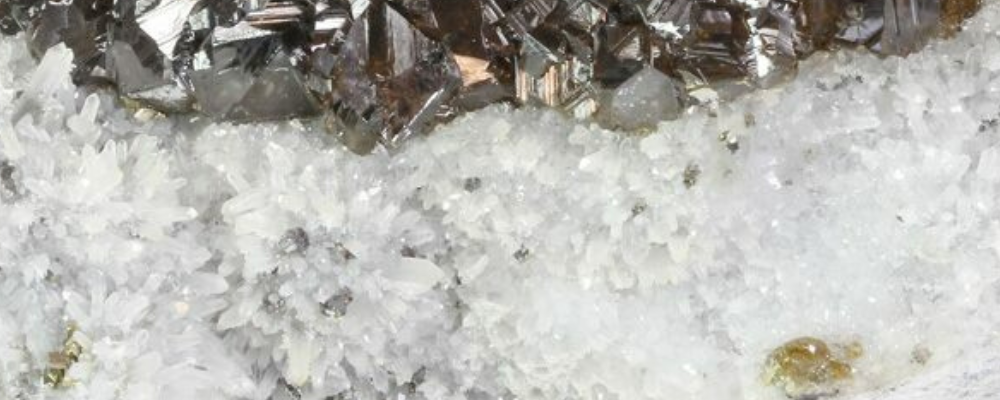
Cleiophane is a clear, iron-poor Sphalerite whose crystals may be colorless, pale yellow, or greenish. It is not a distinct species: its name designates a variety in which the lightening of the color allows light to pass through more easily. Its symbolic language is that of clarity gained through subtraction.
Having appeared in the 19th century, the name carries no documented ancient magical tradition. Its contemporary interpretation is based on the relationship between iron and color in Sphalerite. The Sun reveals, Mercury distinguishes, Air clarifies, and Earth sustains reasoning in actual matter.
To place this stone among related minerals, compare it with Zincite, Sphalerite, and Sphalerite.
A name of uncertain etymology
The name Cleiophane was proposed before 1851 by Thomas Nuttall and published by Thomas H. Henry, who attributed its origin to him. The Mindat entry indicates an uncertain etymology, perhaps derived from Greek words associated with renown and appearance.
It is better to preserve this qualification than to create an appealing translation. Clarity begins here with accepting incomplete information.
An iron-poor Sphalerite
Cleiophane is a clear variety of Sphalerite, zinc sulfide ZnS, containing little iron. The Sphalerite entry shows how the presence of iron can influence color and other physical characteristics.
The Handbook of Mineralogy describes a material with a hardness of 3.5 to 4, perfect cleavage, and a luster that can become adamantine. In its clear form, light reveals the planes and internal reflections more clearly.
Nuttall, Henry, and Franklin
The first recorded locality is Franklin, New Jersey, a mining district famous for the richness of its species. Cleiophane was recognized there as a distinct expression of Sphalerite rather than as an unrelated material.
Its nomenclatural history teaches us to observe variation without multiplying entities. A visible difference may result from a small deficiency, a trace element, or a change in composition.
Clarity does not always require adding an answer. It also appears when a minor influence that darkens the whole is removed: an extra sentence, a distracting priority, a poorly chosen source.
Sun, Mercury, Air, and Earth
The Sun governs visibility and the light that passes through the stone. Mercury receives discernment, sorting, and the message stripped of an unnecessary detour. Air clarifies; Earth verifies that this clarity rests on facts.
Sunday is suitable for bringing things to light, and Wednesday for editorial work. A blank sheet of paper, a clear pane of glass, and a yellow thread accompany the stone without subjecting it to strong exposure.
Clarity, sorting, and signal
Cléiophane accompanies a rereading, a choice between several options, or the simplification of a project. It invites you to look for the small factor that scrambles the message rather than rebuilding the entire structure.
It is suitable for situations where overload masquerades as richness. Removing an element does not necessarily impoverish the work: it can make its intention more visible and its use easier.
The Rite of Removed Noise
Write your intention in one sentence on a blank sheet of paper. Underline the three words without which it would lose its meaning. Then cross out a word, task, or influence that does not help any of the three. Place the Cléiophane beside the text.
Say: “I keep the signal and remove what covers it. Clarity shows me the next gesture.” Rewrite the sentence one last time, then perform that gesture.
Correspondences and references
| Reference | Correspondence |
|---|---|
| Nature | Light-colored, iron-poor variety of Sphalerite |
| Celestial bodies | Sun and Mercury |
| Elements | Air and Earth |
| Days | Sunday and Wednesday |
| Ritual colors | White, pale yellow, light green |
| Areas | Clarity, sorting, rereading, discernment |
| Associated objects | Blank sheet of paper, glass pane, yellow thread |
| Gesture | Remove an influence that scrambles the signal |