
























































































































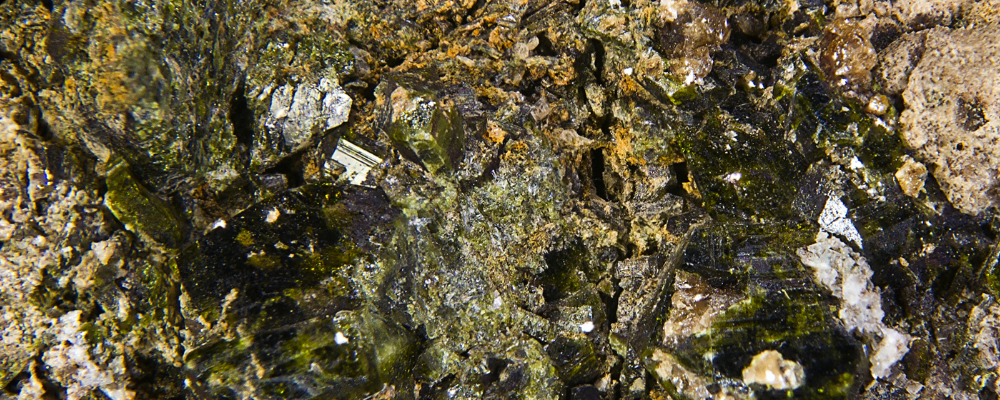
Fassaite bears the name of the Dolomites where it was recognized, in Val di Fassa. Beneath this old name lies a low-iron Augite, formed near rocks transformed by heat. Its presence tells a story of contact: that between magma and limestone, two materials that meet without entirely losing their memory.
It does not belong to stones with an identifiable ancient cult. Its correspondences are therefore proposed as a contemporary ritual language: Mercury for the revision of names, Saturn for classification, Earth and Fire for contact metamorphism.
To place this stone among related minerals, compare it with Diopside, Enstatite, and Babingtonite.
A Stone from Val di Fassa
Fassaite takes its name from Val di Fassa in the Italian Dolomites. The Monzoni and Vallaccia deposits yielded crystals prized by collectors. The mineralogical description of the district places these occurrences in areas where magmatic intrusions transformed the surrounding rocks.
This link to a specific place makes its name a small geological map: it preserves the mountain, the localities studied, and the history of the earliest descriptions.
Augite from Contact Zones
Fassaite is now considered a low-iron variety of Augite rather than an independent species. Mindat summarizes this status, while the Handbook of Mineralogy describes Augite as a dark pyroxene, with a hardness of 5.5 to 6 and two cleavage directions that are nearly perpendicular.
Its green to brownish-green hues come from its composition and its formation environment. Heat does not add mere decoration: it reorganizes the material at the point of contact.
A Name Preserved by History
Advances in analysis have narrowed the definition of mineral species. The name Fassaite is nevertheless still used because it conveys a composition and a local history. It belongs to those old names that do not disappear when science refines its categories.
Changing categories does not abolish the past. Fassaïte reminds us that a designation can be corrected while retaining historical value. This tension nourishes its symbolic use: reread an inheritance, clarify it, then decide what deserves to be preserved.
Mercury, Saturn, Earth, and Fire
In a modern symbolic framework, Mercury presides over words, distinctions, and changes in definition. Saturn sets the proper boundary and classifies what needs to be classified. Earth receives the imprint of the place; Fire represents the transformation produced by contact.
Wednesday is suitable for a review, and Saturday for a lasting decision. Dark green, brown, and black support this work. A notebook, two labels, and a piece of limestone can complete the altar.
Revising Without Erasing
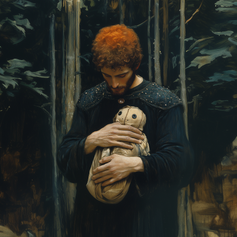
Fassaïte accompanies periods when an old role no longer quite corresponds to reality. It helps you look at what has changed, correct an overly narrow narrative, and recognize what the old name continues to teach.
It can also be used during classification, a transfer, or a reconsideration of a decision. Its focus is not repudiation, but precision.
The Rite of Two Names
Write on a first label the name by which a situation was known for a long time. On a second, write the words that now describe it more accurately. Place the Fassaïte between the two.
Read the labels, then say: “I correct without erasing. I preserve the trace and choose the right word.” Place the first one in an archival notebook and keep the second near your workspace.
Correspondences and References
| Reference | Correspondence |
|---|---|
| Nature | Iron-Poor Variety of Augite |
| Celestial Bodies | Mercury and Saturn |
| Elements | Earth and Fire |
| Days | Wednesday and Saturday |
| Ritual Colors | Dark Green, Brown, Black |
| Domains | Revision, Classification, Inheritance, Precision |
| Associated Objects | Notebook, Labels, Limestone |
| Gesture | Renaming Without Erasing the Trace |