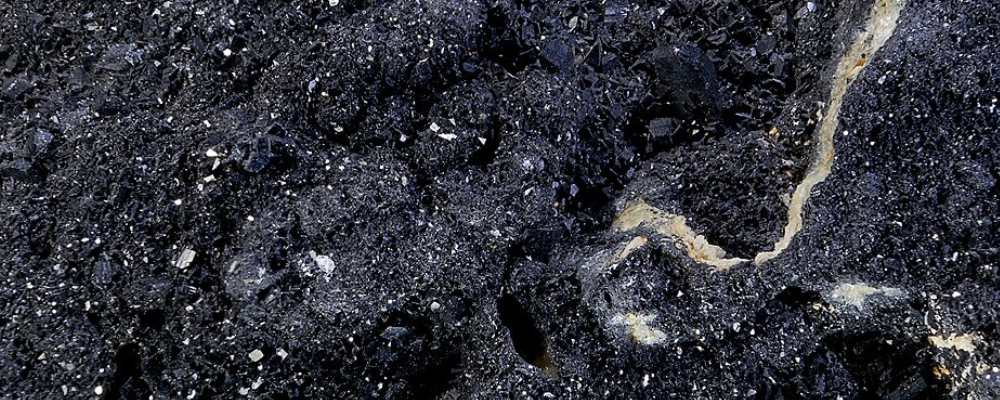
Babingtonite appears as a black punctuation mark in the light-colored cavities of rocks. Its dark, lustrous, well-formed crystals stand out beside Prehnite, Quartz, or Zeolites. It evokes a marker placed at the threshold: one that marks the true beginning of a commitment.
Described in the 19th century, it has no ancient talismanic tradition under this name. Its current symbolism is built on iron, color, and form: Saturn provides the framework, Mars the action, Earth the foundation, and Water the cavity where the crystals are deposited.
To place this stone among related minerals, compare it with Diopside, Enstatite, and Fassaïte.
A dark, iron-rich silicate
Babingtonite is a calcium iron silicate with the formula Ca2(Fe2+,Mn)Fe3+Si5O14(OH). The Handbook of Mineralogy indicates a hardness of 5.5 to 6, a triclinic structure, and a color ranging from very dark green to black.
Its vitreous luster reveals sharp faces under good lighting. The stone may appear completely black at first glance, then reveal green hues along its thin edges.
Black crystals in the cavity
Babingtonite forms in cavities in volcanic rocks and in certain metamorphic settings. It may occur alongside Prehnite, Quartz, Calcite, and Zeolites. The contrast between the black crystals and lighter minerals creates highly expressive specimens.
The Mindat entry presents its forms and localities. The matrix is not merely secondary decoration: it preserves the history of the cavity and gives the crystals their place.
Lévy, Babington, and Massachusetts
Armand Lévy described Babingtonite in 1824 and named it in honor of the physician and mineralogist William Babington. The stone thus belongs to the era of the great mineral classifications of the 19th century.
Massachusetts chose it as its official mineral in 1981, a distinction preserved in the state’s civic information. This modern recognition adds a sense of territory and belonging to its symbolism.
Babingtonite marks the point where an intention enters the material world. Like the black crystal that takes its place in a cavity, a commitment becomes real when it receives a date, a place, and a visible first action.
Saturn, Mars, Earth, and Water
Saturn governs duration, structure, and the marker. Mars corresponds to iron and the inaugural act. Earth provides stability; Water recalls the fluids that circulate through cavities in the rock.
Saturday suits long-term commitments, and Tuesday suits beginnings. A small black stone, an empty bowl, and a written date can accompany the Babingtonite.
Threshold, commitment, and constancy
Babingtonite accompanies the beginning of a discipline, the signing of a promise, entering a place, or resuming regular work. It does not represent the enthusiasm of the first day, but the marker that will make it possible to measure the journey.
Placed near a calendar or a register, it reminds us that constancy is born from a clear appointment with action.
The Rite of the First Marker
Write the commitment in one sentence, then add a start date, a frequency, and proof of completion. Place the Babingtonite at the bottom of the sheet like a dark seal.
Say: “I cross the threshold, give form to my word, and mark the first step.” Then immediately carry out an action short enough to be completed that same day.
Correspondences and references
| Reference | Correspondence |
|---|---|
| Nature | Calcium iron silicate |
| Celestial bodies | Saturn and Mars |
| Elements | Earth and Water |
| Days | Saturday and Tuesday |
| Ritual colors | Black, dark green, gray |
| Domains | Threshold, commitment, constancy, territory |
| Associated objects | Calendar, marker, bowl |
| Action | Dating, then taking the first step |