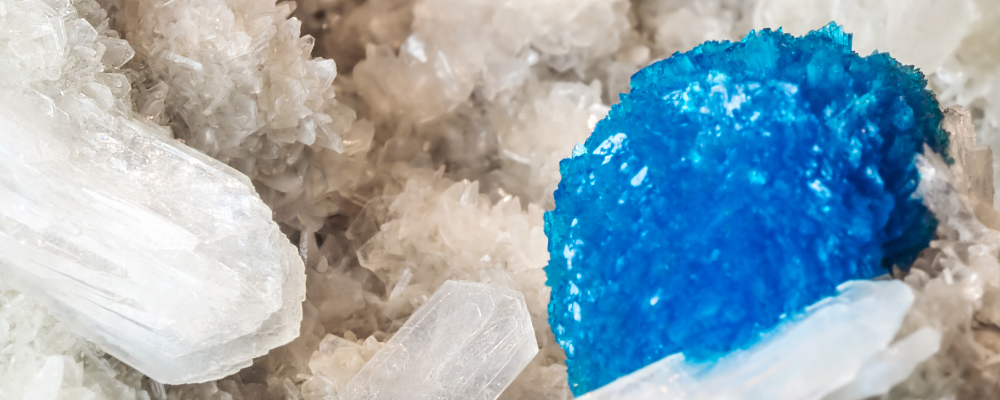
Cavansite forms small rosettes of intense blue, set like mineral flowers on their matrix. Its name condenses calcium, vanadium, and silicon. Its relationship with Pentagonite, which has the same composition but a different structure, gives this stone a distinctive theme: the same elements can produce another expression when they are reorganized.
Cavansite was recognized in the 20th century and has no ancient magical tradition. Its modern correspondences therefore derive from its structure, name, and color. Mercury governs arrangement and speech; the Moon, blue and receptivity; Air carries formulation, while Water softens the form.
To place this stone among related minerals, compare it with Scolecite, Brucite, and Blue Agate.
Calcium, vanadium, silicon
The name Cavansite combines the first syllables of calcium, vanadium, and silicon. The Mindat entry clearly connects the name to the composition of this hydrated silicate.
This word, constructed like a brief formula, suits the theme of reformulation. It does not conceal its components: it brings them together until a new identity emerges.
Blue rosettes
Cavansite is a hydrated calcium vanadium silicate. The Handbook of Mineralogy describes it as orthorhombic, with a hardness of 3 to 4 and prismatic crystals frequently grouped into radiating aggregates.
It shares its chemical composition with Pentagonite, but not its crystal structure. This is called dimorphism: the same formula expressed in two structures. The difference therefore lies not in the ingredients, but in their arrangement.
From Oregon to the Indian basalts
The reference locality is near the Owyhee Dam in Oregon. The 1973 mineralogical article on Cavansite and Pentagonite establishes their structural relationship.
The bright blue specimens most familiar to collectors come from cavities in the basalts of Maharashtra, India, where Cavansite occurs with white zeolites. The contrast makes the blue center and its host matrix visible.
Changing the structure can change the expression. When the words are right but the message does not get through, the problem is not always the content. It may lie in the order, rhythm, or point of entry.
Mercury, Moon, Air, and Water
Mercury receives language, the construction of a name, and variation in forms. The Moon accompanies listening and the color blue. Air gives the sentence; Water changes its rhythm so that it can be received.
Wednesday is suitable for writing and Monday for listening. Three strips of blue paper, arranged around a white circle, make it possible to work without charging the stone itself.
Wording, listening, and reorganization
Cavansite accompanies a delicate conversation, a page to rewrite, or an idea that remains misunderstood. It invites you to preserve the intention while changing the order, tone, or length.
It also supports the reorganization of teams and spaces. Before adding a new resource, it asks whether the elements already present could function differently.
The three forms of speech
Write the same message on three blue bands: first as a direct sentence, then as a question, and finally as an open-ended proposition. Arrange them like rays around a white circle and place the Cavansite nearby.
Say: “I keep the heart of the message and seek the form that can be heard.” Read the three versions aloud, then choose the one whose rhythm seems most fitting.
Correspondences and references
| Reference | Correspondence |
|---|---|
| Nature | Mineral species, blue hydrated silicate |
| Celestial bodies | Mercury and Moon |
| Elements | Air and Water |
| Days | Wednesday and Monday |
| Ritual colors | Bright blue, white, silver |
| Areas | Wording, listening, expression, reorganization |
| Associated objects | Three blue bands, white circle, feather |
| Gesture | Giving three structures to the same message |