






















































































































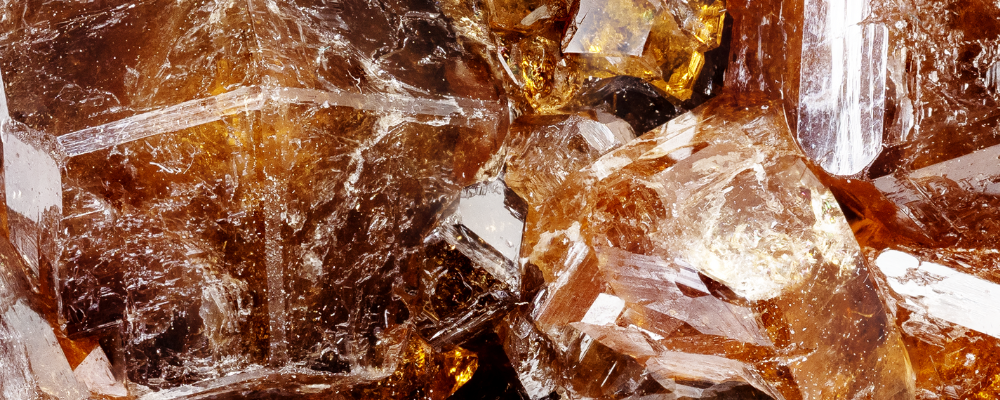
Hessonite is a Grossular Garnet in shades of honey, amber, and cinnamon. Its warm color may conceal an inner movement, a flowing texture that gemologists compare to molasses. In India, the stone called gomed took its place among the nine gems of astrology and became associated with Rāhu, the ascending node of the Moon.
This association has a real historical context. It should not be reduced to a universal promise of luck or protection. Rāhu belongs to a learned astrological system associated with eclipses, appetites, and the powers of shadow. Outside this framework, Hessonite can accompany a contemporary reflection on ambition, projection, and what troubles the gaze.
To place this stone among related minerals, compare it with Garnet, Green Garnet, and Rhodolite.
The Honey-Colored Garnet
Hessonite is a yellow-orange to reddish-brown variety of Grossular. Mindat traces its name to the Greek hesson, “inferior,” probably referring to a lower hardness or density than that of other Garnets known at the time.
The old name “cinnamon stone” describes its color without identifying the species on its own.
A variety of Grossular
Grossular is a calcium aluminum silicate in the Garnet group. The Handbook of Mineralogy indicates a hardness of 6.5 to 7.5 and a wide range of colors.
Hessonite may display a flowing or granular internal appearance, which is very useful for identifying it. Its color comes mainly from iron. Like other Garnets, it has no distinct cleavage, but it can fracture under impact.
Gomed and the Shadow of Rāhu
In Indian astrological tradition, gomed or gomeda refers to Rāhu’s gemstone. The treatise Mani-mālā, published in 1879, lists it among the nine planetary gems, the navaratna.
Rāhu is not a material planet: it personifies the ascending node of the Moon’s orbit, a point associated with eclipses. Gem prescriptions belong to jyotiṣa and require a reading of the chart; they cannot be reduced to wearing a color.
Shadow is not merely the absence of light. In Rāhu’s language, it reveals appetite, obsession, and the images that captivate. Hessonite then becomes a support for looking at what attracts without surrendering judgment to it.
Rāhu, Earth, and Veiled Fire
Rāhu corresponds to eclipses, crossings, ambition, and clouded perceptions. Earth recalls the material nature of Garnet and the need for stable support. Veiled Fire conveys its warm color crossed by a shadow.
Rāhu’s ritual timing varies according to the day and place in Indian astrological calendars; it is better not to invent a fixed day for it. Honey, amber, and smoky brown make up its palette. A dark disk, a covered mirror, and a journal may accompany it.
Ambition, confusion, and discernment
Hessonite accompanies the examination of a powerful desire: does it come from a vocation, comparison, or fear of missing out? It helps separate genuine drive from the fascinating image one pursues in order to be seen.
It is also suitable for periods of uncertainty, when one accepts postponing a decision until the light returns.
The Eclipse Journal
Cover a small mirror with a dark cloth and place the Hessonite on it. Write down what strongly attracts you, then three verifiable facts and three projections surrounding that desire.
Look into the mirror and say: “I look at the image without surrendering my judgment to it. May the shadow reveal its limit, and may my desire reclaim its name.” This practice is a contemporary adaptation, not an astrological remedy from jyotiṣa.
Correspondences and references
| Reference | Correspondence |
|---|---|
| Nature | Orange to brown variety of Grossular |
| Indian correspondence | Rāhu, the Moon’s ascending node |
| Symbolic elements | Earth and veiled Fire |
| Ritual timing | Rāhu’s hour according to the local calendar |
| Ritual colors | Honey, amber, smoky brown |
| Domains | Ambition, projection, confusion, discernment |
| Associated objects | Dark disk, covered mirror, journal |
| Gesture | Distinguishing facts from projections |