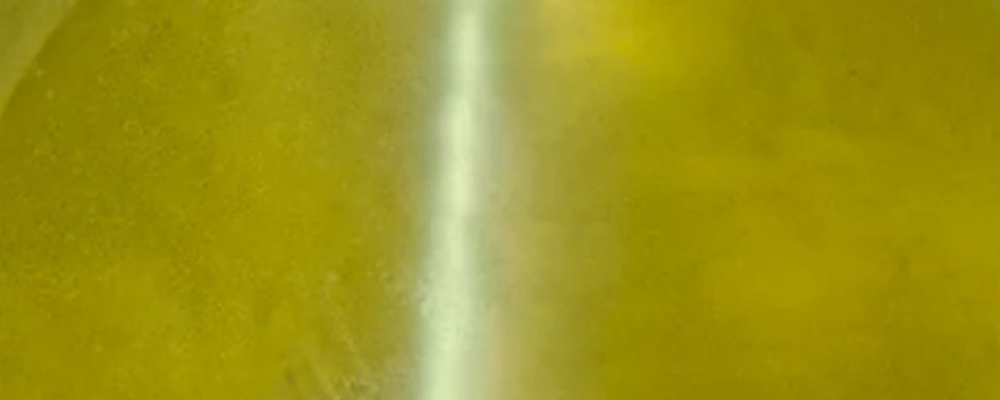
A clear line crosses the Cat’s-Eye and moves with the light. It seems to open, close, and then return to the center, like the gaze of an animal watching without leaving its place.
This name does not designate a single species, but an optical effect called chatoyancy. Chrysoberyl produces the classic Cat’s-Eye; Quartz, Apatite, and other minerals can show a comparable effect. The host material must therefore accompany the name.
To place this stone among related minerals, compare it with Corundum, Ruby, and Sapphire.
Chatoyancy, a line of light
Chatoyancy appears when parallel needles, tubes, or fibers reflect light in the same direction. A cabochon cut oriented in relation to these inclusions then concentrates the reflection into a moving band.
The Gemmological Association of Great Britain explains this mechanism. The sharpest line appears under a point light source moved above the stone.
Cymophane, Cat’s-Eye Chrysoberyl
Without further specification, the gemological name “Cat’s-Eye” refers to chatoyant Chrysoberyl, also called Cymophane. Its colors range from honey to brownish green, and its luminous band may appear white or silvery.
The Gemological Institute of America shows how clouds of inclusions produce the eye. For other minerals, the full name remains preferable: Cat’s-Eye Quartz, Cat’s-Eye Apatite, or Cat’s-Eye Tourmaline.
Vaidurya, Ketu, and the Indian tradition
In Indian astrological tradition, Cat’s-Eye is associated with Ketu, the descending lunar node. Ketu belongs to the nine powers of the Navagraha and is assigned a gemstone in the sets of nine gems called Navaratna.
The Mani-málá by Sourindro Mohun Tagore, published in the 19th century, brings together Indian names, descriptions, and uses of Vaidurya and stones known as Cat’s-Eye. Early identifications covered several materials; chatoyant Chrysoberyl became the gemological standard.
Ketu, Moon, Saturn, Air, and Earth
Ketu represents severance, detachment, hidden causes, and the return of a past act. The Moon governs received light and the nodes of its orbit. Saturn brings vigilance, limitation, and endurance. Air clarifies the choice; Earth maintains the watch.
Monday is suited to observation and dreams. Saturday supports protection and closure. Gray, honey, black, and silver form a palette attuned to the moving gaze.
Vigilance, Protection, and Decision
The Cat’s-Eye accompanies decisions that require following a single line amid several reflections. It suits work involving vigilance, protection against deception, and separation from an influence that has become sterile.
The stone does not replace examining the facts. Its moving eye invites you to change the lamp’s angle, then check whether the same line remains. This gesture becomes a method: shift your viewpoint without losing the center.
The Rite of the Decisive Line
Place the Cat’s-Eye on a dark cloth. Put two pieces of paper on either side, each with one option. Slowly move a small lamp above the stone and observe the line that forms.
Turn off the lamp, then write beneath each option the fact that supports it and the risk it carries. Turn the light back on and say: “I change the angle, keep the line, and choose with understanding.” Make the decision based on the written facts.
Correspondences and References
| Reference | Correspondence |
|---|---|
| Nature | Chatoyancy present in several mineral species |
| Gemological Reference | Cat’s-Eye Chrysoberyl, or Cymophane |
| Astrological Power | Ketu, the descending lunar node |
| Celestial Bodies | Moon and Saturn |
| Elements | Air and Earth |
| Days | Monday and Saturday |
| Areas | Vigilance, protection, discernment, severance, and decision |
| Ritual Act | Move the light, check the facts, and keep the line |