















































































































































































































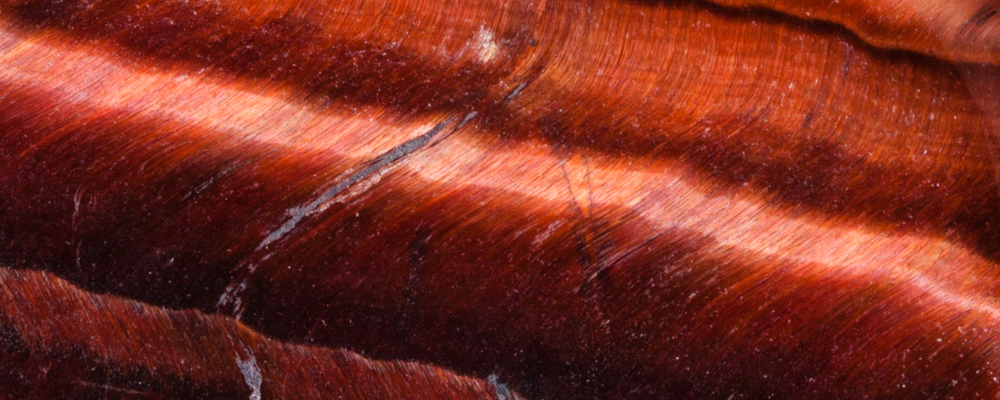
Dark red, brown, and crossed by a moving reflection, Bull’s-eye brings together three powerful images: the watchful gaze, the Fire that sets things in motion, and the Earth that keeps them standing. Contemporary magic uses it for active protection, courage, endurance, and the will to carry an action through to completion.
Its name belongs to the modern lapidary vocabulary, but the symbols used to work with it are older. The protective eye runs through the history of amulets, red belongs to the colors of Mars in the learned magic of the Renaissance, and brown falls under Saturn. Bull’s-eye thus stands between martial drive and Saturnine resilience.
To place this stone among related minerals, compare it with Tiger's Eye, Hawk's Eye, and Cat's Eye.
A Red Quartz with a Moving Gaze
Bull’s-eye, also called Ox-eye or Bull’s-eye, is a chatoyant Quartz related to Tiger’s Eye. Its parallel fibers reflect light in a band that glides across the surface when the stone or lamp moves. Its palette ranges from brick red to mahogany brown.
Some of the red stones offered commercially result from the controlled heating of golden Tiger’s Eye; red zones also occur naturally. This common process changes the color without diminishing the Quartz’s hardness or chatoyancy. The gemmological entry devoted to Bull’s-eye presents this origin in a few lines.
A modern name, older symbols. Nothing supports attributing Bull’s-eye to ancient bull cults. Its current magical use can nevertheless draw on three clear lineages: the protective eye of amulets, martial red, and Saturnine brown. The connection rests on the stone’s shape and color, without inventing an imaginary antiquity for it.
The Eye as a Sign of Protection
A reflection that seems to follow the person looking at it naturally calls for vigilance. Chatoyant stones were given names referring to eyes because their luminous band evokes a pupil that remains open. In ritual, this appearance makes it possible to give the talisman a direction: turned outward, it watches over a doorway, an altar, or the boundary of a circle.
The history of the protective eye extends far beyond this stone. In ancient Egypt, the Wedjat represented the restored eye of Horus and served protection and regeneration. The Metropolitan Museum of Art preserves a Wedjat from the 1st millennium BCE and explains its function. This amulet does not prove the ancient use of Bull’s Eye; it sheds light on the long-standing protective power of the depicted eye.
Between Mars and Saturn
In the Three Books of Occult Philosophy, completed in 1533, Henri-Cornelius Agrippa links reds, fiery colors, and iron tones to Mars. He places blacks, browns, earthy colors, and leaden hues under Saturn. The chapter devoted to planetary colors provides a solid historical basis for interpreting Bull’s Eye’s red-brown palette.
Mars provides drive, courage, combat, and the ability to respond. Saturn brings duration, discipline, boundaries, and resistance. Their combination is less suited to thoughtless impulse than to sustained strength: acting without giving up, defending a position, supporting an effort, and getting through a demanding period.
Strength, courage, and endurance
Contemporary stone magic uses Bull’s Eye to strengthen the will, revive courage, and present a solid presence against whatever intimidates. It supports a return to activity, a competition, an undertaking that requires defending one’s interests, or physical work demanding consistency and self-control.
In protection, its symbolic action is more offensive than that of a purely absorptive stone. Its gaze remains turned toward the threat, the red asserts the ability to strike back, and the brown maintains the boundary. It can thus be paired with a defense talisman, a return-to-sender working, or a device intended to prevent external pressure from gaining ground.
How to Work with Bull’s Eye
Wear the stone when you need to speak firmly, face a confrontation, or conserve your energy during a long effort. Consecrated on a Tuesday, it takes on a martial orientation focused on action and courage. Consecrated on a Saturday, it serves resistance, discipline, and maintaining boundaries more strongly.
In the home, place it near the entrance with its luminous band facing the door. On the altar, pair it with a red candle for strength, a brown one for stability, or a black one for defense. A protection prayer, psalm, or pentacle can define its purpose according to the tradition followed.
To carry a project through to completion, keep the Bull’s Eye with the written petition and a completion date. Touch the stone before each decisive step to recall the commitment made and the boundary not to yield.
An active protection ritual
On a Tuesday, place the Bull’s Eye in front of a red candle and put the name of the person or place to be protected behind the stone. The luminous band should face outward, like an eye stationed before the petition. Anoint the candle from top to bottom to draw strength and protection toward the objective.
Light the candle, then name aloud what must be repelled and what must be defended. Next, pass the stone three times over the Frankincense smoke without bringing it close to the flame, and recite the chosen prayer or formula. Then wear it or keep it at the entrance of the place concerned.
Correspondences and references
| Reference | Correspondence |
|---|---|
| Nature | Red-brown chatoyant Quartz related to Tiger’s Eye |
| Planets | Mars for red and action; Saturn for brown, duration, and boundaries |
| Elements | Fire and Earth |
| Days | Tuesday for courage and defense; Saturday for endurance and stability |
| Areas | Active protection, strength, courage, endurance, discipline, willpower, and return |
| Symbol | A vigilant eye turned outward |
| Ritual action | Wear it, place it at the threshold, point it toward the threat, or attach it to a written petition |
| Color | Natural or obtained through controlled heating; stable color in a stone that has not been artificially dyed |










