















































































































































































































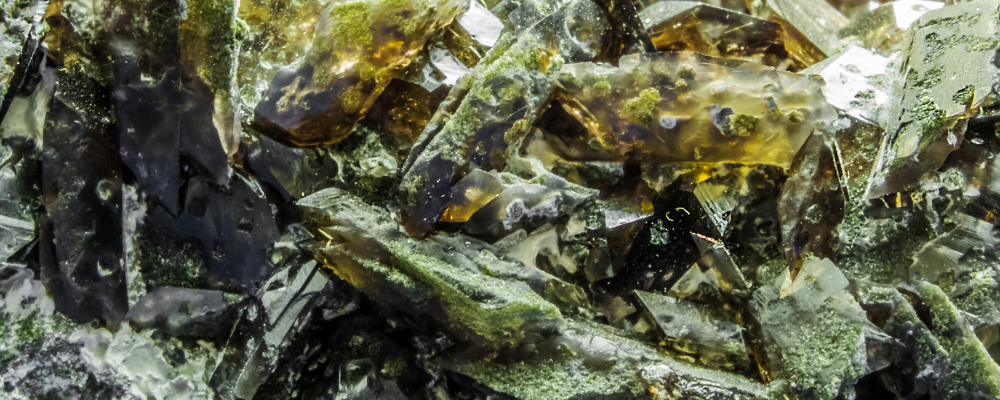
Axinite bears the shape of an axe in its name. Its flattened, oblique, and apparently sharp crystals give the stone an immediate language: separate what must be separated, give a decision a clear edge, and open a passage without yielding to brutality.
Defined by mineralogists at the end of the 18th century, it does not belong to ancient talismans under this designation. Its current esoteric use can remain faithful to its history: Mars receives the tool and the action, Saturn the limit, Mercury the precise formulation, while Earth and Fire support embodied decision-making.
To place this stone among related minerals, compare it with Euclase, Flint, and Enstatite.
A Family of Borosilicates
Axinite refers to a group of calcium aluminum borosilicates crystallized in the triclinic system. The Mindat directory of the Axinite group presents its members and the history of the name.
The crystals are brown, violet, gray, yellow, or pink, with blade- and wedge-shaped forms. Their hardness can approach 7, but their cleavage and brittle tenacity make it necessary to protect the edges.
Iron, manganese, and magnesium
The group includes Axinite-(Fe), Axinite-(Mn), Axinite-(Mg), and Tinzenite, among others. The suffix indicates the dominant element at a position in the structure; it does not describe a mere shade.
The page dedicated to Axinite-(Fe) highlights its brown tones and vitreous luster, while Axinite-(Mn) demonstrates the importance of manganese. An analysis is still necessary to identify the correct member in a stone.
The Axe Named by Haüy
René Just Haüy introduced the name Axinite in 1797, from the Greek axinē, “axe.” He observed the blade-like morphology of certain crystals, not a practical use as a tool.
This origin offers a powerful but recent magical analogy: Axinite represents the act of cutting through confusion. It does not urge one to break things off in anger; it invites you to define the line precisely before crossing it.
The symbolic axe has two functions. It cuts dead wood and opens a path. Axinite is therefore suited to separations that free a possibility, provided that the intention, words, and consequence are clearly named.
Mars, Saturn, Mercury, and Earth
Mars governs the tool, decision, and courage. Saturn sets the boundary and closes a cycle. Mercury chooses the words that make the limit understandable. Earth receives this trio and gives weight to the commitment.
Tuesday is suited to action, Saturday to closure, and Wednesday to announcements. A thread, a key, and a sheet divided in two may surround the stone.
Decision, Severance, and Boundary
Axinite accompanies the end of a habit, the separation of two responsibilities, the refusal of a request, or the choice of a path. Symbolically, it helps transform vague weariness into an actionable decision.
It is also suited to opening: removing an obstacle, clearing a priority, and giving the project a boundary that protects its energy.
The Rite of the Clear Boundary
Draw a line down the center of a sheet of paper. On the left, write what no longer belongs to you; on the right, what you are now taking responsibility for. Place the Axinite above the line without pressing on its edges.
Say: “I recognize the boundary, cut through confusion, and open the right passage.” Then state the decision to the person concerned or write its first effect in your calendar.
Correspondences and References
| Reference | Correspondence |
|---|---|
| Nature | Triclinic Borosilicate Group |
| Celestial Bodies | Mars, Saturn, and Mercury |
| Elements | Earth and Fire |
| Days | Tuesday, Saturday, and Wednesday |
| Ritual Colors | Brown, Gray, Dark Red |
| Domains | Decision, Severance, Boundary, Opening |
| Associated Objects | Thread, Key, Divided Sheet |
| Gesture | Separating What Is Ending from What Is Beginning |










