


Flint is the English name for silex, the stone of the sharp edge and the spark. Long before metal, it cut, scraped, pierced, and produced fire. Few stones connect the human hand to the act of transformation with such clarity.
Its esoteric language therefore does not arise from a color to which virtues were added. It comes from gestures repeated over millennia: striking, separating, shaping, igniting. Added to this is the history of the “thunderstones,” ancient tools found and then interpreted as the remains of a lightning strike.
To place this stone among related minerals, compare it with Gabbro, Diorite, and Pegmatite.
Flint, a silica rock
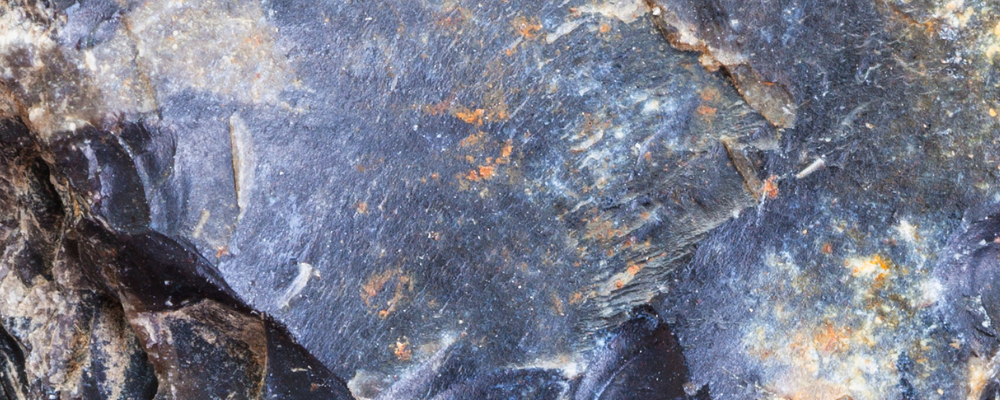
Flint is a very fine-grained rock, rich in silica, that forms in nodules or beds within certain sedimentary rocks, especially chalk. The glossary of the British Geological Survey classifies chert among the sedimentary rocks composed almost entirely of silica; Flint is a variety associated with chalk environments.
Its conchoidal fracture produces extremely sharp edges. Colors range from black to gray, brown, and blond, with a light outer crust. A rough piece may have sharp edges that must be handled like a blade.
The stone that creates a sharp edge
Shaped by percussion, Flint becomes a flake, scraper, point, or axe. It accompanied hunting, hideworking, food preparation, and construction. The British Museum project on the first inhabitants of northern Europe relies extensively on these tools to trace the earliest human presence.
When struck against certain iron-rich minerals or steel, it tears off hot particles capable of igniting prepared material. It does not contain a dormant flame: the spark is born from the impact and the right motion.
Axes that became thunderstones
After their original function was forgotten, polished axes found in the ground were interpreted as stones that had fallen with lightning. The Metropolitan Museum of Art thus presents a small Cretan axe that became a votive object and was associated in ancient Greece with Zeus’s thunderbolts.
Not all “thunderstones” are made of Flint, and not all Flint was given this name. The connection is nevertheless illuminating: an ancient buried tool could become a sign of celestial protection once its human origin was no longer understood.
Mars, Fire, and Earth
Mars governs iron, cutting, courage, and decisive action. Fire corresponds to the spark; Earth, to the nodule extracted from the ground and the tangible tool. Tuesday suits beginnings that require a clean break.
Zeus or Jupiter may be invoked when working with the thunderstone motif, keeping this current distinct from Mars and the cutting edge. A red or white candle placed at a distance is sufficient; there is no need to strike the stone.
Decision, protection, and beginning
The Flint accompanies decisions that must remove the unnecessary, open a path, or defend a boundary. It is suited to creating a tool, starting a project, abandoning a habit, and protecting thresholds.
A non-sharp piece may remain near a door. A sharp flake must be kept in a marked box. Its symbolic power comes less from display than from discipline: knowing where the edge is and choosing when to use it.
The Rite of the First Flake
On a Tuesday, draw the object, project, or boundary that must take shape. Then draw a line separating what will be kept from what will be removed. Place the Flint on the side of action.
Say: “I see the edge, I choose the cut, I begin with an act.” Without striking or shaping the stone, tear away the discarded part and carry out an irreversible but measured action that day: send the file, remove the object, announce the rule, or set aside the time.
Correspondences and references
| Reference | Correspondence |
|---|---|
| Nature | Fine siliceous rock with conchoidal fracture |
| Ancient gestures | Shaping, cutting, scraping, drilling, and producing a spark |
| Historical image | Stone tools interpreted as thunderstones |
| Planets | Mars; Jupiter for the lightning motif |
| Elements | Fire and Earth |
| Day | Tuesday |
| Areas | Decision, protection, beginning, tool, and boundary |
| Ritual gesture | Marking the cut and carrying out the first act |