














































































































































































































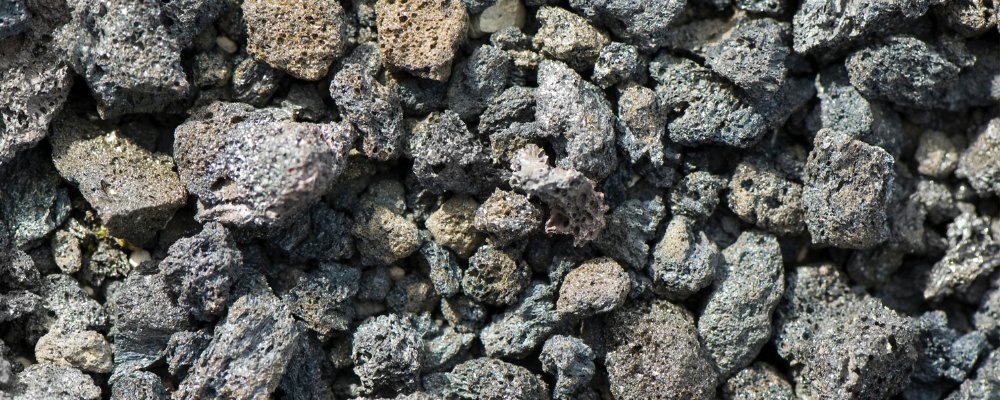
Lava Stone is fire turned into earth. Emerging as a liquid from a volcano, it cools, contracts, and preserves in its pores the traces of the gases that passed through it. Its magic unites the drive of Fire with the grounding of Earth: transform, forge, then stabilize.
It does not designate a specific mineral species. In commerce, this name generally refers to a dark, vesicular Basalt. Its most accurate ritual lineage passes through volcanic powers, Hephaestus and Vulcan, as well as the work that gives a useful form to a dangerous force.
To place this stone among related minerals, compare it with Gabbro, Diorite, and Pegmatite.
From Magma to Porous Basalt
Magma is called lava when it reaches the surface. Rapid cooling forms a fine-grained volcanic rock. The USGS volcanology glossary defines Basalt as a dark rock rich in Iron and Magnesium, containing approximately 45 to 53% Silica.
The visible holes are vesicles left by gas bubbles. Not all stones sold under the name Lava Stone come from the same volcano or the same lava flow. Their common feature remains a birth at high temperature and rapid solidification at the surface.
A Rock for Tools, Roads, and Construction
Basalt has been used to make tools, millstones, paving stones, roads, and architectural elements. Its presence connects human societies to the volcanic terrain they inhabit. The Museum of Stone Tools presents several basalt objects and reminds us that the dense rock is suitable for shaping.
This material history matters to its symbolism. Lava does not remain an image of destruction: once cooled, it becomes a support, a tool, and fertile ground after weathering.
Hephaestus, Vulcan, and Controlled Fire
In Greek religion, Hephaestus governs fire, the forge, craftspeople, and metalworking. Theoi compiles ancient sources and his attributes, including the hammer and tongs. His Roman equivalent, Vulcan, carries the fire of the forge and the danger of fires or volcanoes.
Lava Stone is therefore less suited to unrestrained fire than to power put to work. It supports breaking with an old form, the courage to enter the ordeal, and the discipline that makes rebuilding possible.
Fire opens; stone decides the form. A transformation does not end at the moment of rupture. It becomes real when the energy cools into a structure capable of lasting.
Mars, Saturn, Fire, and Earth
Mars provides impulse, cutting, courage, and heat. Saturn cools, contracts, fixes, and builds. Fire destroys the old form; Earth receives the new matter.
Tuesday is suited to ruptures, efforts, and beginning demanding work. Saturday serves consolidation, boundaries, and maintenance. Black, dark red, a symbolic hammer, a new nail, or a threshold stone extend these associations.
Courage, Rupture, and Reconstruction
To leave a habit behind, name the moment when it begins and prepare a replacement action. The Martian rupture must receive a Saturnian structure.
To rebuild after a crisis, choose what can already serve as ground: a skill, place, reliable relationship, or available resource. The stone marks this foundation.
For courage work, distinguish real danger from discomfort. Mars confronts the former when necessary; Saturn accepts the latter long enough to accomplish the task.
The Cold Forge
On a Tuesday, write on a piece of paper the form you are leaving behind. Fold it around a new nail without burning it. Place the Lava Stone on top and name the behavior that will replace the old one.
On the following Saturday, remove the nail, open the paper, and write down the first evidence of the change. Say: “The fire has opened the way; my discipline gives it form.” Keep the nail near your work tool.
Correspondences and references
| Reference | Correspondence |
|---|---|
| Nature | Dark volcanic rock, generally vesicular basalt |
| Deities | Hephaestus and Vulcan |
| Modern planets | Mars and Saturn |
| Elements | Fire and Earth |
| Days | Tuesday and Saturday |
| Areas | Courage, rupture, work, transformation, and reconstruction |
| Symbols | Forge, hammer, nail, threshold, and fresh ground |
| Ritual act | Giving lasting structure to a rupture |










