























































































































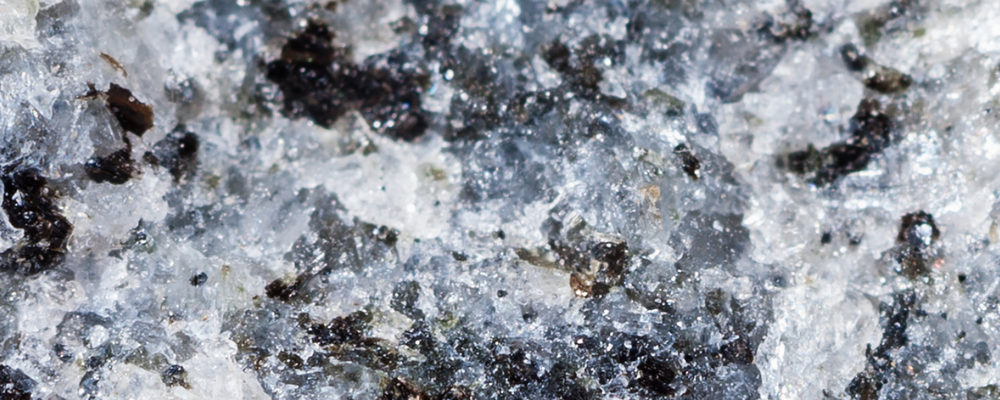
Gabbro forms far from daylight, when magma cools slowly enough for its crystals to become visible. Black, gray, white, or greenish, it brings together several minerals in a compact architecture. Its symbolic strength comes from this underground time: preparing for a long while what will one day bear weight.
This rock has no ancient magic attached to its modern name. Yet it offers a powerful and faithful language rooted in its formation: Saturn for time and structure, Mars for its iron-rich matter, Earth for grounding, and Fire for magma turned to stone.
To place this stone among related minerals, compare it with Diorite, Pegmatite, and Lava.
A rock born beneath the surface
Gabbro is a coarse-grained intrusive igneous rock. It crystallizes in underground masses where slow cooling gives the minerals time to form an assemblage visible to the naked eye.
The British Geological Survey classification diagram places it among mafic intrusive rocks. It is therefore not a homogeneous mineral, but a crystalline community.
An assemblage of crystals
Calcium-rich Plagioclase and Pyroxene make up most of Gabbro; Olivine, Amphibole, Magnetite, Ilmenite, or Biotite may also be present. The light and dark portions vary from one rock to another, creating speckled or cloudy patterns.
The MineralsUK glossary confirms this composition. Each piece thus offers its own balance among several materials, which supports its symbolic use in group workings.
Basalt’s slow-formed brother
Gabbro and Basalt can have similar compositions. Basalt cools quickly at the surface or on the ocean floor and has very fine grains; Gabbro forms underground and has larger crystals.
The BGS geological glossary describes it as the coarse-grained equivalent of Basalt and Dolerite, formed through very slow cooling in large intrusions.
Gabbro’s symbolism comes from hidden time. Where Basalt expresses eruption and the rapid transition from fire to stone, Gabbro represents maturation, assembly, and power prepared out of sight.
Saturn, Mars, Earth, and Fire
Saturn corresponds to duration, labor, and foundations. Mars relates to dark minerals, iron, and the energy of magma. Earth receives the completed rock; Fire preserves its original memory.
Saturday suits structures and long-term projects; Tuesday suits taking action. A square of dry earth, an iron nail, and a dark red candle can accompany the stone.
Foundation, patience, and cohesion
Gabbro accompanies projects that require lengthy preparation, team building, a return to discipline, and the consolidation of a place. It reminds us that visible work rests on stages that no one applauds.
For a group, each grain can represent a distinct function. Cohesion does not come from resemblance, but from the place each person holds within the same structure.
The Rite of the Underground Work
Write down a result you wish to make visible in three months. Beneath this sentence, note three discreet tasks that must mature before the announcement. Place the Gabbro at the bottom of the sheet like a foundation stone.
Say: “I give time to matter, a place to each force, and a foundation to the work ahead.” Schedule the first task in your calendar, then keep the project out of sight until that step is complete.
Correspondences and references
| Reference | Correspondence |
|---|---|
| Nature | Mafic intrusive igneous rock |
| Celestial bodies | Saturn and Mars |
| Elements | Earth and Fire |
| Days | Saturday and Tuesday |
| Ritual colors | Black, gray, dark red |
| Areas | Foundation, patience, team, preparation |
| Associated objects | Dry earth, nail, calendar |
| Gesture | Plan three tasks before revealing the result |