















































































































































































































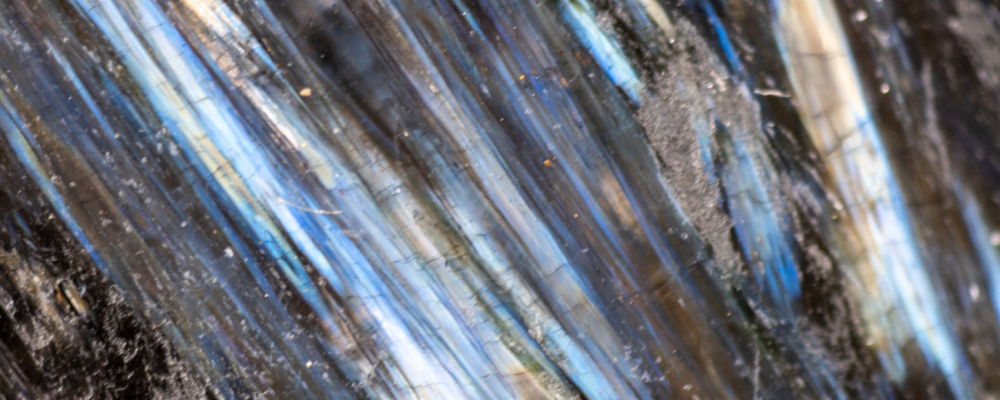
Nuummite appears black until movement reveals flashes of gold, copper, or blue. This Greenlandic rock formed more than 2.7 billion years ago, but its commercial name dates from the 1980s. Its magic is therefore recent: protection, self-mastery, memory of time, and discovering what had remained hidden.
Saturnine black sets the boundary; solar flashes reveal the strength kept beneath the surface. Nuummite is suited to workings in which one must look at a fear, an intention, or personal power without surrendering control to it.
To place this stone among related minerals, compare it with Gabbro, Diorite, and Pegmatite.
A black rock with iridescent flashes
Nuummite is not a mineral species but a metamorphic rock composed mainly of amphiboles, particularly Anthophyllite and Gedrite. Their fine lamellae produce golden, coppery, green, or blue reflections as the stone turns in the light.
The Gemmological Association of Great Britain explains the origin of this iridescence. Its hardness varies around 5.5 to 6, and the quality of the polish determines how visible the flashes are.
Three billion years near Nuuk
The rock comes from the Nuuk region in southwestern Greenland. It formed at the end of the Archean and then underwent several metamorphic episodes. Its age exceeds 2.7 billion years.
The name Nuummite means that it comes from Nuuk. Mindat lists its localities in the region's amphibolites. The material has been known in the trade since 1983, as recalled by the International Gemmological Conference. Its great geological age should therefore not be confused with the antiquity of its occult uses.
A magic born in the late 20th century
Nuummite does not appear in ancient lapidaries or occult encyclopedias from before its commercial distribution. The themes of protection, personal power, ancient memory, and working with hidden aspects developed in the late 20th century.
They come from signs that can be read in the stone: a black mass, immense age, and a light that appears only from the right angle. This contemporary system can be rich without turning an Archean rock into an immemorial talisman.
What is hidden is not absent. Nuummite appears dark when the light remains fixed. A slight movement brings out the gold. It invites you to shift your perspective before concluding that a strength, a solution, or a truth has disappeared.
Saturn, the Sun, and Earth
Saturn governs black, time, boundaries, and mastery. The Sun corresponds to golden flashes, inner authority, and what becomes visible. Earth carries the rock’s antiquity, stability, and return to matter.
Saturday is suitable for protection, memory, and closing a cycle. Sunday reveals a strength one wishes to embrace. Black, gold, a closed box, and a dark mirror make up its altar.
Protection, memory, and mastery
For protection, place the Nuummite in a box near the entrance. Write down what must no longer cross the threshold and the attitude through which you will enforce this boundary.
To work with a fear, hold the stone under moving light. Name the part that protects you and the part that confines you. Keep the first function, then choose an action that reduces the second.
For memory, place it near an old object. Write down what the experience taught you and what it should no longer decide for you. Saturn preserves the lesson without freezing the future.
The glow kept in the night
On a Saturday evening, place the Nuummite in an open black box. Illuminate it with a single candle held at a distance, and gently turn the box until a reflection appears.
Say: “I recognize the hidden strength and give it a proper boundary.” Write down the quality revealed, close the box, then use this quality in an action before the next Saturday.
Correspondences and references
| Reference | Correspondence |
|---|---|
| Nature | Metamorphic rock with anthophyllite and gedrite |
| Origin | Nuuk region, Greenland |
| Age | More than 2.7 billion years |
| Modern planets | Saturn and the Sun |
| Element | Earth |
| Days | Saturday and Sunday |
| Areas | Protection, memory, mastery, revelation, and boundaries |
| Ritual act | Bringing out the shine under moving light |










