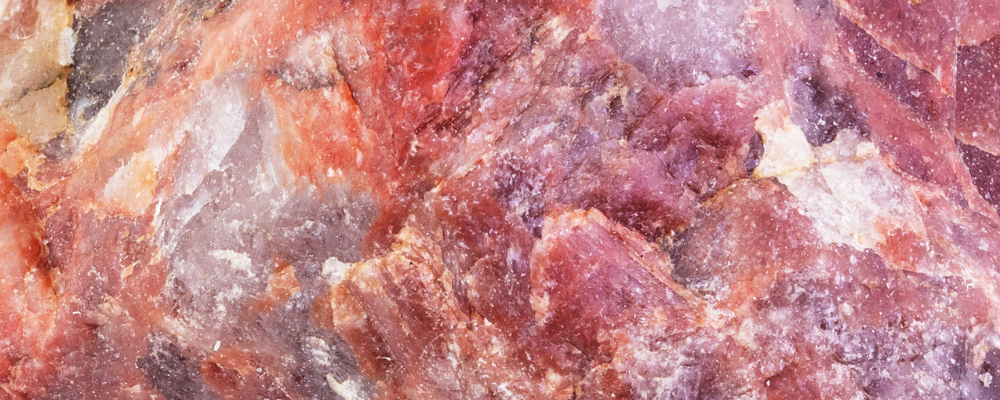
Pegmatite is a home for large crystals. Quartz, Feldspar, and Mica share space there with Tourmaline, Beryl, Spodumene, or other minerals concentrated during the final stages of a magma. It speaks of gathered resources, maturation, and giving form to what remained in reserve.
This rock has no uniform ancient correspondence, because its composition changes from one specimen to another. Its contemporary magic therefore follows two lines: Jupiter for the expansion and abundance of forms, Saturn for the final stage that concentrates, orders, and carries a process through to completion.
To place this stone among related minerals, compare it with Feldspar, Albite, and Labradorite.
The rock of oversized crystals
Pegmatite is an igneous rock with very coarse grains. Most Pegmatites have a granitic composition, with Quartz, Feldspars, and Micas, but the name primarily describes a texture. Each piece forms an assemblage whose constituents must be considered separately.
This plurality gives it its ritual strength. Pegmatite does not represent an isolated virtue: it connects several materials born during the same episode. It suits projects that require different skills, people, or resources gathered around a single work.
What the magma kept in reserve
The United States Geological Survey presents Pegmatite formation as the separation of a residual magmatic liquid or the partial melting of the crust. Water and certain elements become concentrated in this remaining material before it crystallizes.
The final residue is therefore not waste. It may contain what the earlier phases did not receive: lithium, beryllium, boron, cesium, or tantalum. Symbolically, Pegmatite reveals the value of a reserve once thought secondary.
Jupiter and the expansion of forms
Giant crystals do not result solely from slow cooling. A study in the Journal of Petrology links their growth to water in the system, undercooling, and the small number of nuclei capable of rapidly capturing the available material.
Jupiter corresponds to expansion, scale, and resources becoming visible. Pegmatite can thus hold a project whose reach one wishes to develop, provided that this growth has structure.
The rock determines the final correspondence. A Tourmaline-, Mica-, or Quartz-rich Pegmatite adds the distinctive language of those minerals. Jupiter and Saturn describe the shared texture and process here, not each component.
Saturn, Earth, and contained Fire
Saturn governs concentration, limitation, and completion. It transforms the reserve into structure and prevents Jupiterian expansion from becoming scattered. Earth supports the completed rock; Fire recalls its igneous origin without calling for the use of a flame on the specimen.
Thursday supports expansion and the search for means. Saturday suits inventory, selection, and closure. A rock matrix, a resource box, and a work plan constitute its ritual objects.
Resources, maturation, and collective work
Place the Pegmatite near a project’s resources: budget, tools, contacts, and available time. Look less for what is missing than for what remains unused. The stone helps you see scattered reserves as parts of the same structure.
It is also suitable for the end of a creative cycle. When several ideas are waiting, choose the one that can receive the others without confusing them. A completed work requires a form broad enough to accommodate them, followed by a boundary that stops further additions.
In a group, each visible crystal can represent a function. The rite emphasizes the cooperation of differences: the matrix holds everything together without making the parts identical.
The inventory of the last remainder
On a Thursday, gather the remaining means for a project on a sheet of paper. Write down their actual quantity, availability, and the use they can still receive. Place the Pegmatite at the center, then choose a neglected resource.
On the following Saturday, turn this resource into a result: a completed page, an appointment scheduled, a sum allocated, or an object built. Say: “What remained finds its proper form.” Then put away the plan with the intended completion date.
Correspondences and reference points
| Reference point | Correspondence |
|---|---|
| Nature | Igneous rock with very coarse grains |
| Common constituents | Quartz, feldspars, and micas |
| Suggested planets | Jupiter for expansion; Saturn for concentration |
| Suggested elements | Earth and contained Fire |
| Days | Thursday and Saturday |
| Domains | Resources, maturation, growth, cooperation, and completion |
| Ritual image | The final liquid that nourishes large crystals |
| Ritual act | Taking stock of a reserve and giving it a finished form |