















































































































































































































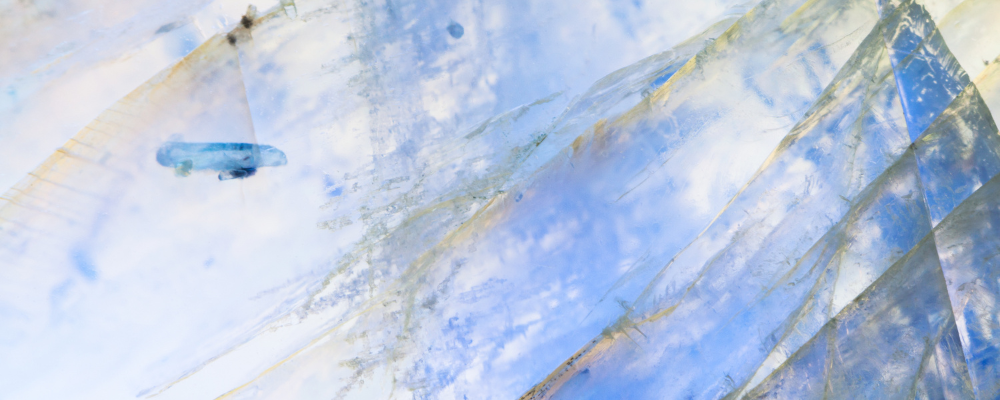
Stone of cycles, travel, and lunar vision, Moonstone accompanies transitions that call for listening before acting. Its light seems to move beneath the surface like the Moon among the clouds. Lapidaries have linked it to divination, love during the waxing Moon, protection on the water, and hope.
Moonstone is a Feldspar with adularescence, not a crystal filled with moonlight. This real explanation does not erase its magical history: Pliny reports a stone whose image followed the phases of the Moon, Leonardus attributes prophecy to it, and Kozminsky places it under Cancer. Cunningham extends this lineage in 1988.
To place this stone among related minerals, compare it with Feldspar, Sunstone, and Albite.
The light gliding beneath the Feldspar
Moonstone belongs to the Feldspars. Its adularescence comes from fine internal layers that scatter light and produce a shifting glow, white or bluish. The material may be Orthoclase or an association of Feldspars, depending on the specimens.
The GIA explains this optical effect and distinguishes Moonstone from white Labradorite marketed under similar names. Its hardness of 6 to 6.5 and cleavage make it important to avoid impacts.
An image that grows with the Moon
Pliny describes a stone bearing the image of the Moon, whose radiance would increase or decrease with the celestial body. Ancient identifications remain difficult, but the relationship between moving light and the lunar phases is ancient.
In the 16th century, Leonardus attributes to Moonstone the ability to prophesy under the waning Moon and promote love under the waxing Moon. The cycle thus becomes a working rule: receive and discern when the light wanes, attract and unite when it waxes.
Cancer, Gabriel, and guidance
In his 1922 treatise, Kozminsky calls the stone Chandra Kanta, reports Indian accounts of absorbed moonlight, and places it under Cancer. He associates it with hope, guidance, travel, and protection at sea.
It describes a divination under the waning Moon addressed to Gabriel. The ancient practice involved placing the stone in the mouth; this is not necessary. Hold it in front of you and recite the prayer: the structure of the rite remains intact without the risk of ingestion.
The phase gives the ritual its direction. The waxing Moon supports love, welcome, and building. The waning Moon is suited to vision, sorting, and withdrawal. The full Moon marks fulfillment; the new Moon opens a cycle.
Love, sleep, and protection for travelers
Scott Cunningham places Moonstone under the Moon and Water. He uses it for love, divination, sleep, protection, and travel. He proposes exchanging two stones between partners in conflict.
The stone can be kept with a Tarot deck, runes, or a dream journal. In a couple, it accompanies a consensual reconciliation. While traveling, offer it a prayer for a safe journey, especially for crossings over water.
Working with the four lunar phases
At the new Moon, entrust it with a beginning. During the waxing phase, place it on what should be nurtured. At the full Moon, give thanks for what has taken shape. During the waning phase, withdraw commitments that have become unnecessary.
This rhythm provides a simple method and prevents assigning every use to the stone at the same time. A Moonstone can follow a single cycle with a single intention, then be released before the next working.
The question under the waning Moon
Three nights after the full Moon, write a question about the path to leave, correct, or keep. Place the Moonstone on the paper, near a white candle, then say a prayer to Gabriel or to the lunar power of your tradition.
Remain silent for nine minutes and note the images or words that arise. Then cover the stone. The next day, reread your notes and compare the response with the facts before deciding. Close the ritual before the new Moon.
Correspondences and references
| Reference | Correspondence |
|---|---|
| Nature | Feldspar with adularescence |
| Planet | Moon |
| Sign | Cancer according to Isidore Kozminsky |
| Element | Water |
| Day | Monday |
| Areas | Cycles, divination, love, sleep, travel, hope, and protection |
| Angel | Gabriel in the ritual reported by Kozminsky |
| Ritual gesture | Match a single intention to the lunar phase |










