























































































































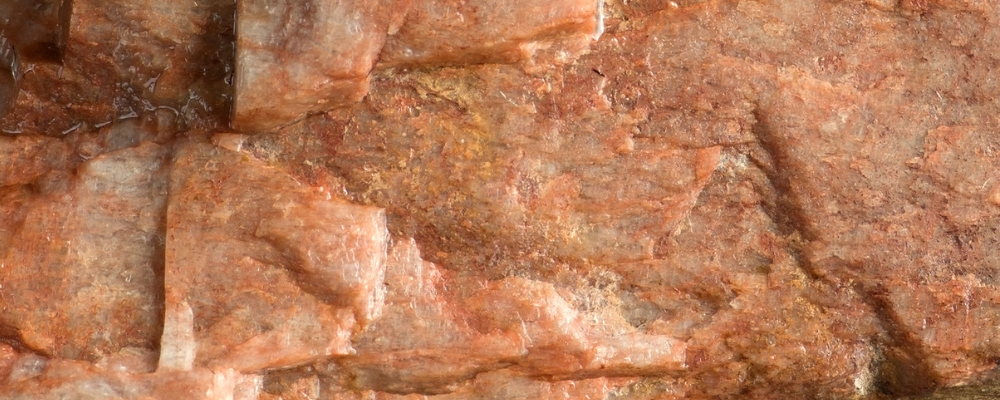
Feldspar is not a single stone, but a vast family that builds a large part of the rocks in the Earth's crust. Beneath its white, pink, gray, or green hues lies a common architecture, capable of producing Labradorite, Moonstone, Amazonite, and several Sunstones.
This kinship gives Feldspar a rich esoteric language: the house that contains different characteristics, the structure that remains while its members change, the ground from which new forms arise. The Moon corresponds to cycles and family; Saturn to the framework; Earth and Water to formation and then alteration.
To place this stone among related minerals, compare it with Albite, Labradorite, and Moonstone.
A family that builds rocks
Feldspars are aluminum silicates associated with potassium, sodium, or calcium. Very abundant in the Earth's crust, they are part of granite, gabbro, and many igneous or metamorphic rocks.
The Mindat page dedicated to the Feldspar group presents its major members. Their hardness is around 6, and their two cleavage directions create a solid material, but one that is not impervious to impacts.
Alkalis and plagioclases
The family has two major branches. Alkali feldspars include Orthoclase, Microcline, and Sanidine, in the realm of potassium and sodium. Plagioclases range from sodium-rich Albite to calcium-rich Anorthite.
The University of Minnesota explains this series and its characteristic striations. Saying “Feldspar” therefore amounts to naming a house; more precise identification indicates the branch and the member.
Moon, sun, and colors
Certain Feldspars produce remarkable optical phenomena. Moonstone shows a floating glow; Labradorite displays shifting colors; Sunstone sparkles thanks to its inclusions; Amazonite offers a soothing blue-green.
The Encyclopaedia Britannica describes the group in terms of rocks and chemical series. Each variety has its own history, but generic Feldspar retains a broader meaning: kinship, structure, and transformation.
Feldspar can be understood as a family of forms. This modern symbolism does not attribute the particular properties of Labradorite or Moonstone to every piece. It works with the shared architecture that allows differences to hold together.
Moon, Saturn, Earth, and Water
The Moon governs the home, transmission, family memory, and cycles. Saturn builds the framework and lasting rules. Earth forms the rock; Water slowly alters it and contributes to the formation of clays and soils.
Monday suits the home and relationships; Saturday suits foundations and boundaries. A key, a square of fabric, and an empty bowl may surround the stone.
Home, foundation, and transmission
Feldspar accompanies a move, the creation of a home, the clarification of roles within a family, or the establishment of a work structure. Symbolically, it helps distinguish what supports from what confines.
It is also suitable for transmissions: a recipe, a rule, a story, or a gesture that one wishes to preserve while allowing the next generation to give it its own form.
The Rite of the Four Foundations
Draw a square and write in its corners: place, resources, rules, connections. For each word, note an action that strengthens your project. Place the Feldspar in the center.
Say: “I build a form that supports life and lets each part find its place.” Choose the simplest action and carry it out before the next phase of the Moon.
Correspondences and references
| Reference | Correspondence |
|---|---|
| Nature | Very abundant group of silicates |
| Celestial bodies | Moon and Saturn |
| Elements | Earth and Water |
| Days | Monday and Saturday |
| Ritual colors | White, gray, pink, brown |
| Areas | Home, structure, kinship, transmission |
| Associated objects | Key, square, bowl |
| Gesture | Name four foundations, then strengthen one |