















































































































































































































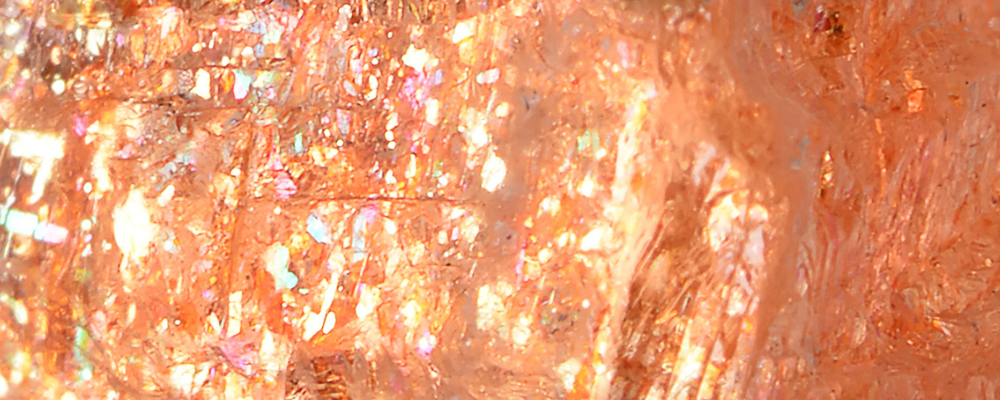
Sunstone is aptly named: at the slightest movement, coppery or golden sparks pass through its substance. In modern Western magic, this brilliance belongs to the Sun, protection, vitality, desire, and visible success.
It accompanies moments when one must step out of reserve, present one’s work, or rekindle a weakened will. Its teaching lies in its play of light: the strength already exists, but it needs the right angle to appear.
To place this stone among related minerals, compare it with Feldspar, Moonstone, and Albite.
The feldspar that catches the light
Sunstone belongs to the feldspar family. The name may refer to Orthoclase, Oligoclase, or Labradorite whose inclusions reflect light. Its colors range from pale yellow to red, green, or coppery brown.
The Gemological Institute of America describes a hardness ranging from 6 to 7.2, depending on the feldspar. Oregon material owes some of its colors and brilliance to fine copper platelets; other sources contain Hematite inclusions.
Aventurescence, a fire within the stone
The glitter is known as aventurescence. Flat inclusions suddenly reflect light when the stone reaches a favorable angle. The flashes may form a fine dust, a metallic sheen, or sharply defined points of fire.
A study by Gems & Gemology shows how the orientation and arrangement of copper alter visible effects. This light, which appears through movement, naturally nourishes rites of revelation, confidence, and presence.
The Renaissance solar reception
In his encyclopedia published in 1988, Scott Cunningham revisits a resurgent association between sparkling orange feldspar and the Sun. The stone was set in gold to call solar influence to its wearer.
Cunningham attributes protection, energy, and the vigor of desire to it. The occult history of this name is more recent than that of Ruby or Amber, but it has a strong coherence: warm color, shifting reflection, solar metal, and light made visible.
Light demands action. Sunstone does not shine the same way from every angle. It becomes the witness to a quality one stops hiding: talent, desire, authority, beauty, or completed work.
Sun, Fire, and Gold
The Sun governs radiance, reputation, confidence, and decisiveness. Fire provides the impetus that transforms an intention into action. Gold, the associated metal, anchors dignity and success.
Sunday is suitable for its consecration. A yellow, orange, or golden candle extends its symbolism. For desire workings, Friday may be chosen to unite solar ardor with Venus’s gentleness.
Protection, energy, desire, and success
To protect a place, set the stone in front of a white candle and name what should remain alive in the home: joy, courage, hospitality, or trust. Solar protection illuminates as much as it repels.
For success, place it on a completed project, a file, or a creation before presenting it. Ask less for fame than for the right visibility: to be seen by those capable of recognizing the value of the work.
For desire, wear it during a date or place it near a red candle. Consecrate it to a confident presence, without trying to force a particular person’s attraction.
The Rite of Rediscovered Radiance
On a Sunday morning, place the Sunstone in front of a golden candle. Write down a quality you already use and the situation in which it deserves to shine. Slowly turn the stone until you see its radiance.
Say: “What lives within me receives its light. I appear without a mask and act without pride.” Place the stone on the paper, then perform an act of visibility that same day: send, present, propose, or speak up.
Correspondences and references
| Reference | Correspondence |
|---|---|
| Nature | Aventurescent feldspar |
| Hardness | Approximately 6 to 7.2 on the Mohs scale |
| Planet | Sun according to Scott Cunningham |
| Element | Fire |
| Metal | Gold |
| Day | Sunday |
| Areas | Protection, vitality, desire, confidence, visibility, and success |
| Ritual act | Find the radiance, name the quality, then show it |










