















































































































































































































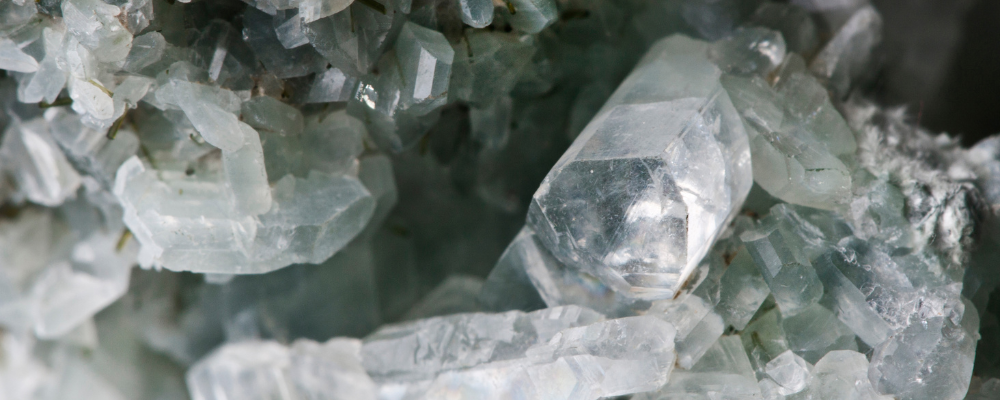
Albite offers a whiteness touched with pearlescence, gray, or bluish reflections. Its clean planes catch the light like overlapping pages, ready to receive a new order.
This appearance suits it well: Albite is the sodium pole of the large Plagioclase family. In symbolic work, it becomes a stone of clarification, starting afresh, and beginning in writing with precision.
To place this stone among related minerals, compare it with Feldspar, Labradorite, and Moonstone.
The white pole of the Plagioclases
Albite is a sodium Feldspar with the formula NaAlSi3O8. It is one of the two poles of the Plagioclase series, the other being calcium-rich Anorthite. It occurs in granites, pegmatites, and several metamorphic rocks.
The Mindat entry presents its characteristics and numerous localities. The RRUFF database provides access to spectroscopic data useful for its identification.
A name given in 1815
Johan Gottlieb Gahn and Jöns Jacob Berzelius named Albite in 1815 after the Latin albus, “white,” referring to its usual color. The mineral page on Webmineral preserves this historical reference.
The mineral was present in rocks long before receiving this name, but no ancient stone called Albite can be identified with certainty in lapidaries. Its specific magical correspondence therefore belongs to a modern construction.
The blank page and the clear plan
Albite’s whiteness evokes a sheet cleared of erasures. Its clean cleavage adds the image of classification, separation of layers, and an order that can be reread.
The blank page is not emptiness: it is space made available. Albite accompanies the moment when old instructions, dead tasks, and confusing wording are removed to establish a clearer framework.
Moon, Mercury, Air, and Water
The Moon suits whiteness, receptivity, and the renewal of cycles. Mercury governs sorting, language, and methods. Air clarifies ideas; Water softens what needs to be reorganized.
Monday supports personal new beginnings, while Wednesday suits files and studies. A blank sheet, a gray pencil, and an empty bowl create an altar attuned to the stone.
Clarify, sort, start again
Albite supports sorting a space, redesigning a schedule, beginning a course of study, and revising a text that has become confusing. It invites you to distinguish what should remain, what should change place, and what can be removed.
Placed near a planner, it serves as a witness to a streamlined organization. It is also suitable for transitions where the full path is not yet known: simply make the next action clear.
The blank-sheet ritual
On a Monday, take a blank sheet and write only three headings: keep, move, remove. Sort the elements of the project or situation under each one. Place the Albite above the page.
Say: “I make the space clear and begin with what can be named.” Immediately perform one action from each category, even if very briefly, then date the sheet.
Correspondences and references
| Reference | Correspondence |
|---|---|
| Nature | Sodium feldspar, plagioclase endmember |
| Name | From the Latin albus, “white,” 1815 |
| Celestial bodies | Moon and Mercury |
| Elements | Air and Water |
| Days | Monday and Wednesday |
| Ritual colors | White, gray, silver |
| Areas | Sorting, method, resumption, new beginning |
| Ritual action | Sort into keep, move, and remove |










