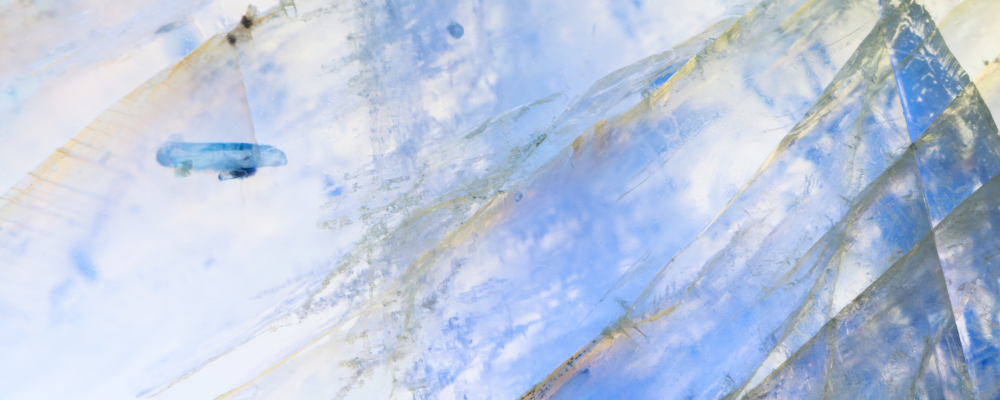
Adularia seems to keep a veil of moonlight beneath its surface. When the stone moves, a white or bluish glow glides through its mass and then disappears, as if the light were hesitating between presence and withdrawal.
This phenomenon has shaped its lunar identity, but precision remains necessary: not every Adularia is a Moonstone, and not every Moonstone is Adularia. The mineralogical name, the commercial name, and the magical correspondence meet without becoming identical.
To place this stone among related minerals, compare it with Feldspar, Albite, and Labradorite.
A Feldspar with shifting light
Adularia is a variety of Orthoclase, a mineral in the potassium feldspar group. It forms white, colorless, or slightly tinted crystals. Some specimens display adularescence: a diffuse clarity seems to float beneath the surface when the viewing angle changes.
This play of light comes from the internal structure and the interaction between feldspar domains. The Gemological Institute of America explains this phenomenon in Moonstones, while its work on optical-effect gemstones places adularescence among the interactions between light, inclusions, and structure.
From the Alps to the name Adularia
The mineralogist Ermenegildo Pini named Adularia in 1780 after the Adula massif in the Alps. The Mindat entry recalls this origin and its occurrence in Alpine fissures.
The term “Moonstone” is broader: it can refer to several white feldspars showing a blue or silvery sheen. Adularia without adularescence remains Adularia; a commercial Moonstone may belong to another feldspar species.
Moonlight without a false past
The name Adularia dates to the late 18th century. Ancient texts devoted to moonstones therefore cannot automatically identify this mineral. Its magical connection with the Moon is based mainly on its shifting luster, its whiteness, and its modern association with Moonstone.
Adularia does not contain a captured moonbeam. It offers an accurate image of the cycle: the light appears, withdraws, and returns when the position changes. Its teaching is less about prediction than about rhythm and attention to the right moment.
Moon, Water, Monday, and silver
The Moon governs cycles, memory, receptivity, and transitions. Water expresses the mobility of reflection and the capacity for receptivity; a touch of Air suits dreams, images, and inner speech. Monday is its day, silver its metallic color, and the number nine can mark the completion of a cycle.
A white candle, a covered mirror, a bowl of water placed at a distance, or a calendar creates a simple altar. Keep the stone dry: the water serves as a ritual symbol, not as a charging bath.
Cycles, listening, and the right moment
Moonstone accompanies transitions, periods of waiting, decisions requiring good timing, and dream-related practices. It helps distinguish what should be started, maintained, slowed, or brought to a close.
Near a notebook, it supports regular observation of moods and events. On a family altar, it can represent memory changing form without disappearing. It does not demand following every lunar phase: the chosen rhythm should remain suited to real life.
The lunar calendar ritual
On a Monday, write four words on a sheet of paper: birth, growth, fulfillment, and withdrawal. Under each one, place an aspect of the project that corresponds to that phase. Place the Moonstone in the center.
Tilt it until you see its reflection, then say: “I recognize the time for everything and act at the moment that suits it.” Choose a single phase and date the associated action. Return to the sheet after seven or twenty-nine days, depending on the scale of the project.
Correspondences and references
| Reference | Correspondence |
|---|---|
| Nature | Orthoclase variety, feldspar group |
| Name | Adula Massif, 1780 |
| Phenomenon | White or bluish adularescence on some specimens |
| Celestial body | Moon |
| Elements | Water and Air |
| Day | Monday |
| Domains | Cycles, memory, dreams, transition, and timing |
| Ritual gesture | Naming the phase, then dating the right action |