























































































































Brushite forms when phosphate-rich waters encounter calcium under precise conditions. Clear, pale, and filled with water, it offers an image of the threshold: change becomes possible when the environment finally brings together the necessary elements.
Its ritual language is contemporary. The Moon governs water, maturation, and the passage from one state to another; Saturn establishes the condition, limit, and timing. Water provides the solution, while Earth provides the support. Brushite accompanies decisions that require less force than precision.
To place this stone among related minerals, compare it with Ocean Jasper, Brazilianite, and Adularia.
A clear crystal filled with water
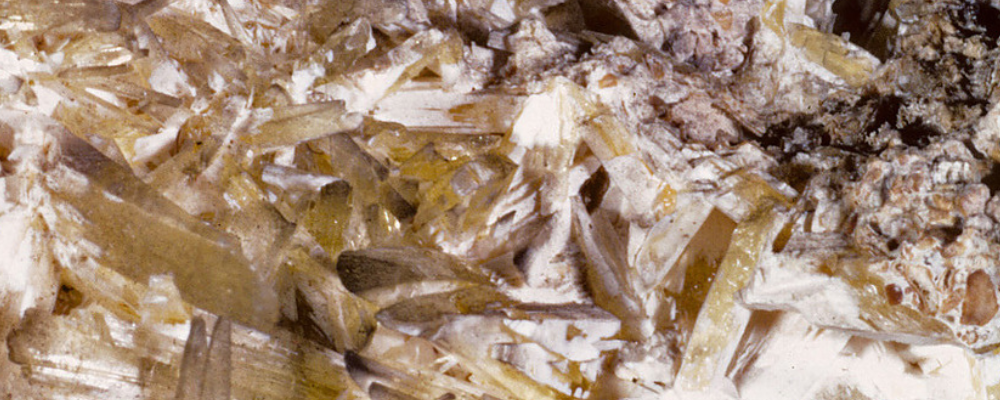
Brushite is a hydrated calcium phosphate. It forms small blades, needles, tables, or powdery masses in colorless, ivory, or pale yellow shades. The Handbook of Mineralogy describes its composition, cleavage, and formation environments.
Its structure contains water, but the mineral remains soft and sensitive. This restraint gives it its first correspondence: keeping a possibility in reserve until the place and time allow it to crystallize.
Caves, phosphates, and the formation threshold
Brushite is among the minerals found in caves. It can form when an acidic, phosphate-rich solution reacts with Calcite or clay. It is also found in phosphorites and other environments where calcium, phosphate, and water come together.
The cave provides an apt image: a protected space, slow circulation, and a transformation that remains invisible until the crystal appears. Brushite is therefore suited to projects that require a preparation phase before any exposure.
George Jarvis Brush and the mineral name
The stone honors George Jarvis Brush, an American mineralogist born in 1831 and a professor at Yale University. His name connects Brushite with the work of description and classification in the 19th century.
This origin reinforces its function as a reasoned threshold. Before opening a stage, it is necessary to define what will make it recognizable. A date, a resource, an agreement, or information can constitute the condition that transforms waiting into a beginning.
Moon, Saturn, Water and Earth
The Moon corresponds to structural water, gestation, and changes of phase. Saturn corresponds to the framework that makes passage possible, patience, and the criterion that brings waiting to an end. These modern attributions follow the stone’s formation and fragility.
Water dissolves and transports; Earth receives and fixes. Monday is suited to listening and preparation. Saturday serves to determine the limit, delay, or condition that will authorize the next movement.
Threshold, condition, and favorable moment
Brushite supports an application, a move, returning to study, or a change of role. It helps distinguish the desire to move forward from the actual condition for passage. Placed near a calendar, it represents a prepared beginning rather than an impulsive departure.
It is also useful when waiting becomes unclear. Write down what depends on you, what depends on a third party, and what depends on time. The stone marks the point where these three lines meet. As soon as the defined condition appears, action must follow.
The Ritual of the Necessary Condition
On a Monday, draw a door on a sheet of paper. On the left, write the current situation; on the right, the desired step. On the threshold, write a clear and verifiable condition. Place the Brushite on this sentence and leave the sheet in place until Saturday.
On Saturday, set a date for reassessment. If the condition has been met, cross the threshold through action. If it has not, modify the means without erasing the criterion. The ritual teaches that patience retains its value when it has a measure.
Correspondences and reference points
| Domain | Correspondence | Reading |
|---|---|---|
| Planets | Moon and Saturn | Maturation, condition, delay, and passage. |
| Elements | Water and Earth | Solution, transport, support, and fixation. |
| Days | Monday and Saturday | Prepare the change; set the criterion. |
| Colors | Colorless, ivory, pale yellow | Reserve, clarity, and discreet beginning. |
| Figures | Door, threshold, drop | Passage, condition, and crystallization. |
| Verbs | Prepare, wait, cross | The talismanic method of Brushite. |
Brushite represents the moment when waiting receives a rule. It brings together the water that prepares, the earth that fixes, and the threshold that transforms a possibility into an act.