















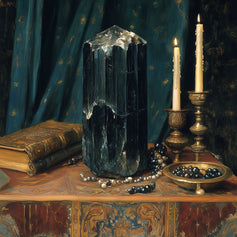
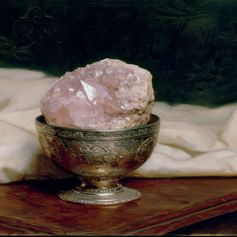
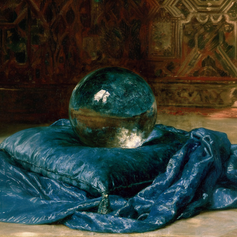






























































































































Selenite is a lunar stone of clarity, peace, and passage. Its light does not burst forth like a flame: it passes through the sheets of gypsum, diffuses, and transforms a wall into a window. This movement gives it a fitting place in rites of reconciliation, consecration, and the closing of cycles.
Its name evokes Selene, the Greek Moon. Its material history also leads to lapis specularis, the transparent gypsum that the Romans used to let in light while maintaining a separation between inside and outside.
To place this stone among related minerals, compare it with Gypsum, Alabaster, and Desert Rose.
The Gypsum Named for the Moon
Selenite is a crystalline variety of gypsum, a hydrated calcium sulfate. Its hardness of 2 means it can be scratched with a fingernail. The fibers, blades, or sheets transmit light and produce a white, satin, or milky sheen.
The Handbook of Mineralogy describes this material as rich in structural water. This composition explains part of its symbolic affinity with the Moon and Water, while also requiring dry storage.
Selene, Cycles, and Received Light
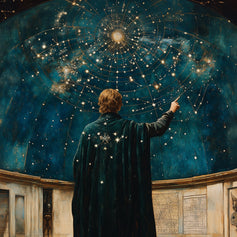
The name Selenite comes from Selene, the Greek personification of the Moon. Like the nocturnal star, the stone receives light and makes it visible in a softened form. It therefore governs less the brilliance of assertion than perception, memory, listening, and the regular return of the phases.
A Selenite can mark a new moon, a full moon, the beginning of a vigil, or the end of a task. Placed beside a notebook, it gives a focal point to nighttime observations. Set on the edge of an altar, it draws a calm boundary between the consecrated space and the rest of the room.
The Romans’ lapis specularis
In Book 36 of his Natural History, Pliny the Elder describes the extraction of lapis specularis, a transparent stone cut into sheets. In the Roman world, these sheets of gypsum closed off windows and let in light before the spread of window glass.
Research dedicated to the lapis specularis Roman mines sheds light on this function. The ritual image is powerful: filtering without obscuring, protecting without blocking passage, seeing the outside without abandoning the boundary.
Moon, Water, and Reconciliation
In his 1988 encyclopedia, Scott Cunningham associates Selenite with the Moon and Water. He also proposes exchanging two pieces between people seeking reconciliation.
This gesture becomes operative when it accompanies clear speech. Each person receives a stone as a witness to a commitment: listening, acknowledging wrongdoing, repairing what can be repaired, or respecting a distance that has become necessary. Moonlight does not force agreement; it makes the conditions for peace visible.
Clarity, threshold, and consecration
Selenite is suitable for bedrooms, prayer spaces, study areas, and lunar altars. It supports requests for peace, delicate discussions, the examination of a dream, the closing of a period, and the consecration of an object through voice or light.
To purify another stone, place the two objects side by side and perform a defined gesture: a prayer, the sound of a bell, a psalm, or exposure to indirect moonlight. Selenite then serves as a threshold and witness to the operation, like a window that keeps the passage open without removing the frame.
The Rite of the Lunar Window
On a Monday evening, place two Selenites parallel to each other on either side of a sheet of paper. Between them, write what you want to see more clearly. Beneath this sentence, note what must remain outside and what may enter your space.
Light a white candle at a distance and watch its light reflect on the stones. Say: “I let through what brings light. I keep the boundary that protects.” Fold the paper toward you for a request for welcome, or away from you for a closing, then remove it at the next lunar cycle.
Correspondences and references
| Reference | Correspondence |
|---|---|
| Nature | Crystallized gypsum, soft and sensitive to water |
| Name | Selene, the Greek personification of the Moon |
| Historical image | Roman window made of lapis specularis |
| Planet | Moon |
| Element | Water |
| Day | Monday |
| Uses | Clarity, peace, reconciliation, cycles, threshold, and consecration |
| Symbols | Crescent, window, pale mirror, and door |
| Ritual gesture | Filtering, bordering, exchanging, or illuminating an intention |