




















































































































































































Blue like a veiled sky, Angelite first invites us to listen. Its name is recent, but the image it carries is much older: the angel is the messenger, the one who crosses a distance to convey a message.
This stone nevertheless calls for some precision. Angelite is not a distinct mineral species: it is the trade name given to a gray-blue Anhydrite discovered and distributed from Peru. Its esoteric history therefore belongs to contemporary correspondences, not to the lapidaries of antiquity or the Middle Ages.
To place this stone among related minerals, compare it with Anhydrite, Scolecite, and Selenite.
A sky-blue Anhydrite
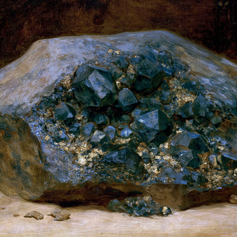
Angelite is a massive, fine-grained Anhydrite, a calcium sulfate with the formula CaSO4. Its color ranges from milky blue to gray-blue, with white or reddish-brown patches. Its modest hardness gives it a soft touch and a matte appearance, quite different from the glassy luster of Quartz.
Anhydrite literally means “without water.” It is closely related to Gypsum, which contains water in its crystal structure, but the two minerals are not interchangeable. The Mindat entries on Anhydrite and Gypsum help explain this relationship.
A modern name from Peru
“Angelite” is a trade name given to this Peruvian variety because of its sky-blue color. It should therefore not be assigned an ancient lineage. Its recent origin takes nothing away from its symbolic strength: it simply indicates that its current uses were built from its name, its hue, and the impression of calm it conveys.
The stone belongs to those materials whose magical identity emerges before our eyes. Rather than inventing a lost temple or a people who supposedly worshipped it, we can embrace a contemporary, coherent, and restrained interpretation.
The angel as a messenger figure
The word “angel” comes from the Greek angelos, “messenger.” This etymology, recalled in the history of the word provided by Merriam-Webster, offers a more accurate basis than automatically attributing it to a specific archangel.
\Angelite does not promise to summon a celestial being.\ It can serve as a support for prayer, a request for protection, or the preparation of a message. Its function is that of a passage: putting words in order, addressing them, then leaving room for a response.
In religious devotion, each person may associate it with the figures recognized by their own tradition. In a secular practice, the messenger represents the conscience that translates an intuition into understandable words.
Mercury, Moon, Air, and Water
Modern correspondences unite Mercury, master of messages, with the Moon, linked to receptivity. Air governs the voice and the circulation of signs; Water brings the silence necessary for listening. Wednesday is suited to writing or a decisive conversation, while Monday is suited to prayer and contemplation.
The pale blue calls for white or light-blue candles, a softly ringing bell, a feather, or a notebook. These objects add no power to the stone: they create a ritual grammar around transmission.
Speech, listening, and reconciliation
Angelite accompanies moments when speaking rightly matters more than speaking loudly: apologies, mediation, a delicate announcement, a request for help, or a letter one keeps putting off. It also supports listening, because a message truly exists only when it can be received.
It is suitable for altars dedicated to protection, the deceased, or family prayer. Its peaceful color helps create a space for presence. It replaces neither a concrete response nor professional help when the situation requires it.
The Rite of the Entrusted Word
On a Wednesday, write the recipient’s name, then three sentences: what must be said, what you are asking for, and what you are ready to hear. Place the Angelite above the paper and read the text aloud softly.
Then keep a minute of silence. Correct any wording that seeks to coerce the other person or conceal your intention. Fold the paper toward you to call for a response, or outward to entrust a message. Send, say, or carry out the action before the end of the day.
Correspondences and references
| Reference | Correspondence |
|---|---|
| Nature | Blue-gray anhydrite, calcium sulfate |
| Name | A modern commercial name inspired by the sky and angels |
| Figure | The messenger, without an imposed attribution to an archangel |
| Planets | Mercury and Moon |
| Elements | Air and Water |
| Days | Wednesday for transmitting, Monday for receiving |
| Areas | Right speech, listening, prayer, mediation, and memory |
| Ritual gesture | Write, read, remain silent, then act |