















































































































































































































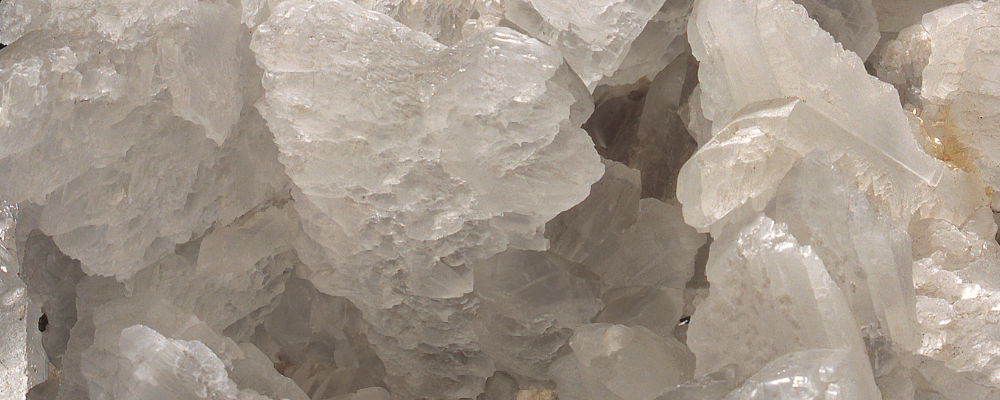
Gypsum is a soft stone that contains water in its structure. Transparent when called selenite, fibrous as satin spar, and massive as gypsum alabaster, it has run through the history of images, vessels, and architecture. Its softness is not a weakness: it makes carving, impression, and transformation into plaster possible.
The ancient uses of gypsum were material and funerary before they became esoteric. Selenite’s lunar association comes from its name, formed from Selene, the Greek Moon. The purification practices popular today belong to a contemporary framework that can be used without presenting it as an ancient rite.
To place this stone among related minerals, compare it with Selenite, Alabaster, and Desert Rose.
Gypsum, Selenite, and Alabaster
Gypsum is the name of the mineral species. Selenite refers to its transparent or translucent crystals, satin spar to its fibrous form with a silky sheen, and gypsum alabaster to its massive form, suitable for sculpture. Mindat presents these varieties and their relationships.
The name Selenite refers to Selene, the Greek personification of the Moon, because of the pale sheen attributed to the material. This etymological link permits lunar poetry, but does not prove the existence of an ancient cult devoted to these crystals.
A Stone That Contains Water
Gypsum is a hydrated calcium sulfate, CaSO₄·2H₂O. The Handbook of Mineralogy assigns it a hardness of 2: a fingernail can scratch it.
When heated, it loses some of its water and becomes plaster. Mixed with water again, it hardens by recovering a gypsum structure. The stone thus unites dissolution, impression, and a return to form.
Reliefs, Vases, and Impressions
Gypsum alabaster was used to carve vessels, plaques, and sculptures. The Metropolitan Museum of Art preserves a Cypriot gypsum alabaster flask dating from the 6th or 5th century BCE.
The large reliefs of Assyrian palaces were also carved from local gypsum, now visible in the Met’s Assyrian Court. Over the centuries, the soft material has preserved the features of rulers, protective genies, and scenes of power.
What receives an imprint can also pass it on. Gypsum connects contained water, the hand that shapes, and the form that remains. Its symbolism gains strength from this tangible history.
Moon, Saturn, Water, and Earth
The Moon corresponds to received light, reflection, and the memory of forms. Saturn governs fixation, architecture, and what remains after drying. Water circulates through the material; Earth gives it substance.
Monday is suited to contemplation, and Saturday to setting a boundary. White, ivory, and pearl gray make up its palette. A dry clay tablet, a piece of chalk, and a mirror can accompany it.
Imprint, clarity, and form
Gypsum supports work involving form: giving shape to a thought, preserving a trace, or preparing a calm space. Its whiteness can serve as a medium for symbolic purification, understood as sorting rather than as a promise to erase every difficulty.
It is also suited to memory practices: recognizing what has shaped us, then choosing what we want to pass on.
The Tablet of Light
Place the Gypsum near a blank sheet of paper. Write a sentence describing the form you wish to give your day or your project. Place a mirror behind the stone so that it reflects the light toward the text.
Say: “I receive, I distinguish, and I give form. What deserves to remain finds its imprint.” Keep the sheet in a notebook; do not carve the specimen.
Correspondences and references
| Reference | Correspondence |
|---|---|
| Nature | Hydrated calcium sulfate |
| Celestial bodies | Moon and Saturn |
| Elements | Water and Earth |
| Days | Monday and Saturday |
| Ritual colors | White, ivory, pearl gray |
| Domains | Imprint, memory, clarity, shaping |
| Associated objects | Mirror, chalk, dry tablet |
| Gesture | Giving visible form to intention |










