















































































































































































































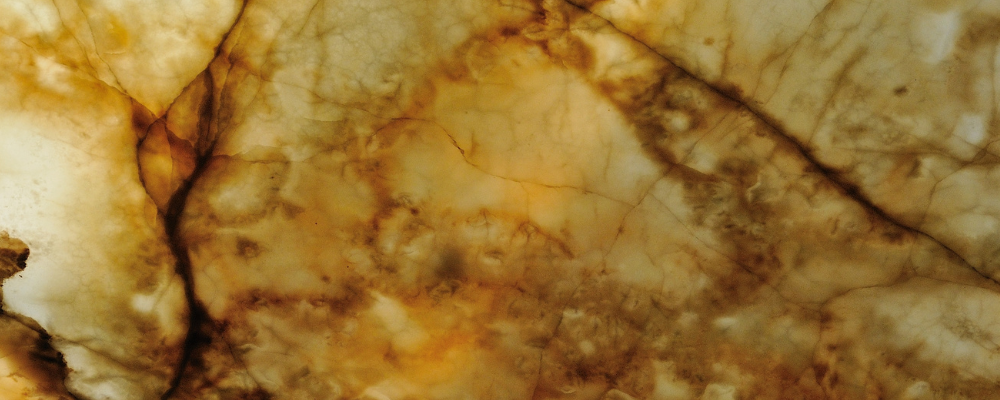
Alabaster retains light instead of reflecting it. White, honey-colored, or veined, it lets a soft glow pass through, and has been used for perfume vessels, offerings, sculpture, and funerary monuments.
Its name nevertheless covers two materials: Gypsum Alabaster, soft and fine, and “Egyptian Alabaster,” which is massive Calcite or travertine. Distinguishing between them makes it possible to connect each object to the right history without losing the common thread of contained light.
To place this stone among related minerals, compare it with Gypsum, Selenite, and Desert Rose.
Two stones under one name
European Alabaster is generally a fine variety of Gypsum, hydrated calcium sulfate, soft enough to be scratched with a fingernail. So-called Egyptian Alabaster is calcium carbonate, closer to Calcite and travertine. Both can be translucent and easy to carve, which explains why the same name has persisted throughout art history.
This distinction determines the care and interpretation of an object. An antique vase made of “Egyptian Alabaster” does not prove that the white Gypsum sold today received exactly the same ritual uses.
Vases, perfumes, and offerings from Egypt
The Metropolitan Museum of Art preserves a travertine flask, or Egyptian Alabaster, whose form reproduces a libation vessel and whose decoration evokes the lotus, youth, and renewal. Another royal cosmetic jar bears witness to the use of this stone for perfumed oils and ointments.
These objects connect Alabaster with the vessel, the offering, and the preservation of an aromatic substance. The material is not the whole story: meaning is carried by the ensemble formed by the vase, its contents, its owner, and the action performed.
The Alabaster jar and anointing
In the Gospels, a woman brings an Alabaster jar containing costly perfume and pours it out as an act of honor. The account, notably readable in the Gospel according to Mark, has durably linked Western Alabaster to anointing, generosity, and wholehearted giving.
\The biblical object first refers to a vessel, not a crystal carrying an autonomous virtue.\ A contemporary use may draw on the logic of the container and the offering without claiming that every piece of Alabaster is consecrated by this account.
Moon, Venus, Water, and Earth
The Moon corresponds to whiteness, receptivity, memory, and subdued light. Venus governs fragrance, anointing, hospitality, and giving. Water represents the liquid offered; Earth, the vessel that gives it form. Monday suits memory, Friday fragrance and gratitude.
A soft lamp, white cloth, small closed bottle, or fresh flowers are enough to create the altar. Do not pour oil or perfume directly onto the stone: the gesture can be performed in a nearby container.
Devotion, Memory, and Hospitality
Alabaster accompanies prayers, commemorations, welcoming a guest, and gestures of gratitude. It suits spaces where one wishes to preserve a soft light: a family altar, bedside table, reading nook, or corner dedicated to the deceased.
Its function as a container also inspires reflection on what we choose to preserve. A letter, name, photograph, or intention may be placed near it. The aim is not to hold on to what must leave, but to give memory a dignified form.
The Rite of the Offered Fragrance
On a Friday, place the Alabaster near a small, closed bottle. Name the person, deity, or value you wish to honor. On a sheet of paper, write what you have received and the gesture through which you will pass it on.
Open the bottle for a few moments without touching the stone, and say: “What was received becomes an offering; what was kept becomes memory.” Close it again, then carry out the designated gift: a message, meal, flower, help, or time given.
Correspondences and References
| Reference | Correspondence |
|---|---|
| Nature | Fine Gypsum; or Travertine Calcite for Egyptian Alabaster |
| Ancient objects | Libation vessels, perfume bottles, and ointment jars |
| Religious image | Alabaster Vases and Anointing in the Gospels |
| Planets | Moon and Venus |
| Elements | Water and Earth |
| Days | Monday and Friday |
| Areas | Devotion, offering, memory, fragrance, and hospitality |
| Ritual gesture | Naming what was received and passing it on |










