















































































































































































































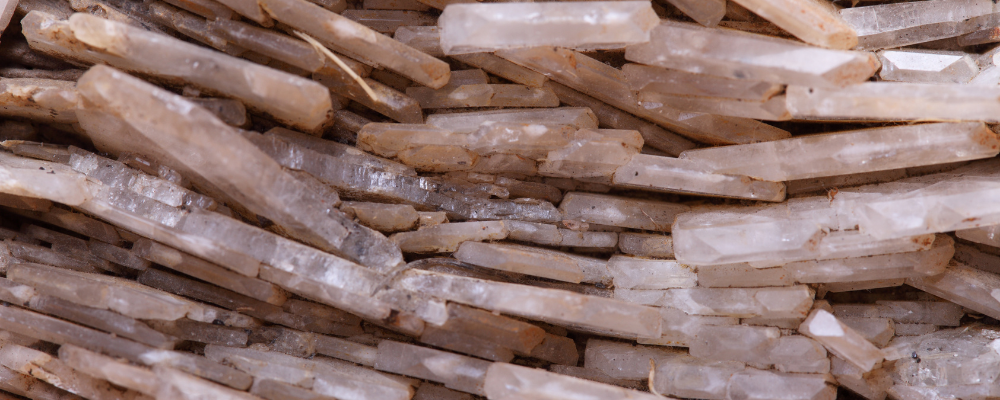
Barytine surprises as soon as it is picked up: it weighs more than its appearance would suggest. This density gave the stone its name; another of its stories, born in Bologna in the 17th century, linked it to a light stored and then released in darkness.
It thus brings together two rare images: the weight of Saturn and solar radiance. One belongs to the raw mineral; the other to a material transformed by calcination. Distinguishing them makes it possible to build a magical practice faithful to history.
To place this stone among related minerals, compare it with Gypsum, Selenite, and Alabaster.
A surprisingly heavy stone
Barytine is a barium sulfate with the formula BaSO4. White, honey-colored, blue, pink, or brown, it forms tabular crystals, rosettes, and aggregates. Its high density makes it noticeably heavier than a Quartz of the same size.
The Handbook of Mineralogy entry describes its modest hardness, around 3 to 3.5, and its cleavage. The US Geological Survey recalls its role as the main industrial source of barium.
The weight inscribed in its name
The name comes from the Greek barys, “heavy.” Mindat indicates that it was established in 1800 by Dietrich Ludwig Gustav Karsten in reference to this unusual density for a nonmetallic mineral.
Here, weight becomes a quality made visible through gesture. It can represent responsibility, commitment, proof, and everything that must be taken on rather than merely desired.
The luminous stone of Bologna
Around 1602 or 1603, Vincenzo Cascariolo collected a Barytine-rich stone near Bologna. After treatment with intense heat, the resulting material could emit in darkness a light it had previously received. A study published by Lund University traces this first known persistent luminescence.
The raw crystal placed on the altar is not the phosphorescent stone of Bologna. The historical effect appears after calcination and chemical transformation. The rite may draw on the image of the “solar stone” without claiming that ordinary Barytine glows in the dark.
Saturn, Sun, Earth, and Fire
Saturn corresponds to weight, duration, duty, and limits. The Sun reflects the history of light absorbed and then released. Earth carries density; Fire recalls the transformation of Bologna. Saturday suits commitment, while Sunday suits clarity and transmission.
A scale, a golden candle placed at a distance, a seal, or an object connected to a responsibility may accompany the stone. No heating is required, and no calcination experiment should be attempted.
Weight, Responsibility, and Light
Barite accompanies administrative commitments, positions of authority, debts to settle, and tasks that can no longer be postponed. It helps measure the true weight of a promise before making it.
Its luminous history also makes it suitable for study and transmission: receiving knowledge, preserving it, then passing it on when the time comes. On a desk, it represents an accepted burden; near a bookcase, a light preserved in matter.
The Ritual of the Illuminated Burden
On a Saturday, place the Barite on a sheet of paper and write down the responsibility that weighs on you. On the left, note what truly belongs to you; on the right, what must be returned, delegated, or refused.
Light a candle at a distance and say: “I know the weight, I illuminate the burden, I carry only what belongs to me.” Choose one action and give it a date. Extinguish the candle, then carry out this measure before resuming the ritual.
Correspondences and references
| Reference | Correspondence |
|---|---|
| Nature | Dense and soft barium sulfate |
| Name | From the Greek word for “heavy” |
| History | Transformed and luminescent Bologna Stone in the 17th century |
| Planets | Saturn and the Sun |
| Elements | Earth and Fire |
| Days | Saturday and Sunday |
| Areas | Responsibility, measure, study, authority, and transmission |
| Ritual gesture | Separating the rightful burden from what must be returned |










