















































































































































































































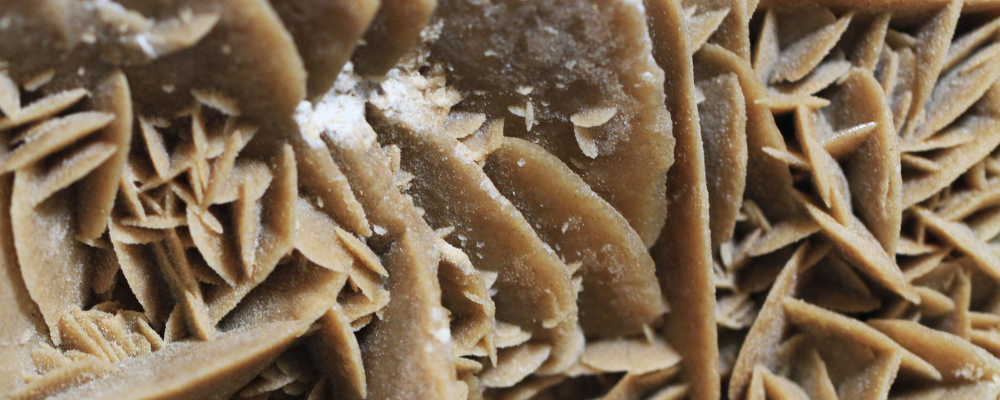
The Desert Rose is born when salt-laden water withdraws and allows Gypsum to crystallize around the grains of desert sand. Its petals were neither sculpted nor glued: they result from mineral growth under intense evaporation. Its modern magic speaks of patience, form found in aridity, and the memory of absent water.
It generally belongs to the Gypsum family, like Selenite, although Barite can also form rosettes. The Moon governs water and the cycle here; Saturn represents the desert, slowness, and the structure that remains after withdrawal.
To place this stone among related minerals, compare it with Gypsum, Selenite, and Alabaster.
A rosette of Gypsum and sand
The Desert Rose is an aggregate of flattened crystals that radiate like petals and trap grains of sand. Mindat indicates that Gypsum is the most common host mineral, but that Barite, Celestine, and other species can also adopt this form.
Gypsum is a soft, hydrated Calcium sulfate, with a hardness close to 2. Its page on Mindat confirms its perfect cleavage and low resistance to scratching. The beige, ochre, or brown color comes from the included sediment.
The salt water that withdraws
The National Museum of Qatar explains that the rosettes form beneath the surface of sabkhas, coastal or inland salt flats. Evaporation concentrates the groundwater until Gypsum precipitates.
The crystals grow in the sand and incorporate it. The mineral flower thus records an ancient passage of water through a place that appears dry when it is discovered.
The mineral flower of the desert
The name “Desert Rose” does not correspond to a stone found in the ancient lapidaries. Its magic belongs to modern correspondences of Gypsum and to observing its formation. It does not promise blossoming without resources: it shows that a form appears when water flows, concentrates, and then withdraws.
It is suited to periods of waiting, restraint, and simplification. It helps recognize what a loss, distance, or silence has made visible, then retain only the useful structure.
The desert cannot create the rose without water. The form remains after withdrawal, but it retains the memory of what passed through it. The Desert Rose teaches an endurance that denies neither the need nor the source.
Moon, Saturn, Water, and Earth
The Moon governs hidden water, memory, cycles, and Gypsum associated with Selenite. Saturn relates to the desert, simplicity, slow time, and preservation. Water dissolves and carries; Earth gathers the crystal.
Monday is suited to memory and emotional needs. Saturday serves waiting, limits, and simplification. An empty bowl, a little sand in a separate container, a crescent moon, or a dried flower can extend these connections.
Patience, simplicity, and endurance
To get through a period of waiting, name what depends on you and what depends on time. Place the stone on the first answer in order to preserve your power to act.
To simplify a situation, remove an obligation, object, or expense that no longer nourishes the structure. Saturnine simplicity creates space without confusing deprivation with abandonment.
To preserve a memory, choose a single sign capable of representing the experience. The Desert Rose suits memories that are honored without rebuilding the entire past around them.
What withdrawal reveals
On a Saturday, fill a glass with water and place it at a distance from the stone. Write down what is leaving your life, then what that departure finally allows you to see.
Pour the water onto a plant or into the earth without wetting the Desert Rose. Say: “I return what must leave; I keep the form that can serve.” Keep only the second sentence.
Correspondences and references
| Reference | Correspondence |
|---|---|
| Nature | Gypsum rosette containing sand, or more rarely Baryte |
| Formation | Mineral precipitation under intense evaporation |
| Modern planets | Moon and Saturn |
| Elements | Water and Earth |
| Days | Monday and Saturday |
| Areas | Patience, memory, simplicity, endurance, and waiting |
| Symbols | Dried flower, empty bowl, sand, and hidden water |
| Ritual gesture | Recognizing what withdrawal has made visible |










