















































































































































































































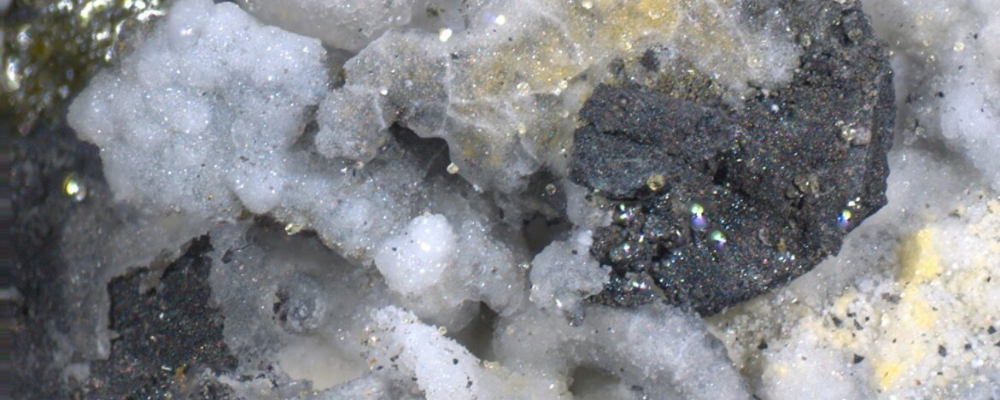
Bararite forms where hot vapors condense into white crystals: fumaroles, coal fires, and soils transformed by lasting heat. It represents what remains after fire has passed through, when the invisible settles and finally takes on a legible form.
Its modern name carries no ancient magical tradition. Its formation nevertheless allows for a strong contemporary correspondence: Mercury governs vapors and messages, Saturn residues and inventory, Air transports, and Fire transforms. Since the material is soluble and chemically sensitive, the ritual is performed with its drawing or photograph.
To place this stone among related minerals, compare it with Gypsum, Selenite, and Alabaster.
A White Mineral Salt
Bararite is an ammonium fluorosilicate, with the formula (NH4)2SiF6. The Handbook of Mineralogy describes it as white to colorless, transparent, soft, and crystallized in the hexagonal system.
It forms small flattened crystals and delicate aggregates. Its solubility in water distinguishes it from stones meant to be washed or worn daily.
Crystallizing from Vapor
Bararite is deposited from cooling hot gases. It is known from volcanic fumaroles, near burning coal seams, and on heated anthracite piles.
It shares its composition with Cryptohalite but adopts a different crystal structure. The Mindat entry specifies this relationship and its main localities.
Barari and Coal Fires
The name comes from the locality of Barari, in the Jharia coalfield of India. The mineral was associated there with a burning coal seam. This geographical origin does not point to a local religious use.
Its formation nevertheless carries a vivid symbolism: a hot, mobile environment leaves deposits that can finally be identified. Bararite then becomes a witness to what comes after, not an agent of purification through smoke.
What settles after the fire must be sorted. Some traces contain information, others require safe disposal, and still others become a debt to settle. Bararite gives this inventory a form.
Mercury, Saturn, Air, and Fire
Mercury governs vapor, movement, and messages. Saturn receives the remnants, accounts, and responsibility for what follows. Air transports invisible matter; Fire causes transformation.
Wednesday is suited to analyzing messages, and Saturday to sorting. A photograph, a blank sheet, and an empty sealed container can serve as supports.
Post-crisis, traces, and inventory
Bararite accompanies reflection after a breakup, conflict, unexpected expense, or period of intense work. It invites you to look at what remains once the urgency has passed.
It is suited to inventories, restoring order, and repair efforts. Its whiteness does not erase the trace: it makes it visible on a clear surface.
The Rite of Fire Deposits
Place a photograph of Bararite in the center of a sheet. Around it, write what the recent period has left behind: information, burden, expense, fatigue, or decision. Connect each trace to an action.
Say: “I acknowledge what the fire has deposited; I preserve the lesson and handle the rest according to its nature.” Complete a closing action within twenty-four hours.
Correspondences and references
| Reference | Correspondence |
|---|---|
| Nature | Soluble ammonium fluorosilicate |
| Celestial bodies | Mercury and Saturn |
| Elements | Air and Fire |
| Days | Wednesday and Saturday |
| Ritual colors | White, ash gray, pale yellow |
| Areas | Post-crisis, inventory, trace, closure |
| Support | Photograph, sheet, sealed container |
| Gesture | Connect each trace to an action |










