















































































































































































































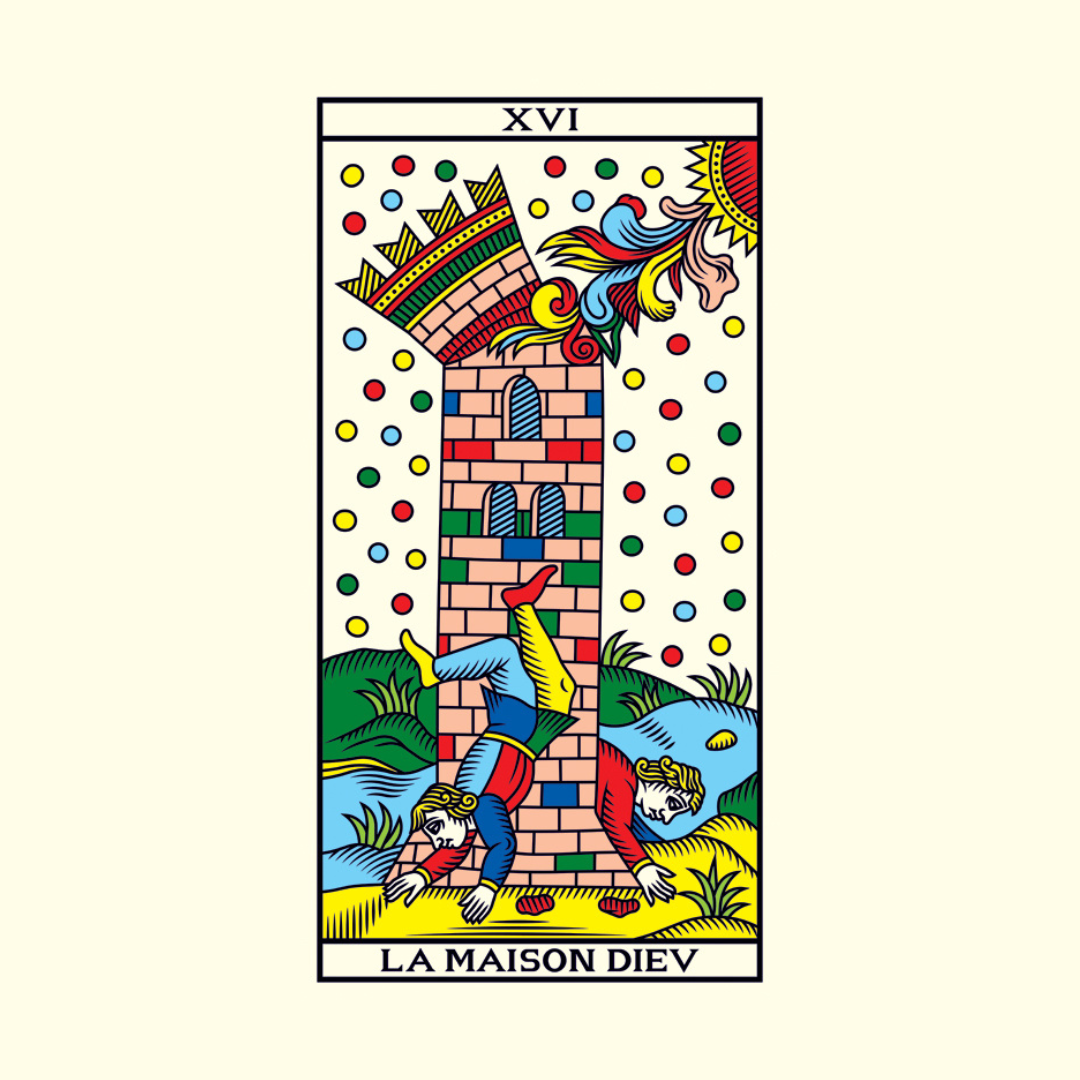

The House of God shows a structure struck at its highest point. Its top opens, two figures leave the tower, and a shower of colored forms crosses the image. The sixteenth card does not mean that all destruction brings liberation. It first indicates a rupture, an impossible-to-contain revelation, or the collapse of a structure that no longer protects its occupants.
The name varies from deck to deck: House of God, Tower, Lightning-Struck Tower, Lightning. This diversity makes it impossible to reduce the card to a fixed story about the Tower of Babel, the fall of a king, or a destroyed temple. These stories belong to the commentaries. The Marseille image remains more open: a building loses its crown under the effect of a force from above, while figures fall or withdraw.
An old card with changing titles
Like the Devil, the Tower is missing from the seventy-four surviving cards of the Visconti-Sforza deck. There is therefore no original Milanese card from this deck that would allow its appearance to be reconstructed with certainty. Modern editions that complete the deck offer a contemporary creation, useful for playing but without facsimile value for this card.
Printed decks attest to several solutions. The Tarot de Marseille shows a tower whose crown-shaped top is lifted by a flame or a discharge from the sky. Two figures appear outside, and small round or elongated forms occupy the space. A deck held at the British Museum even titles its sixteenth card “The Lightning” and replaces the building with a struck tree. British Museum, printed tarot deck.
Iconographic reference. The term “House of God” is not enough to identify the building as a church. The drawing shows a crowned structure. The Tower of Babel, the temple, and the fall of pride are interpretations developed around the image.
From the House of God to the Lightning-Struck Tower
Mathers describes a crowned tower struck by lightning. Men fall with the debris. He summarizes the card as ruin and dislocation. Papus and Wirth place the sixteenth card under the letter Ayin in their French sequence and develop the fall of a structure that has become incapable of containing what it claimed to enclose.
The Waite-Smith makes the violence of the event more direct. A lightning bolt enters through the top of the tower, a crown is torn away, two figures are hurled into the void and tongues of fire spread through the night. Waite sees in it the destruction of a house built on falsehood, but he himself criticizes several overly literal biblical explanations.
In the Golden Dawn, the Tower is assigned the letter Pe and the planet Mars. The French Ayin–Maison Dieu sequence and the Golden Dawn Pe–Tower sequence do not overlap. Mars reinforces the idea of rupture, shock and sudden action, but this attribution appeared well after the printed cards that established the image.
What the early authors attributed to it
Mathers attributes ruin, dislocation, overthrow, loss and bankruptcy to the Tower. Reversed, it retains these meanings to a partial degree. His interpretation therefore does not turn the overthrow into a reassuring message: the event remains an assault on the structure, even if its scale may vary.
Waite gives misery, distress, adversity, calamity, disgrace, deception and ruin. He emphasizes the unexpected catastrophe. Reversed, the card may indicate a milder form of the same event, but also oppression, imprisonment or tyranny. In a contemporary reading, these lists call for context rather than a spectacular prediction.
Meaning in a spread
In a favorable reading
The Tower may indicate a truth coming to light, a defective structure finally exposed, a swift exit from an oppressive framework or a decision that ends the concealment. Its favorable aspect does not lie in the damage, but in the possibility of finally seeing the construction's true condition.
It advises acting in the right order: protect people, limit losses, establish the facts, then rebuild. Immediately seeking a positive lesson can deny the shock. The card becomes useful when it helps distinguish what must be secured from what is no longer worth saving.
In an unfavorable reading
The card may signal a crisis, a brutal announcement, a loss of status, an open conflict, a setback or the collapse of a project based on faulty assumptions. It also shows the constant fear of catastrophe, which leads to multiplying safeguards without examining the actual weaknesses.
Love, work and finances
| Area | Favorable reading | Shadow aspect | Question to ask |
|---|---|---|---|
| Love | Revealed truth, breaking free from a destructive pattern, finally speaking plainly. | Explosive dispute, forced separation, broken trust. | What must be protected before any confrontation? |
| Work | Reorganization made inevitable, structural problem brought to light. | Dismissal, internal crisis, canceled project, overthrown authority. | Which documents, rights and contacts need to be secured? |
| Finances | Halting a fragile arrangement, quickly acknowledging a loss. | Unexpected expense, bankruptcy, drop in value, lack of reserves. | What immediate risk must be contained? |
| Project | Test that reveals a flaw before a more costly commitment. | Public failure, technical breakdown, central hypothesis invalidated. | What can be recovered without maintaining the entire structure? |
How to read its associations
The Tower brings shock, opening, revelation and the fall of a structure. The neighboring card indicates what is affected, the origin of the rupture or how to organize what follows.
| Association | Possible dynamic | Point of caution |
|---|---|---|
| The Tower + Emperor | Overthrown authority, weakened administrative or professional structure. | Prepare for continuity of responsibilities. |
| The Tower + Justice | Decision that brings down a status, dispute or truth established by the facts. | Keep the evidence and obtain qualified advice. |
| The Tower + Wheel of Fortune | Sudden reversal, circumstances changing without delay. | Avoid irreversible decisions while in shock. |
| The Tower + Death | Collapse followed by a clear ending, structure impossible to restore. | Save people and resources before closing. |
| The Tower + Temperance | Repair, negotiation or a gradual return to normal operations after the crisis. | Do not rebuild before identifying the flaw. |
| The Tower + Devil | Scandal, broken control, debt or manipulation made public. | Anticipate the reactions of the party losing its power. |
| The Tower + Star | Truth exposed, relief after the break, simpler rebuilding. | Trust returns after safety has been secured. |
Correspondences according to different schools
| Reference | Attribution | Historical scope |
|---|---|---|
| Family | Major Arcana XVI | Card with varying titles and designs in printed decks. |
| Visconti-Sforza | Missing card | No modern reconstruction can be considered the original from the 15th century. |
| Tarot de Marseille | Crowned tower, celestial flame, figures, and colored shapes | Image of rupture and the opening of the structure. |
| Other French decks | The Lightning, with a struck tree | Variant attested in a deck held at the British Museum. |
| French occultism | Ayin; ruin and dislocation | Attribution of the Papus-Wirth sequence. |
| Golden Dawn | Pe and Mars | Distinct system from the French-suit Ayin–Tower. |
| Waite-Smith | Lightning, torn-off crown, two figures, and rain of fire | Dramatic version of the struck Tower. |
| Element | No direct element in the Golden Dawn system | The card is associated with Mars rather than an element. |
| Stone, plant, and season | No attribution shared by the older schools | Contemporary lists vary according to their authors. |
| Reading keywords | Breakup, crisis, revelation, fall, opening, restructuring | The truth appears when the façade no longer holds. |
| Shadow aspect | Catastrophe, loss, conflict, bankruptcy, panic, oppression | The priority is safety and facts. |
Choosing a tarot deck to work with this card
To find this arcana in a complete deck, compare the Tarot de Marseille, the Rider-Waite-Smith, and all of our divination tarots. If you are a beginner, also consult How to choose your first tarot deck?.
Sources and reference texts
British Museum, tarot card with the XVI blade The Lightning ; Accademia Carrara, Tarocchi. The Origins, the Cards, Fortune, 2026 ; The Metropolitan Museum of Art, Before Fortune-Telling: The History and Structure of Tarot Cards ; S. L. MacGregor Mathers, The Tarot, 1888 ; Papus, The Tarot of the Bohemians, 1889 ; Oswald Wirth, The Tarot of the Medieval Image-Makers, 1927 ; Arthur Edward Waite, The Pictorial Key to the Tarot, 1911.










